Portuguese
  Spanish


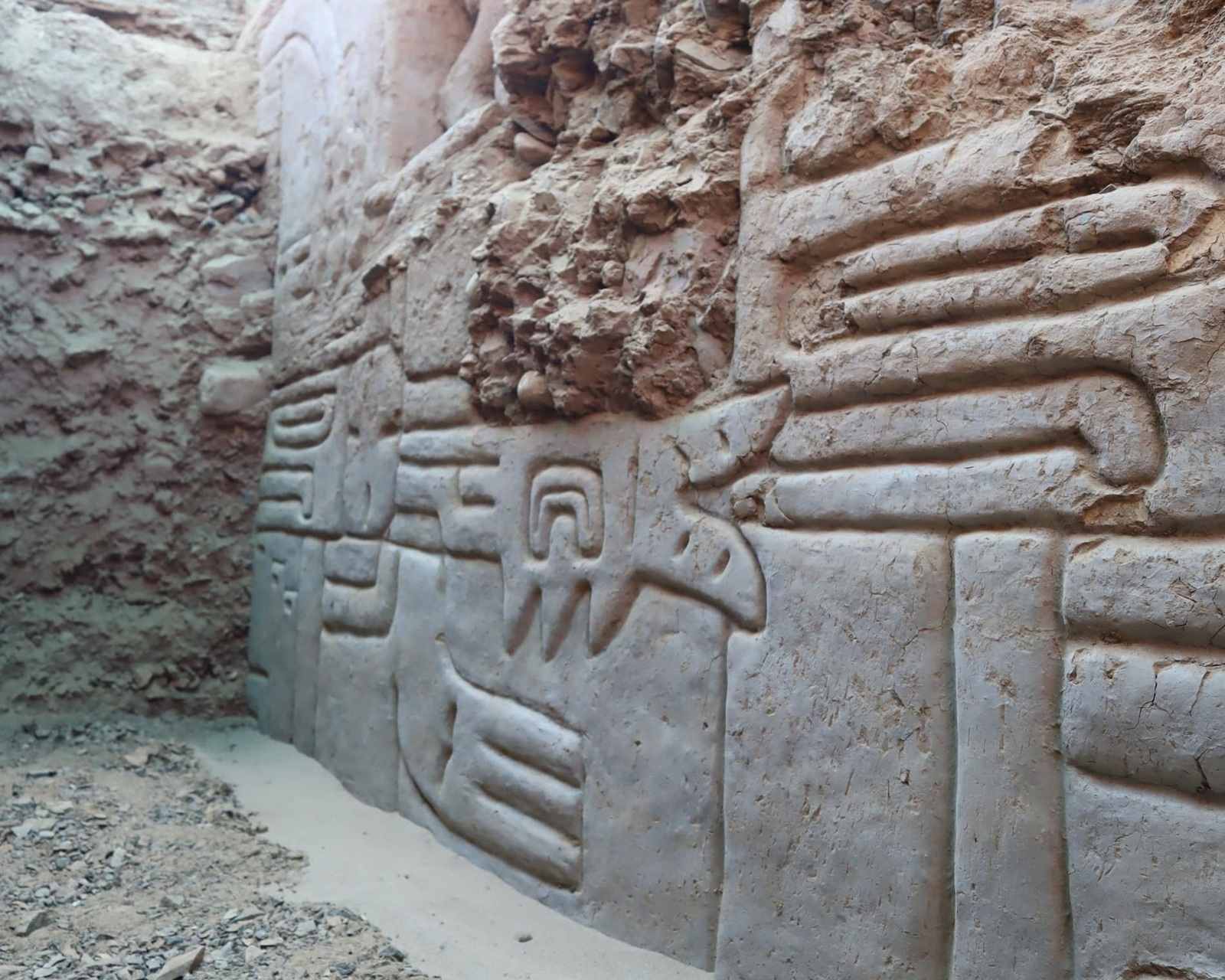


An Archaeological Finding in Peru Captured the Attention of the Scientific World. In Huaca Yolanda, in the Tanguche Valley, a 4,000-Year-Old Three-Dimensional Mural Was Revealed, with Vibrant Colors and Symbols Representing the Link Between Nature, Cosmos, and Religion.
Archaeologists in Peru discovered a 4,000-Year-Old Three-Dimensional Mural. The work was located at the archaeological site of Huaca Yolanda, in the Tanguche Valley. The finding was published in the British newspaper The Guardian on September 2, 2025.
The piece measures almost six meters in length by 2.9 meters in height. In vibrant colors — blue, yellow, red, and black — it features relief friezes that impress with their complexity.
In the center, a bird of prey appears with wings spread and a head adorned with diamond-shaped motifs. This image stands out and seems to symbolize power, spirituality, and a connection to the celestial world.
-
The Little-Known Story of a Home-Built Airplane That Promised Freedom but Faced Safety Issues After Numerous Accidents

-
He Didn’t Build a Plane, But Spent Decades Trying to Make Bicycles Fly with Wings and Pedals; Remaining Models Tell This Unusual Story in Germany
-
Roraima Security Secretary Poses as Doctor to Expose Technician Charging $600 for Free Public Health MRI in Brazil; Technician Confessed

-
To Protect Its Beaches, the Netherlands Deposits 21.5 Million Cubic Meters of Sand into the Ocean, Letting Nature Reinforce Dunes and Shoreline



The Vision of an Ancient Civilization
According to Chief Archaeologist Ana Cecilia Mauricio from the Pontifical Catholic University of Peru, this is a “truly unprecedented” discovery. The mural includes stylized fish, fishing nets, mythical beings, and cosmic symbols.
These elements suggest that nature and cosmos were strongly linked to religion and social rituals of the time. Moreover, the mural shows that the early societies of Peru already had a sophisticated and complex form of expression.
Decoding the Meaning
The images also reveal signs of social hierarchy. Mauricio explains that shamans were likely central figures, with religious and scientific influence. They possessed knowledge about medicinal plants and astronomy.
A striking detail is the scene in which a human transforms into a bird. For the researcher, this may represent a shamanic rite associated with altered states of consciousness induced by substances like the San Pedro cactus, traditionally used in the Andes.
The Temple and Its Function
Researchers believe that the mural decorated the interior of a temple. The space was likely used in religious ceremonies during the formative period (2000 BC – 1000 BC), when the first complex societies of Peru emerged.
This period was marked by advances in agriculture, the emergence of urban centers, and the construction of ceremonial spaces. Therefore, the mural is not just a work of art, but also a key to understanding the social and spiritual life of its creators.
Similarities and Differences
The mural from Huaca Yolanda shares some similarities with those found in other sites across the country. However, its coastal style, with an emphasis on marine and fishing elements, differentiates it from the murals of Chavín de Huántar in the mountains, where jungle animals predominate.
This distinction shows how geography influenced the cultural expression of each society. While some turned to the jungle, others depicted the sea and the instruments that sustained life.
Threats to Preservation
Despite its relevance, Huaca Yolanda is not officially protected. The site faces risks caused by urban expansion, agriculture, and looting. Mauricio warns that nearby ruins have already been damaged by illegal construction.
She urges the Ministry of Culture of Peru and local authorities to intervene to ensure the preservation of the mural. Without urgent measures, the risk of loss is real.
A Look to the Future
Since 2012, Mauricio’s team has been researching the region for more information about the early coastal societies. The goal is to understand how these peoples interacted with the environment and how they dealt with phenomena like El Niño, which has impacted the region for centuries.
The discovery of the mural opens a new window into this complex past. It reveals not only art but also spirituality, science, and the social relations of a civilization that shaped the cultural foundations of Peru.