Portuguese
  Spanish


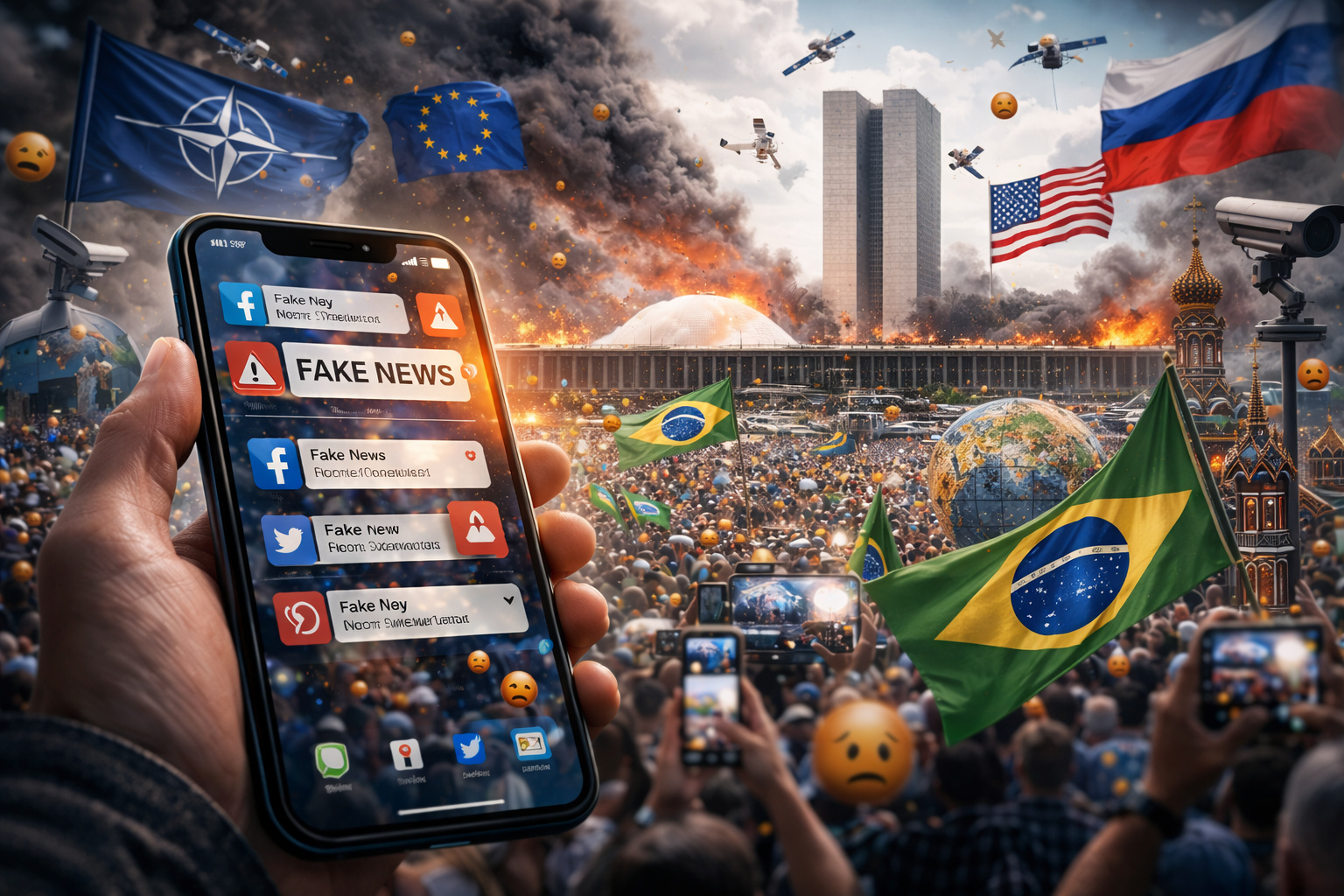

Influence Campaigns, Informational Sabotage, and Continuous Attacks on Institutions Put the Country in a Gray Zone of Permanent Democratic Tension
Brazil has been undergoing a continuous process of political and institutional destabilization for at least a decade. This phenomenon does not happen by chance. On the contrary, it is a planned, persistent, and silent dynamic associated with contemporary geopolitical disputes.
In December 2025, Ursula von der Leyen, President of the European Commission, stated that Western democracies face systematic information manipulation campaigns. According to the European leader, the conflicts of the 21st century begin with lies, institutional sabotage, and distortion of public opinion, as warned by official alerts from the European Union.
In Brazil, this process is already manifesting intensely. Here, indirect geopolitical pressure does not occur through military means, but infiltrates through social networks, messaging apps, and recurring cycles of fake news.
-
European Parliament Approves Digital Euro, Aiming to Challenge Visa and Mastercard’s Dominance and Transform Payments Across Europe by 2029

-
Israel finds Hezbollah militarized tunnel over 200 meters long under village, with 4 missile launch shafts, 12 chambers, anti-tank missiles, drones, and weapons depots at a depth of 25 meters.

-
Ukraine launches largest drone attack on Moscow since 2022, Russia claims to have intercepted nearly 200 aircraft near the capital, Kapotnya refinery targeted again, and offensive reignites alert about war reaching the Russian energy heart just a few kilometers from the Kremlin.

-
Truck drivers, freight, and fines from 2022 take center stage in politics: Chamber approves MP with amnesty, mandatory tracking by CIOT, million-dollar penalties, and new minimum wage for those who spend more than 24 hours on the road.



Informational Strategy Operates in the So-Called Gray Zone
Unlike traditional conflicts, these strategies avoid direct confrontations. Instead, they operate in the so-called gray zone, a concept widely debated in international forums since 2023.
In this model, the agent remains invisible, while confusion grows. A technical failure becomes proof of incompetence. A manipulated video gains headline status. The constant repetition, therefore, generates social exhaustion.
As a consequence, simplified narratives become accepted, while collective trust gradually weakens.
Everyday Misinformation Amplifies Fear and Social Distrust
In daily life, seemingly simple rumors serve a strategic role. False news about public policies and social programs spread fear, insecurity, and distrust, even when quickly debunked.
Still, doubt remains, as the goal is not to fully convince but to disorganize public debate. Thus, the permanent conflict becomes normalized.


Internal Actors Amplify Geopolitical Disputes
Despite common perception, these offensives do not solely rely on external agents. On the contrary, their effectiveness requires internal collaboration.
In Brazil, irresponsible influencers, automated profiles, businesspeople with political interests, and opportunistic political actors amplify false narratives. In this way, global conflicts are transformed into domestic crises.
These groups do not need direct orders from abroad. It is enough for them to share the same objective: weaken the state and undermine democracy.
Democratic Institutions Become Priority Targets
In this scenario, the democratic institutions become the primary targets. The electoral system, Supreme Federal Court, professional press, universities, science, and public policies suffer systematic delegitimization campaigns.
This is not a legitimate democratic critique. It is a matter of deliberate corrosion, as institutional analyses have indicated since 2016.
When every authority is presented as an enemy and every decision as a fraud, the ground for authoritarian solutions is prepared.
Europe Responds While Brazil Still Hesitates
Meanwhile, European countries began coordinated responses between 2024 and 2025, with investigations, accountability, and regulatory advancements.
In Brazil, however, part of society still minimizes the problem, allowing misinformation structures to continue operating with relative normality.
Defending Democracy Requires Structural Confrontation
Combating this dynamic does not mean censoring opinions. It means facing organized structures of misinformation, strengthening professional journalism, regulating digital platforms, and investing in critical education.
Above all, it means reaffirming politics as a legitimate space for democratic dispute and not as an arena for symbolic destruction.
The Informational Instability Is Already Underway in Brazil. Pretending normality, therefore, is to allow the silent corrosion of democracy. In light of this, the question remains unavoidable: which side of history does each one choose to stand on?