Portuguese
  Spanish


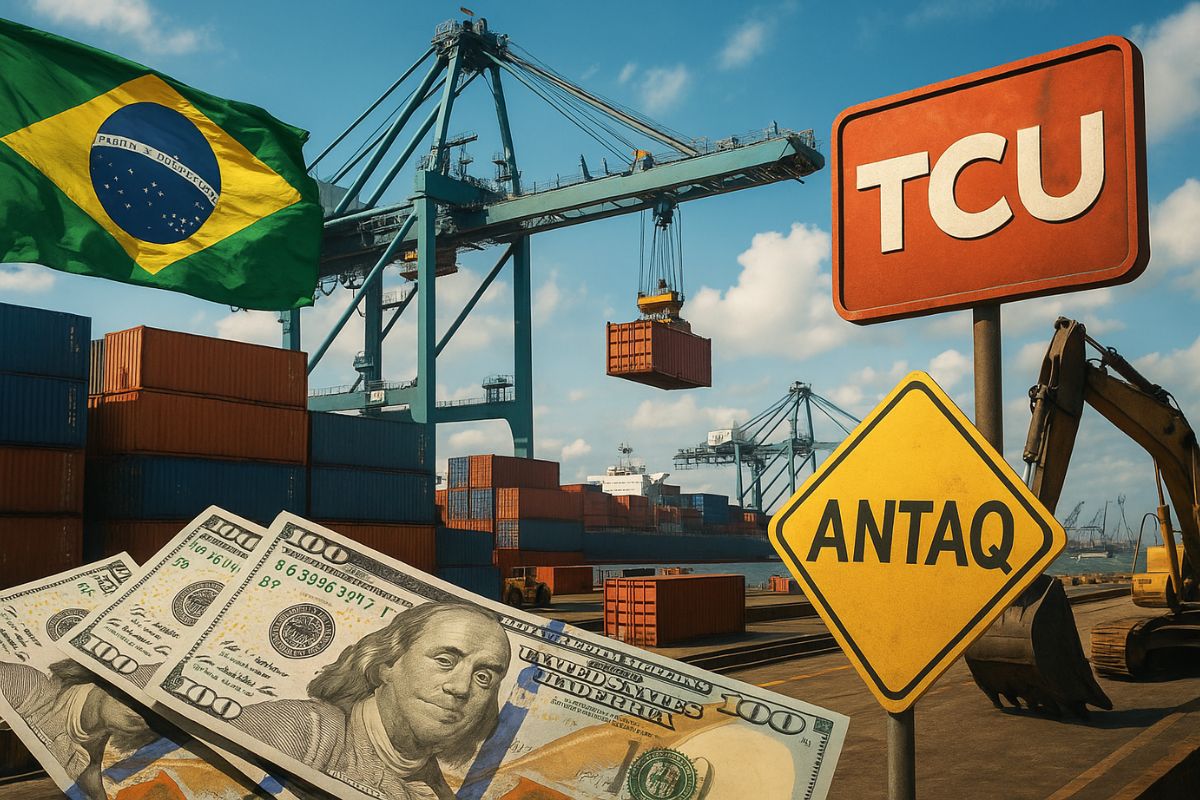

Tecon 10 Concession Model Divides Antaq, Treasury, and Ministry of Ports and May Delay Auction of Brazil’s Largest Container Terminal.
The dispute over the Santos megaterminal has become one of the largest infrastructure battles in the country. The project, which anticipates investments of up to R$ 40 billion, faces divergences between the federal government, the Federal Court of Accounts (TCU), Antaq, and the Treasury, and its auction may be halted before it even starts.
According to Folha de S. Paulo, the central point of the controversy is the bidding model: whether the auction should occur in a single phase, allowing participation from all sector players, or in two stages, initially restricting it to companies already established in the port.
The Impasse Among Public Bodies
The rapporteur of the process, Minister Antonio Anastasia from the TCU, requested opinions from different agencies. The result, however, was a mosaic of irreconcilable positions.
-
He Left Construction, Partnered with His Wife, and Turned a Homemade Gelato Hobby into Brazil’s Largest Chain with 240 Stores and $100 Million Annually

-
Brazil Faces Caregiver Shortage Despite Having 34.1 Million Elderly, Highlighting a Major Challenge for Families
-
Brazil’s Assaí Generates $4 Billion in Quarterly Revenue, Profits $16.7 Million, Highlighting High Tax Burden

-
Former Marketing Agency Owner Thrives on Foraging for 250 Days, Sampling Over 170 Plants, and Says He No Longer Remembers Supermarkets


The technical area of the court and the Treasury advocate for broad competition, without restrictions. Meanwhile, Antaq and the Ministry of Ports and Airports prefer a two-phase model to limit market concentration.
In practice, the choice of format may determine who will be able to compete in the bidding. An open auction would benefit giants like Maersk, MSC, CMA CGM, and DP World.
On the other hand, restrictions could favor new entrants, such as the Philippine ICTSI, which advocates for greater diversity among operators.
Market Concentration or Efficiency?
The debate goes beyond the legal issue. For the TCU, concentration does not necessarily harm the consumer.
The agency argues that economies of scale and high investments in technology have already ensured efficiency gains at current terminals.
Conversely, the Ministry of Ports maintains that the goal of the concession should not only be to maximize revenue but also to ensure a competitive and accessible service.
The opinion sent to the TCU reinforces that the priority should be to reduce risks of market capture and expand options for users and shipowners.
Financial Impact and Risk of Judicialization
The Treasury warns that limiting competition may lower the grant’s value, reducing revenue for public coffers.
Furthermore, there is concern about judicialization, as interested companies, including Maersk itself, have already approached the courts seeking injunctions to block the model with restrictions, albeit without success so far.
Legal uncertainty may delay the schedule and postpone the terminal’s operation, which is slated for the Saboó neighborhood in Santos.
With 622,000 square meters, four berths, and the capacity to move 3.5 million TEUs per year, Tecon 10 will be the largest container terminal in the country.
What Is at Stake
With R$ 40 billion expected in investments over 25 years, the Santos megaterminal is considered strategic for Brazil’s competitiveness in foreign trade.
The port already accounts for nearly 30% of the country’s trade balance, and the new structure promises to expand logistics capacity in a scenario of rising demand.
However, the regulatory impasse could undermine the attractiveness of the auction, restricting the number of proposals and delaying investment arrivals.
The challenge, according to experts, will be to balance economic efficiency, diversity of players, and legal security to ensure that the project moves forward.
The future of the megaterminal still depends on the TCU’s opinion and Antaq’s final decision. Meanwhile, investors and port users are closely monitoring the conflict that could redefine the Brazilian port sector.
And you, do you think the auction should be open to everyone to ensure greater revenue, or is it better to restrict participation to avoid market concentration? Leave your opinion in the comments.