






 Portuguese
  Spanish


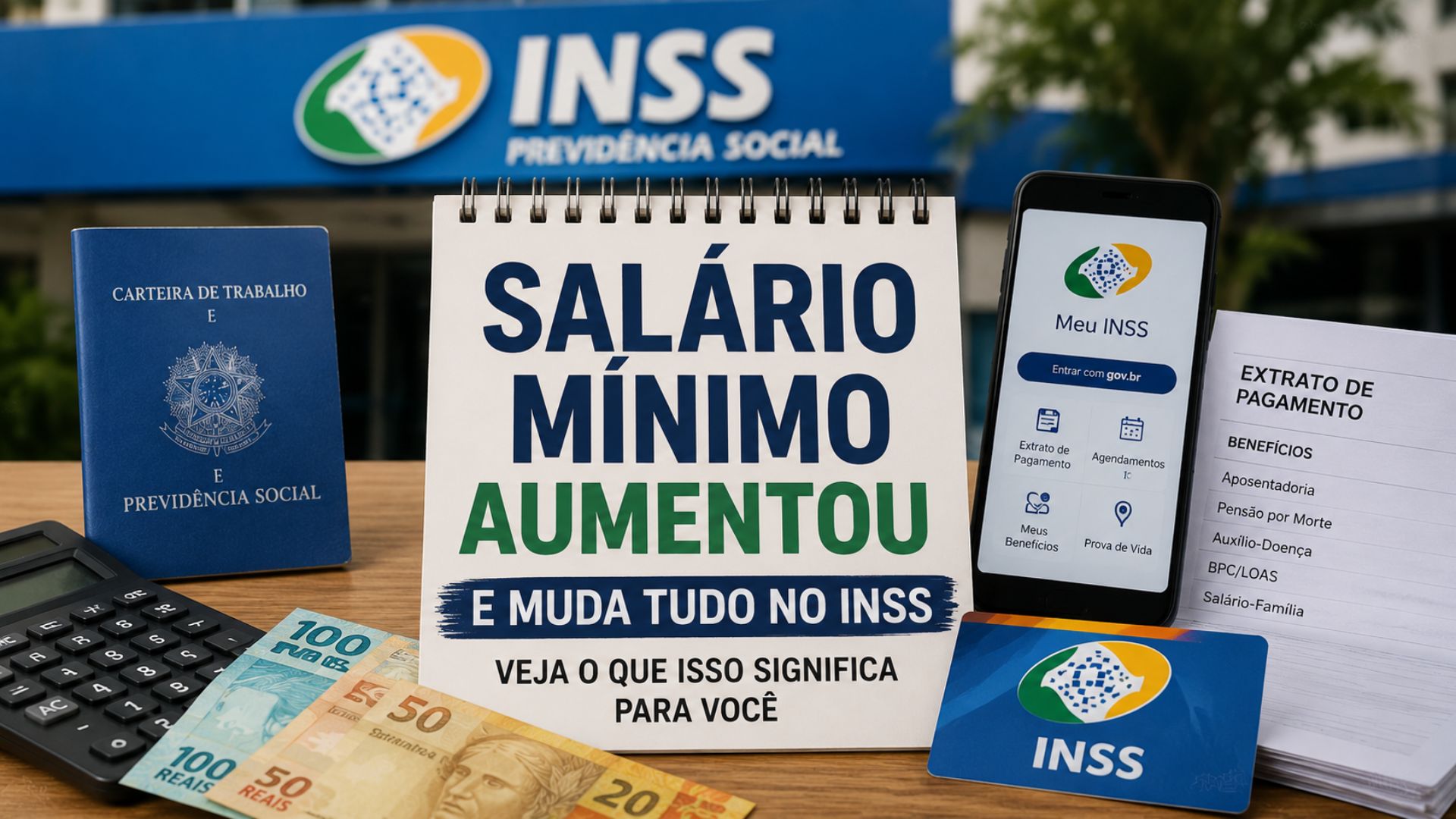


New minimum wage changes INSS benefits, increases money circulation in the economy, and raises pressure on public spending in 2026, with direct effects for retirees, formal workers, social beneficiaries, and commerce sectors spread across thousands of Brazilian cities.
The minimum wage of R$ 1,621 has started to alter payments for workers, retirees, pensioners, and beneficiaries of social programs linked to the national floor, with a direct impact on the income of millions of Brazilians and on Social Security expenses in 2026.
The amount represents an increase of 6.79% compared to the previous floor of R$ 1,518, which is equivalent to an addition of R$ 103.
Although it came into effect in January, the impact became clearer in payments made from February onwards.
-
Brazil’s 2026 Tax Refund: Record 9.58 Million Filers in Largest Payout Ever, But a Key Detail on Priority Recipients Draws Nationwide Attention

-
Itaú Alters Hybrid Work Model, Increasing Office Days from 2028, Prompting Employees to Adjust to New Routine
-
Facing Labor Shortage, Japan Plans to Invest $34 Million to Attract Foreign Workers in Construction, Healthcare, Industry, and Commerce

-
Brazilian City Makes Remarkable Leap, Becomes 4th Wealthiest in the Country with GDP of R$ 134.1 Billion



The change affects those who receive the minimum wage and also benefits that use the minimum wage as a reference.
Among them are INSS retirements, pensions, social security aids, Continuous Cash Benefit, unemployment insurance, salary bonus, and family allowance.
INSS benefits already reflect new minimum wage
At INSS, the adjustment mainly affects insured individuals who receive benefits equivalent to a minimum wage.
With the update, retirements, pensions, and aids that were at the floor started to be paid at the value of R$ 1,621.
The rule also influences the Continuous Cash Benefit, paid to low-income elderly and disabled people.
Since the benefit follows the minimum wage, the transfers were also adjusted to the new national floor.
Benefits above the minimum follow another correction criterion, linked to inflation measured by the INPC.
Therefore, not all retirees and pensioners receive the same percentage of adjustment applied to the minimum wage.
In addition to monthly payments, the new value affects the social security contributions of self-employed workers, optional contributors, and individual microentrepreneurs.
Since part of these collections is based on the national floor, the values were also updated.
Adjustment is expected to impact nearly 62 million Brazilians
Dieese estimates that the new minimum wage is expected to impact 61.9 million people in the country.
This group includes formal workers, domestic employees, retirees, pensioners, beneficiaries of social programs, and people who receive labor benefits.
The same survey estimates that the adjustment could inject R$ 81.7 billion into the economy in 2026.
The majority of this money tends to circulate in essential expenses, such as food, transportation, medication, household bills, and basic services.
This effect is usually more visible in small and medium-sized municipalities, where pensions and benefits have a significant impact on local income.
In many cities, INSS payments help sustain commerce and stimulate sectors like markets, pharmacies, and services.
The government also estimates that the combination of minimum wage appreciation and the expansion of the Income Tax exemption range could stimulate around R$ 110 billion in the economy throughout 2026.
Social Security will have a billion-dollar increase in expenses
The increase in the minimum wage raises the income of those receiving benefits linked to the floor, but also increases the government’s mandatory expenses.
Social Security is expected to have an additional estimated cost of R$ 39.1 billion this year due to the update.
This impact occurs because millions of social security and assistance benefits are adjusted whenever the national floor rises.
Since these payments are recurring, the effect is not limited to a single month and spreads throughout the annual budget.
The pressure on public accounts increases attention on mandatory expenses, especially in a scenario of fiscal constraints.
Even so, the adjustment preserves the role of the minimum wage as a reference income for low-paid workers and INSS beneficiaries.
For the insured, the change means an immediate nominal gain.
For the government, it represents a significant increase in financial commitments, especially for benefits that cannot fall below the national floor.
Unemployment insurance, allowance, and family salary also change
The adjustment is not limited to Social Security.
Unemployment insurance also starts to consider the new minimum wage, as no installment can be lower than the current national floor.
The salary allowance follows the same logic, as the amount paid to the worker varies according to the length of service in the base year, with the minimum wage as the maximum limit.
With the new floor, the benefit ceiling was also updated.
The family salary, intended for low-income workers with children or dependents within the required conditions, is also affected by parameters linked to the annual adjustment.
Thus, the change reaches different areas of labor and social protection.
In companies, the new floor changes the payrolls of employees who receive the minimum wage.
It can also influence vacation calculations, 13th salary, overtime, and contributions levied on remuneration.
New minimum wage reinforces the economic impact of the minimum wage
The minimum wage serves as a reference for a wide network of public and private payments.
Therefore, any adjustment has an impact beyond the paycheck of those who receive the minimum wage.
In consumption, the effect tends to appear mainly among lower-income families, who allocate a larger portion of their budget to immediate expenses.
This pattern helps explain why minimum wage increases tend to have a direct impact on commerce and services.
On the other hand, the same mechanism raises public spending in sensitive areas of the budget.
Social Security concentrates an important part of this impact because it includes millions of benefits linked to the lowest amount paid by the INSS.
The update to R$ 1,621 simultaneously affects income, consumption, contributions, labor benefits, and social security expenses.
The scope of the adjustment explains why the minimum wage remains one of the main economic references in the country.








