






 Portuguese
  Spanish


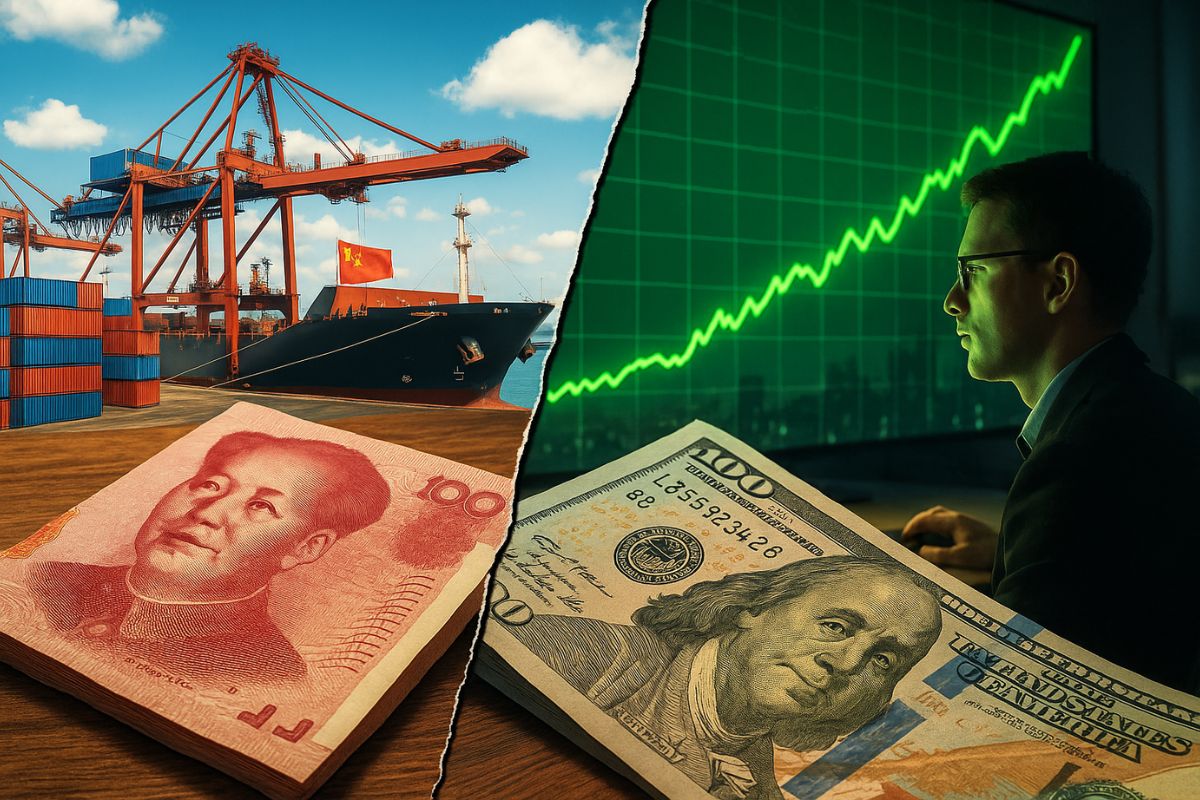


Is It the End of the Dollar? Understand How China’s New “Dollar” Could Impact Brazil and Its Investments. Experts Analyze the Rise of the Yuan in Global Trade and the Risks and Opportunities for the Brazilian Economy
The rise of the new “dollar” from China — the yuan — in international trade is raising alarm bells among economists and investors. Brazilian companies, such as Til Beans, have already announced plans to abandon the dollar in import operations and adopt the Chinese currency directly. This movement reflects a global trend of currency diversification, accelerated after U.S. sanctions against Russia.
Currently, the dollar accounts for 54% of world trade and dominates the financial market, but is losing ground in international reserves and global payments. Meanwhile, the yuan, although it represents only 2% of global reserves and 7% of currency transactions, is growing steadily and strategically. According to specialists, this scenario places Brazil in a unique — and potentially advantageous — position in the trade disputes between the U.S. and China.
The Rise of the Yuan and Global Repositioning
According to recent data, the dollar has dropped from 70% to 58% in the share of global currency reserves since the early 2000s. During the same period, the yuan officially joined international reserves, gaining strength in Asian trade and bilateral operations.
-
Brazil’s Federal Revenue Auction: iPhone 13 for $95, PlayStation 4 for $80, and Volkswagen Jetta for $2,600 Among 232 Lots Available

-
Tech Giant Oracle Lays Off 21,000 Employees and Invests $70 Billion in Artificial Intelligence

-
Chilean Giant Acquires St. Marche, Expanding from Discount to Premium Supermarkets in São Paulo’s High-End Retail Market
-
After 60 Years of Selling Cheap Milk, Brazilian Family Invests in $4,000 Equipment to Transform Farm’s Milk into Premium Sweets, Producing 2 Tons Daily and Aiming for $6.4 Million


The professor of international economics consulted by the report notes that the history of hegemonic currencies is cyclical: the British pound lost ground to the dollar in the 20th century, and now China’s rise as the largest industrial power may pave the way for the yuan. However, the lack of transparency in the Chinese system and state control still generate distrust among global investors.
Opportunities and Risks for Brazil
Brazil is currently the largest supplier of raw materials to China and a relevant trade partner for the United States. This places it at the center of a dispute that could yield strategic gains if the country knows how to negotiate. Specialists argue that Brazil should adopt a neutral stance and demand counter-offers — such as technology transfer and establishment of local industries — in exchange for supplying inputs.
With commodity prices rising and the real strengthening, the country is already feeling positive impacts: the EWZ index, which measures the Brazilian stock market in dollars, grew by 25.01% in 2025, surpassing the 9.64% of the S&P 500 in the same period. Even without significant fiscal reforms, the external scenario has favored the Brazilian economy.
The Brazilian Investor in This New Scenario
For investors, analysts recommend diversifying the international portfolio and preparing for possible changes in the global monetary system. The decline of the dollar in Brazil opens up opportunities to purchase foreign assets at more attractive prices, but geopolitical instability requires caution.
The currency dispute will not be resolved in the short term, and Brazil needs to decide whether it wants to merely react to the moves of great powers or actively act to benefit from this economic realignment.
The new “dollar” from China is still far from replacing the dollar as the primary global currency, but its expansion is already influencing commercial strategies and investments. Brazil, if well positioned, can be one of the big beneficiaries — as long as it aligns foreign policy, the industrial sector, and long-term interests.
Do you think Brazil should adopt the yuan in negotiations with China or maintain priority on the dollar? What would be the smartest strategy to protect our economy and attract investments? Share your vision in the comments.








Muito boa matéria, bem escrita
Eu creio que o Brasil está caminhando para um buraco sem saída economicamente com esse governo comunista que quer acabar com o dólar no Brasil.
Se a população do Brasil não agir rápido, quando acordar será tarde de mais. Já vamos estar escravizado pelo regime Chinês.
Os dois, tanto o yuan chines como o dólar americano, fazer equilíbrio