






 Portuguese
  Spanish


The Palm Jumeirah, an artificial island in the shape of a palm tree, is Dubai’s most ambitious postcard. Built between 2001 and 2008 using only sand and rock, without concrete in its formation, it added 56 kilometers of coastline, sold 4,500 mansions in less than three days, and can be seen from space.
Few projects translate Dubai’s ambition as well as a giant palm tree drawn on the sea. According to AZoBuild, in the early 2000s, the emirate decided to rely less on oil and invest in tourism but faced a short coastline. The answer was Palm Jumeirah, an artificial island created from scratch to extend the shore and attract foreign investment.
According to AZoBuild, the project was completed in 2008 and added 56 kilometers of coast to the city. More than an aesthetic whim, the palm tree was designed to maximize beachfront access in a compact area, solving both a space problem and a marketing strategy to reposition Dubai as a luxury destination.
A palm tree drawn on the sea
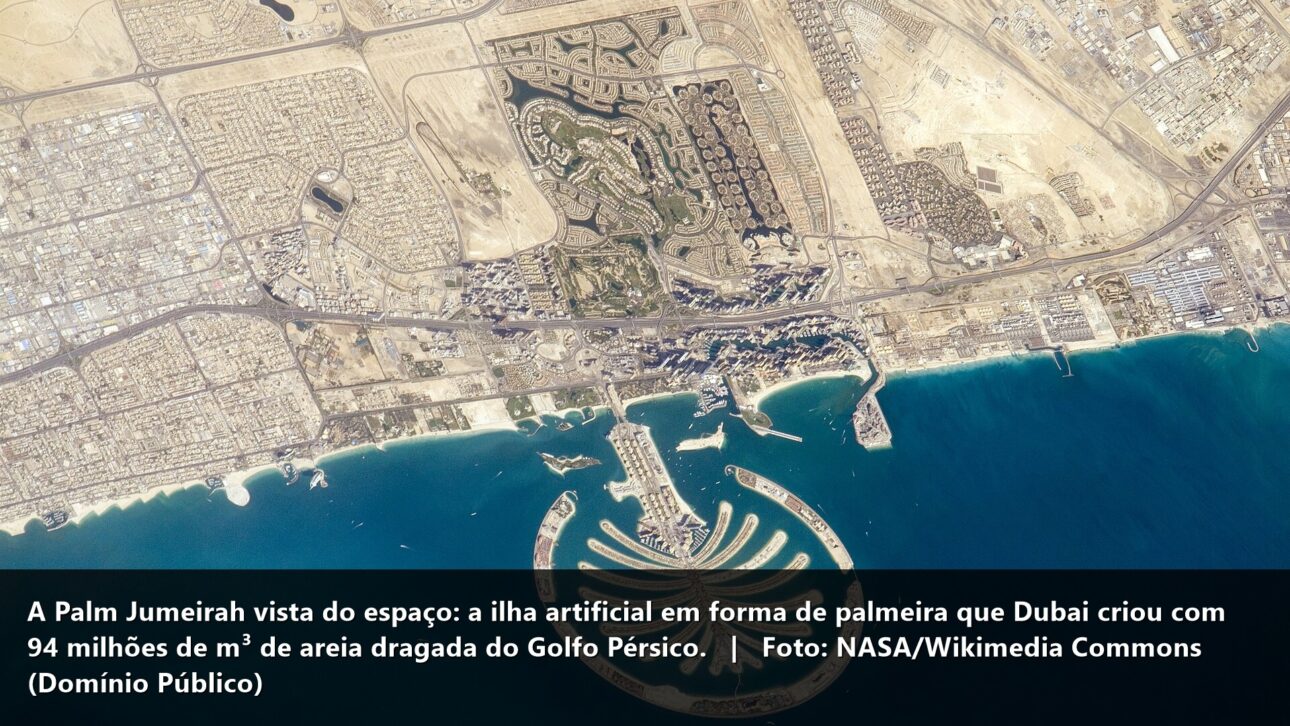
The choice of shape was not random. The palm tree is a national symbol of the United Arab Emirates, associated with resilience and growth, and also had a practical advantage: its “leaves” allowed squeezing the maximum coastline into a compact area. It was this combination of symbolism and engineering that helped transform Dubai’s luxury tourism into a global brand.
-
São Paulo plans the largest road tunnel in Brazil, over 6 km in the Serra do Mar, as part of an R$ 8 billion project that promises to increase the capacity for trucks and buses between the plateau, the coast, and the Port of Santos by 145%.

-
Few people know, but a dam in the USA required 5 million barrels of cement, 4.44 million cubic yards of concrete, and even an ice plant capable of producing 2 million pounds per day to prevent cracking during curing; discover the engineering behind the Hoover Dam.

-
They seemed sturdy enough to support a 222-meter tower, but three giant bolts broke because invisible hydrogen atoms had weakened the steel.
-
It seemed like just a futuristic metal facade, but curved panels turned into reflectors, heated sidewalks to around 60°C, hit apartments, and needed to be given a matte finish.



Behind the project was the state developer Nakheel Properties, in partnership with the American company HHCP. In total, the island occupies about 560 hectares, all created by landfill, meaning land where there was once only sea.
Its anatomy indeed resembles a palm tree: a central trunk, a crown with 17 leaves where the villas are located, and a crescent-shaped breakwater that embraces the entire set.
94 million m³ of sand and no concrete
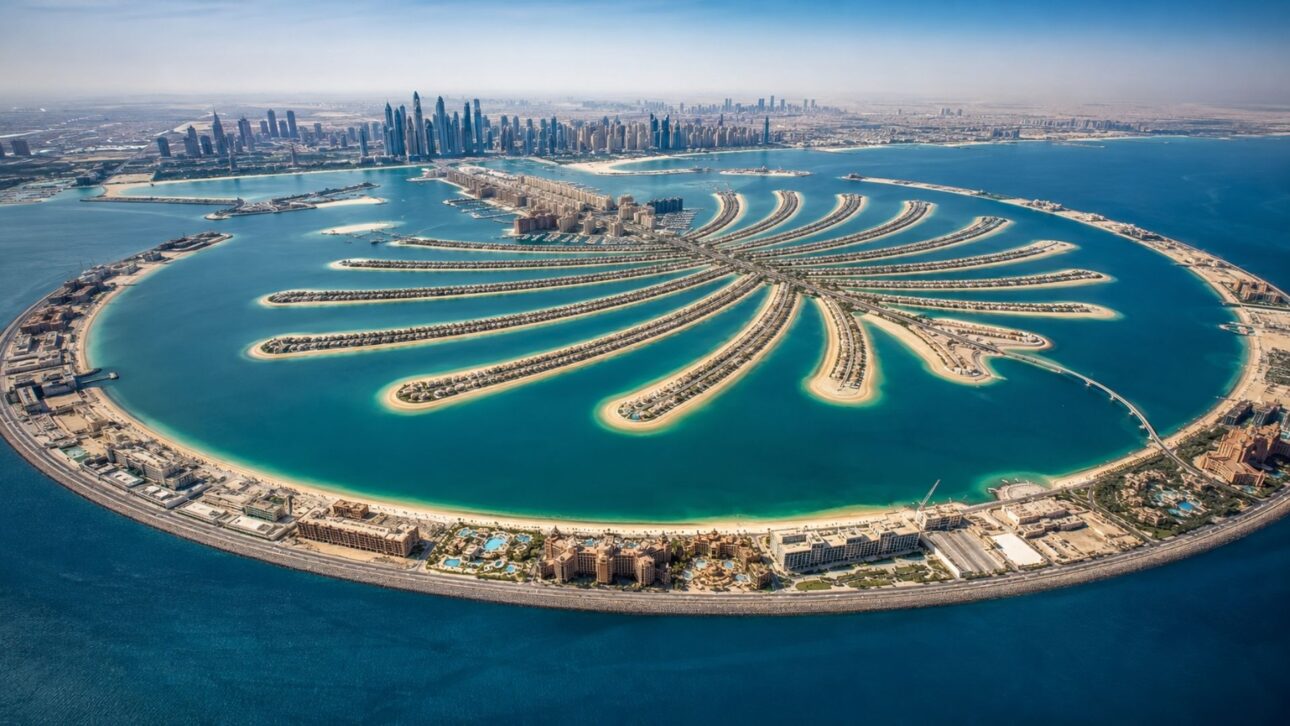
The most impressive part might be the material. The Palm Jumeirah was shaped solely with sand and rock, without a gram of concrete or steel in its formation. The European companies Van Oord and Jan De Nul carried out the dredging, dumping about 94 million cubic meters of sand with GPS-guided dredgers in a technique nicknamed “rainbowing,” where the material is sprayed over the water. To protect the structure, about 7 million tons of rock from the Hajar Mountains were added.
None of this was improvised. More than 100 studies preceded the work, covering everything from transportation and infrastructure to sea behavior, with independent oceanographers monitoring marine conditions before, during, and after construction.
The crescent-shaped breakwater extends for 11 kilometers and protects the island from waves and erosion, while a 1.4-kilometer underwater tunnel, 25 meters deep, connects the fronds to the rest of the complex.
The infrastructure of a city on the water

Creating the land was only half the challenge; the other was making it habitable. The island received underground services, desalination plants, and a vacuum sewer system, as well as a 5.4-kilometer monorail, the first in the Middle East, linking the Gateway Towers to the famous Atlantis Hotel. The goal was to function as a complete neighborhood, not just a photo backdrop.

The layout divides the Palm Jumeirah into three well-defined zones. The trunk houses shops, restaurants, and apartment buildings; the fronds feature luxury villas with private sea access; and on the outer crescent, the large resorts, such as Atlantis The Palm.
A six-lane tunnel connects the parts of the island, and about 8,000 residents, both permanent and seasonal, live today on this reclaimed piece of sea.
Sunken jets and dolphins: the environmental side

The dredging disturbed the ecosystem, and part of the project was precisely to try to repair the damage. In a more than unusual solution, two F-100 Super Sabre military jets were sunk near the island to form artificial reefs, which now house marine life and attract divers.
Later, openings were made in the crescent-shaped breakwater to improve tidal circulation and prevent the water from becoming stagnant.
Gradually, nature responded. The nutrient-rich landfill and the careful design of the seabed helped in the return of fish, crabs, mollusks, and corals, and during the COVID-19 lockdown there was even an increase in the number of dolphins spotted near the island, a sign of improved water quality. To top it off, more than 12,000 palm trees were cultivated in a nursery and transplanted throughout the complex.
4,500 mansions sold in less than three days
From a real estate perspective, Palm Jumeirah was an immediate phenomenon. The first batch of 4,500 homes sold out in less than three days, and the island quickly established itself as one of Dubai’s most valued addresses.
Before that, still in the first residential phase, reports indicate that 4,000 units were sold in just 72 hours.
The appeal has remained over time. In 2022, the island housed residents from more than 70 nationalities and had become a recognizable landmark of the city, reinforced by attractions such as the Aquaventure water park and a collection of luxury hotels. The artificial palm tree ceased to be just an engineering work to become part of Dubai’s very identity.
The challenges that come with the tide
Maintaining an entire island in place, however, is a constant and everlasting task. The constant action of the waves gradually displaces the sand, which requires periodic replenishment of the beaches and adjustments to the rock formations. It’s the price of sustaining kilometers of coastline that, after all, were invented.
There are still more delicate points. Satellite data from NASA indicated a sinking of about 5 millimeters per year, although Nakheel disputes the numbers and claims there are no structural problems.
Some residents have also complained over time about the spacing between houses and the overload on infrastructure, reminders that living over the sea has its trade-offs.
A model difficult to replicate
The success of Palm Jumeirah was so great that it inspired even more ambitious sisters, such as Palm Jebel Ali and Palm Deira. However, none of them have been completed to this day, which shows how difficult it is to replicate a maritime project of this scale without continuous economic and logistical support. To give an idea of the size, it is estimated that more than 800 football fields would fit on the island, which can be seen from space with the naked eye.
More than two decades later, Palm Jumeirah remains a case study on creating land where there was none. At a time when coastal cities face rising seas and climate change, Dubai’s palm is both an engineering feat and a reminder that such projects need to be cared for forever — it wasn’t enough to build it; it must be maintained every day to keep it standing.
And you, would you live on an artificial island like Dubai’s?
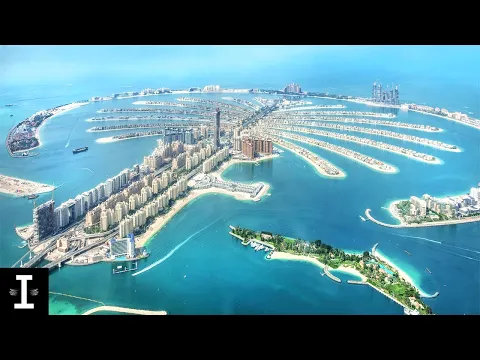

Dredged sand from the seabed, a palm tree visible from space, and mansions that sold out in three days: Palm Jumeirah sums up Dubai’s boldness in turning money and engineering into solid ground.
Do you think projects like these are the future of space-limited cities, or too risky a bet given the rising sea levels? And would you agree to live on a man-made island? Leave your opinion in the comments.


