






 Portuguese
  Spanish


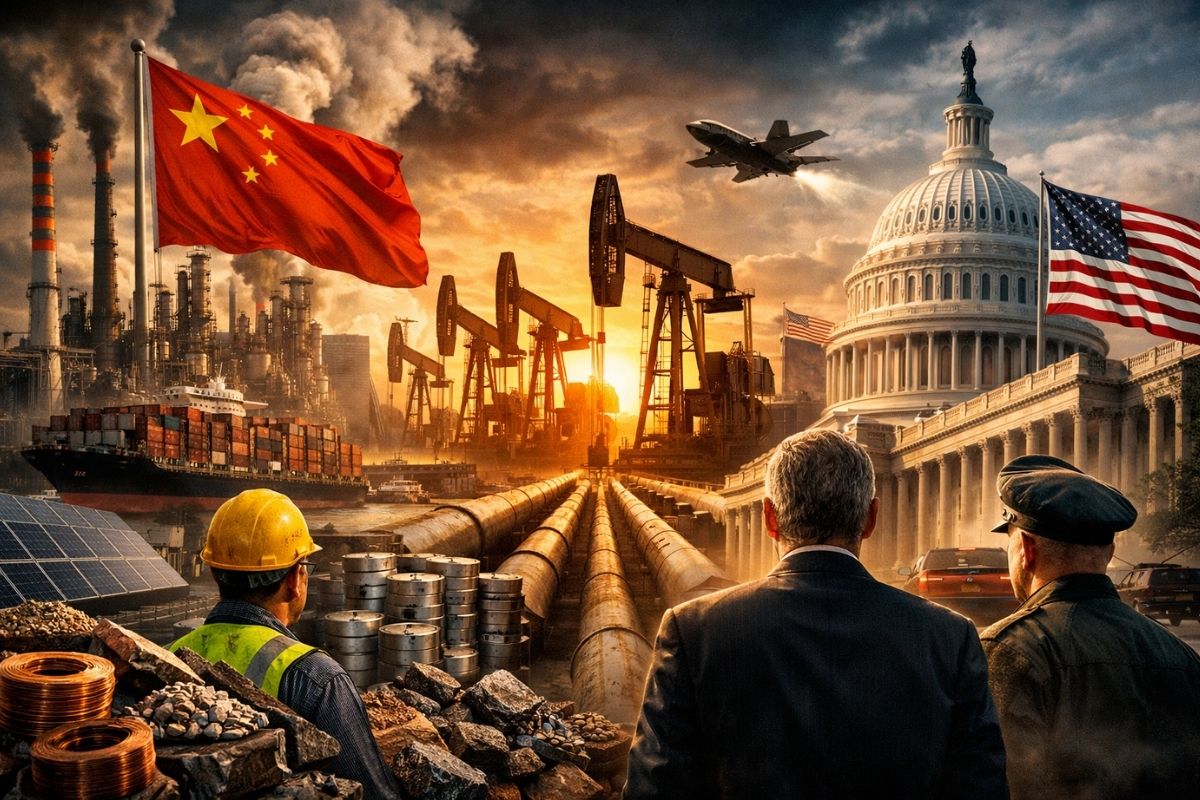


In Washington and in European capitals, the bet on intellectual property and finance pushed mining, refining, and smelting away. Meanwhile, China consolidated processing sovereignty, expanded electricity and renewables, and began to dictate access to gallium, rare earths, graphite, magnesium, and polysilicon on the planet right now
In Washington, the alert is no longer theoretical: China started concentrating the gears that transform ore into usable material, while the West outsourced the heavy work of mining, refining, and manufacturing for three decades and treated the industry as a “dirty” step.
In the reevaluated reading by analysts and investors, the result is a strategic disarmament: geological deposits in the West do not guarantee sovereignty when the “intermediate flow” of purification, smelting, and chemical separation is in the hands of China, which now combines energy infrastructure with dominance of critical materials.
How The West Exchanged Factory For Financial Mirage
Over the past three decades, Western democracies operated under the idea that software, intellectual property, financial instruments, and code would be the top of value creation.
-
Brazil’s 2026 Tax Refund: Record 9.58 Million Filers in Largest Payout Ever, But a Key Detail on Priority Recipients Draws Nationwide Attention

-
Itaú Alters Hybrid Work Model, Increasing Office Days from 2028, Prompting Employees to Adjust to New Routine
-
Facing Labor Shortage, Japan Plans to Invest $34 Million to Attract Foreign Workers in Construction, Healthcare, Industry, and Commerce

-
Brazilian City Makes Remarkable Leap, Becomes 4th Wealthiest in the Country with GDP of R$ 134.1 Billion




In this view, mining, refining, and manufacturing became low-margin services, easily outsourced to low-cost jurisdictions with no strategic risk.
The described consequence is a loss of domestic productive capacity in the name of quarterly efficiency.
What seemed rational in the short term opened a void in the physical world: without knowing how to smelt metal, there is no material sovereignty.
The Paradox Of Raw Materials And Processing Sovereignty
The central argument of the “raw material paradox” is straightforward: owning the raw mineral does not equate to owning the material that the economy actually uses.
Lithium mines in Australia or copper in Arizona, by themselves, become suppliers of a chain where the decisive step is to refine, smelt, and purify.
At this point, China would have monopolized the so-called processing sovereignty, meaning the heavy industrial capacity that transforms rock into critical input for technology, energy, and defense.
Critical Materials: Numbers That Changed The Balance
The data cited in the report point to extreme concentration in specific segments:
Gallium: about 98% of global production, with use in AESA radars, 5G networks, and future semiconductors.
Rare Earths: about 90% of chemical separation capacity and more than 90% of NdFeB magnet production.
Graphite: over 90% of graphite anode production, a central piece of lithium-ion batteries.
Magnesium and Polysilicon: between 90% and 95% in magnesium smelting and 95% of the polysilicon used in solar energy.
The synthesis is that China not only dominates the resource but also the industrial bottleneck that provides practical access to the resource.
Energy And AI: The Barrier That Is Not Software
The narrative describes a reality shock for the West: the race for artificial intelligence is not just about chips and code when cheap electricity is lacking to power data centers.
The text positions energy as a physical limit, not a detail.
In this scenario, China is described as an “electro-electronic state,” producing 2.5 times more electricity than the US and building 74% of all solar and wind projects underway in the world, while expanding electrical infrastructure as a competitive advantage.
Washington And Venezuelan Oil: 20th Century Tool In 21st Century Crisis
In Washington, the described response involves an attempt to redesign the energy map focusing on Venezuelan crude oil.
The logic would be to consolidate reserves of Venezuela, Guyana, and the United States under American influence, totaling about 30% of global reserves, according to the report.
But the text itself points out limits: Venezuelan oil would be “foreclosed,” with debt of up to US$ 60 billion to China in the oil-for-loans model, alongside crumbling infrastructure, while Beijing offers 21st-century infrastructure based on renewables and high-voltage networks.
Lack Of People, Not Just Money: The Human Bottleneck
The final argument is that rebuilding industrial sovereignty is not just about investment.
Metallurgists and process engineers adjusting furnaces and chemical separation lines are retiring without replacement, after 30 years of deactivating heavy industrial capacity.
The text describes a timeline conflict: the financial clock of quarterly profit against the industrial clock of decades and the war clock of immediate reserves.
While China synchronizes these horizons through state action, the West remains stuck in the short term.
Do you think the West can still rebuild smelters, refineries, and factories in time to reduce dependency on China, or has material sovereignty already turned into a practically lost race?






A Corrida por lucro trimestral me parece que foi a maior força motriz da desindustrialização americana e do ocidente. Teve o subproduto da concentração de renda também. A classe média da manufatura teve salários e benefícios comprimidos pra aumentar os lucros. Os poucos já ricos que vivem do lucro trimestral ficaram milionários…hoje 10% dos ricos possuem 90% da riqueza global do ocidente.