Portuguese
  Spanish


Archeologists identified ancient tombs on the northern coast of Egypt and a Byzantine city in the western desert, in findings that gather gold pieces, urban structures, and records of the daily life of ancient populations.
On July 4, 2026, Egypt announced the discovery of 18 ancient tombs at the archaeological site of Marina el-Alamein, on the northern coast of the country, about 100 kilometers from Alexandria.
During the excavations, archeologists found four small gold pieces placed in the mouths of some deceased, known as “golden tongues,” a practice associated with funerary beliefs of the Greco-Roman period, according to the Ministry of Tourism and Antiquities.
The discovery was presented by the Egyptian government along with another find: a residential city from the Byzantine era in the Dakhla Oasis, in the western desert.
-
Nigeria Dumps 120 Million Tons of Sand into Atlantic to Build Massive City with 8.4 km Sea Wall for Protection Against Ocean Waves and Erosion

-
German Engineer Developed Diesel Engine Running on Vegetable Oil Decades Before Electric Cars Became Popular; Can This Forgotten Idea Work in 2026?

-
James Webb Telescope Uncovers Unexpected Clues on Mysterious Moon, Potentially Redefining Planetary Origins

-
$1.5 Billion Sleipnir Vessel Transforms Ocean into Floating Construction Site with 12 Hybrid Engines and Capacity to Lift 20,000 Tons


The two excavation fronts gather evidence about daily life, urban organization, economic activity, and religious practices in different periods of Egypt’s history.
The announcement comes amid the country’s efforts to expand the presence of archaeology in tourism.
The sector is one of Egypt’s main sources of foreign currency, alongside the Suez Canal, and part of its strength is linked to visitors’ interest in ancient sites, museums, and historical routes.
Golden tongues were found in tombs in Egypt
The tombs were located in Marina el-Alamein, an area near the city of El Alamein, on the Egyptian Mediterranean coast.
The site is associated by archeologists with the ancient Greco-Roman port city of Leukaspis, built in the 2nd century and occupied until the 4th century, according to information released by the ministry.
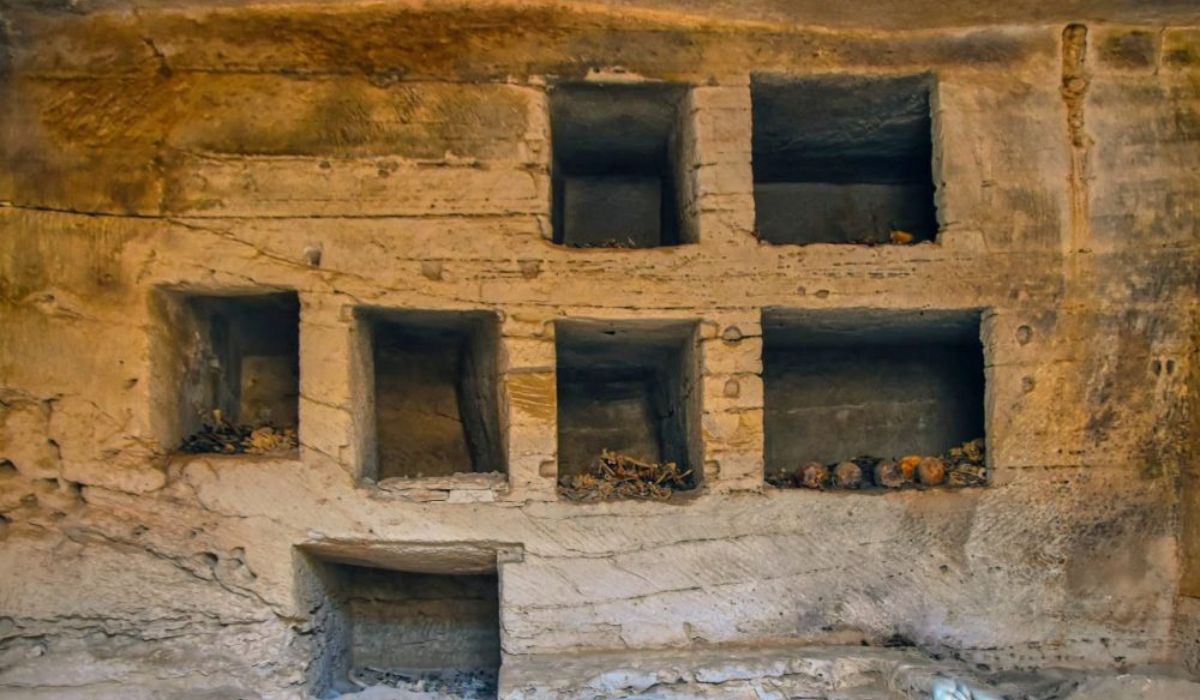
At the site, the team found 11 rock-cut tombs, with an average depth of 8 meters, and seven surface graves constructed in limestone.
Part of the structures preserved burial openings closed by stone slabs, a detail highlighted by Egyptian authorities in the description of the state of the excavations.
According to the head of the archaeological mission, Eman Abdel-Khaliq, the four gold pieces were identified inside the mouths of some of the deceased.
The practice, known as “golden tongue,” appears in funerary contexts of ancient Egypt and Greco-Roman times and is often interpreted by researchers as an element linked to beliefs about the afterlife.
The find does not indicate that all 18 tombs contained this type of amulet.
The information released by the ministry only indicates the presence of the pieces in some of the bodies, which requires caution to avoid the interpretation that the entire set presented the same funerary ritual.
In addition to the gold pieces, archaeologists found ceramic vases, amphorae, lamps, plates, altars, limestone basins and other objects related to the funerary use of the structures.
A 2.5-meter granite sarcophagus was also located, with bone remains that are still under study.
Near the sarcophagus, the team identified fragments of a sphinx statue made of plaster.
According to the mission, the set of recovered objects will be analyzed to enhance understanding of the rites, occupation, and social composition of the ancient port city.
Marina el-Alamein preserves Greco-Roman vestiges
Marina el-Alamein was revealed in 1986 and began to be studied as one of the sites linked to the Greco-Roman occupation on the northern coast of Egypt.
The ancient Leukaspis was located in a strategic area of the Mediterranean and, according to the Ministry of Tourism and Antiquities, was active between the 2nd and 4th centuries.
The materials found in the tombs indicate the presence of Egyptian, Greek, and Roman references in the same archaeological context.
Among the items described in statements and reports based on official information, there are altars, funerary elements, sarcophagi, and amulets associated with the religious practices of the time.
According to reports published based on the ministry’s statement, archaeologists also found a limestone altar for offerings with a facade inspired by the so-called “false door,” an element known in Egyptian funerary tradition.
The set also includes an incomplete marble statue that may represent Aphrodite and a limestone tombstone with the figure of a seated man holding a bird.
The Minister of Tourism and Antiquities, Sherif Fathy, stated that the excavations contribute to the study of the cultural identity of the inhabitants of Marina el-Alamein.
According to the ministry, the progress of the research also integrates the plan to prepare the site to receive visitors, in a region already known for beach tourism on the northern Egyptian coast.
There is disagreement among sources about the total number of tombs identified in Marina el-Alamein.
The Associated Press reported that the new find raised the number to 48, while Arab outlets citing the ministry’s statement recorded 44.
Until a new consolidated confirmation, the data should be presented as divergent.
Byzantine city identified in the Dakhla Oasis
In the same announcement, Egypt reported the discovery of a residential city from the Byzantine era at the Ain el-Sabil site in the Dakhla Oasis, in the New Valley province, in the western desert.
The area includes streets, houses, religious structures, and defensive constructions linked to a 4th-century community, a period when Egypt was part of the Byzantine Empire.
The urban layout described by the authorities shows main roads running north-south, crossed by smaller streets running east-west.
This organization formed squares and open spaces, according to Hisham el-Leithy, secretary-general of the Supreme Council of Antiquities.
In the elevated part of the settlement, the mission identified a basilica-style church, dated to the mid-4th century.
The construction faced one of the city’s main streets and appears as one of the religious structures mentioned by the Egyptian government in the announcement of the discovery.
The team also located two watchtowers at the edges of the settlement and a fortified structure with thick walls.
The houses had reception halls and vaulted ceilings, according to the archaeological mission’s description.
In areas associated with domestic life, bread ovens, kitchens, and stone tools used for grinding grains were found.
These remains indicate activities related to food production and the routine of the ancient inhabitants, according to the researchers responsible for the excavation.
Houses, coins, and inscriptions help reconstruct daily life
Among the constructions identified in Dakhla is the house of Tisus, described as a deacon of the church and associated with the second half of the 4th century.
Archaeologists also point out that another residence, attributed to Tapibos and dated to the early same century, may have functioned as a domestic church before the basilica’s construction.
The hypothesis of domestic religious use was presented by the archaeological team based on the house’s layout and the settlement’s context.
As this is a technical interpretation, the information should remain attributed to the researchers and not be treated as an independent conclusion.
The recovered objects include well-preserved bronze coins, with portraits of Byzantine emperors, Latin inscriptions, and Christian symbols.
Gold coins attributed to the reign of Constantius II, Roman emperor between 337 and 361, were also found.
Another set mentioned by the authorities includes about 200 pottery fragments used as writing supports, known as ostraca.
The inscriptions record commercial transactions, correspondence, and details of daily administration, according to Diaa Zahran, head of the department of Islamic, Coptic, and Jewish Antiquities.
This type of material is used by researchers to study administrative practices, trade relations, and aspects of the routine of ancient communities.
In the case of Dakhla, the fragments help connect architectural structures to written records produced in the settlement itself.
The presence of coins, texts, churches, houses, and domestic equipment indicates a community with organized economic, religious, and social activities, according to the interpretation presented by the specialists involved in the excavations.
New analyses should still detail the chronology of the structures and the relationship between the objects found and the excavated buildings.