Portuguese
  Spanish


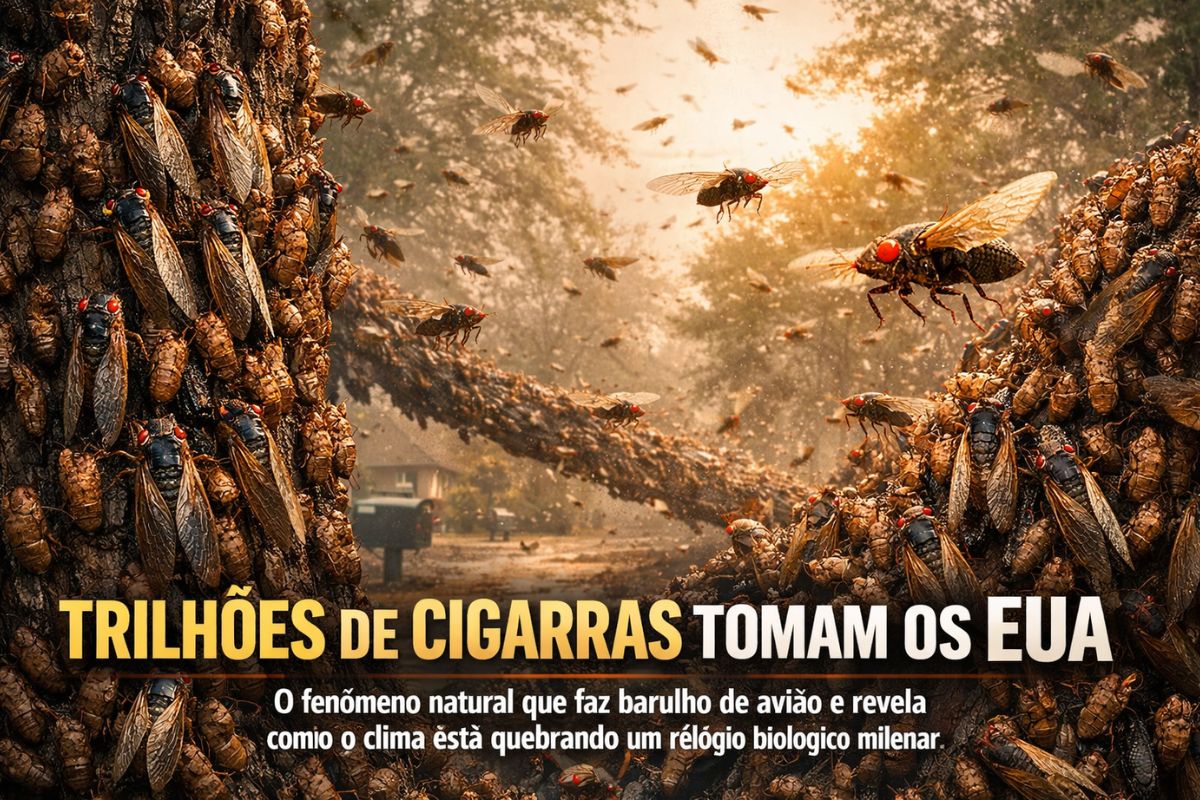


In 2024, Trillions of Periodical Cicadas Emerged in the United States, Disrupted Daily Life and Exposed How Global Warming Is Disrupting a Thousands-Year Biological Clock.
In 2024, trillions of cicadas emerged at the same time in the United States, transforming entire cities into a continuous buzz, covering trees, streets, and houses, making it clear that something very deep is changing in the relationship between climate and nature.
Behind the spectacle of trillions of cicadas occupying forests, neighborhoods, and highways, scientists see an increasingly clear warning: soil warming is disrupting a biological clock that took millions of years to adjust and that is now starting to fail in just a few decades, with impacts that go far beyond noise and mess.
Cicadas: Noise, Myth, and Quiet Service to Nature

If you live anywhere with trees, you’ve probably heard the sound of cicadas on hot summer afternoons. For many people, the singing is just a nuisance, loud, constant, hard to ignore. But no matter how noisy they are, cicadas have never been considered an environmental or economic disaster.
-
Pennsylvania Mine Creates Ice in Summer Heat and Melts in Winter, Turning a Mountain Crevice into a Reverse Natural Refrigerator

-
China Accelerates Global Expansion of Robotics: From Smart Vacuums to Industrial and Humanoid Machines, Millions Exported to Over 150 Markets
-
Polar Air Mass to Hit Brazil: Temperatures to Plummet in Nine States, Near Freezing in the South with Frost Risk Until Monday
-
Chinese “dark factories” produce electric cars 24/7 with minimal human intervention, as Zeekr assembles 800 units daily, raising concerns in Brazil.





They don’t destroy crops, don’t eat fruits, don’t sting people, and don’t transmit diseases. Researchers remind us that cicadas are, in practice, harmless to humans and crops. They don’t want your plants; they just want to sing and reproduce.
What almost no one realizes is how much this noisy cycle benefits nature. Whenever they emerge after more than a decade underground, cicadas dig millions of small holes, creating a ventilation network that helps the soil “breathe” and facilitates rainwater infiltration to tree roots.
When trillions of cicadas complete their cycle and die, their bodies become an incredibly rich natural fertilizer, capable of dramatically increasing nutrient availability in the soil.
These bodies are rich in nitrogen, phosphorus, and potassium, equivalent to thousands of tons of organic fertilizer distributed for free by the forest.
At the same time, they serve as an abundant source of protein for over 25 species of animals, from birds to mammals and even fish. In cicada years, predators shift focus and relieve pressure on other insects, helping to maintain ecosystem balance.
Periodical Cicadas and the Most Bizarre Biological Clock of Nature


Among around 3000 species of cicadas in the world, only a small group belongs to the so-called periodical cicadas and lives exclusively in the United States.
They are divided into dozens of “broods,” groups that share an extremely precise emergence calendar: some appear every 13 years, others every 17 years.
For about 95 percent of their lives, these cicadas remain buried up to 60 centimeters deep, slowly sucking the sap from tree roots. They spend over a decade in the dark, almost motionless, without seeing sunlight, only to live just six weeks above ground.
Why so much time hiding? Underground, they escape nearly all surface predators and feed on a stable, albeit poor, source of nutrients that requires extremely slow development.
In compensation, this food scarcity ensures safety and little competition. There is no other insect with such a strange biological calendar.
Each brood has its own emergence year, as if there were an invisible clock programmed with millennial precision.
And when the time comes, it’s not thousands, it’s billions or even trillions of cicadas emerging at the same time, in an explosion of life so great that the defense strategy is excess: there are so many prey available that predators simply cannot keep up.
2024: When Two Broods Met and Trillions of Cicadas Took Over the USA

A single group of periodical cicadas is already a significant event. But in 2024, the United States experienced something very rare. Two of the country’s largest broods emerged together, one on a 17-year cycle and the other on a 13-year cycle, synchronized by a mathematical coincidence that occurs only once every approximately 200 years.
Right at the beginning of spring 2024, residents of 16 states felt the ground tremble. It wasn’t heavy trucks or earthquakes; it was the sound of trillions of cicadas rising to the surface at the same time.
In some areas of Illinois and Tennessee, the noise reached around 110 decibels, comparable to standing next to a jet plane during takeoff.
Biologists working outdoors had to wear industrial ear protection to have conversations. In many places, the number of cicadas exceeded millions per hectare. Tree trunks, branches, and even the ground appeared covered by a living, vibrant layer, in continuous motion.
Studies estimated that a relatively small area could host hundreds of thousands of cicadas per square meter.
If we lined up a trillion cicadas one after another, the line would be long enough to cross the distance between Earth and the Moon dozens of times. The combined emergences of 2024 were enough, in theory, to cover thousands of cities the size of New York.
When the City Turns into a Sea of Sound, Shells, and Corpses
With such extreme density, chaos was inevitable. In forests near cities like Bloomington, the weight of millions of nymphs sticking to branches at the same time caused many limbs to break, as if a hailstorm had passed.
In Louisville, residents reported slippery streets due to the accumulation of corpses. In some spots, the trillions of cicadas that emerged and died had to be removed with shovels, trucks, and high-pressure water jets, because the bodies formed thick layers over sidewalks, parking lots, and even hospital entrances.
Cicadas landed on TV cameras, stuck to microphones, and fell into reporters’ coffee cups during live broadcasts. Families described the noise as a siren blaring 24/7.
Males produced sound by flexing special membranes hundreds of times per second, like a biological loudspeaker. When millions did this together, the result was a sea of sound capable of vibrating car windows and drowning out truck traffic.
In everyday life, events were postponed, outdoor parties had to be interrupted, pets became sick after eating too many cicadas. The season when trillions of cicadas invaded American daily life became practically a collective experience, divided between fascination and exhaustion.
Why the United States Doesn’t Simply Exterminate the Cicadas

Faced with so much noise, mess, and inconvenience, the question arises almost automatically: why not eliminate the periodical cicadas? The answer is simple and uncomfortable. They are not pests; they are an ecological phenomenon.
Cicadas don’t bite, don’t sting, don’t devastate crops, and aren’t vectors of diseases. Direct economic damage is minimal when compared to agricultural pests or disease-carrying mosquitoes.
Exterminating trillions of cicadas would be costly, bring little real benefit, and cause massive destruction elsewhere in the ecosystem.
To kill a single brood, an enormous amount of pesticides would be necessary. In 2024, when two broods emerged together, the scale would be even more absurd.
This chemical load would not only affect the cicadas but also birds, bees, butterflies, earthworms, and essential pollinators, creating an environmental disaster far greater than any temporary noise.
Furthermore, environmental laws in several U.S. states protect periodical cicadas, prohibiting large-scale spraying during the season and treating these emergences as ecological heritage.
Federal agencies classify them as native species of high value, precisely because of the role they play in soil, the food chain, and forest dynamics.
Zombie Fungi, Killer Wasps, and Humans at the Top of the Menu
Despite the astronomical numbers, periodical cicadas are far from invincible. They face enemies that seem straight out of a horror movie, like the fungus that turns cicadas into real “zombie machines” of spreading infection, causing their lower bodies to literally fall apart and be replaced by a mass of spores.
Infected, cicadas continue trying to mate, hyperactive, unaware that parts of their bodies have already disappeared, spreading the fungus with every contact. There is no treatment or practical control for this process in nature.
There are also impressive predators, like a large wasp specialized in hunting cicadas, which paralyzes them with venom and drags them to underground nests to serve as live food for larvae.
Residents of some areas describe the scene as a “death with wings,” watching cicadas being dragged across the ground as if they were shopping bags strewn about the forest.
And finally, humans enter the picture. In 2024, chefs, curious individuals, and content creators took advantage of the fact that trillions of cicadas were available and started testing recipes.
Cicadas became roasted, fried, breaded snacks, mixed into cookies, and even used in sushi versions. In many other countries, they have long been seen as street delicacies, traditional dishes, or protein-rich ingredients.
From Japan to Greece: Music, Spirituality, and Art
Cicadas are not exclusive to the United States, nor do they only make noise in American forests. In various countries, this small insect has gained deep cultural layers.
In Japan, the sound of cicadas is practically the official soundtrack of summer. The singing is not seen as noise, but as part of the collective memory.
Different species have their own names, appearing in anime, movies, and books. For many Japanese, the cycle of years underground and few weeks above symbolizes the impermanence of life, something beautiful precisely because of its brevity.
In China, the cicada is linked to the spiritual world. Small jade cicadas were placed in the mouths of the dead as a symbol of rebirth and the ascent of the soul, and poems describe the insect as an expression of purity, as it lives in the treetops and only feeds on sap.
In ancient Greece, the cicada represented art and freedom. Classical texts detail its life cycle with a precision that still impresses.
Jewelry in the shape of cicadas was common, and even today the singing of the insect echoes among pines, linking the past and present in the same sound.
Around the world, the cicada can be summer music, a spiritual symbol, a climate indicator, artistic inspiration, and even street food. And it is precisely this diversity of meanings that makes the risk of losing part of this phenomenon even more severe.
The Biological Clock That Global Warming Is Breaking
For millions of years, the biological clock of periodical cicadas seemed almost perfect. The broods emerged on time, every 13 or 17 years.
But in recent decades, something started to go out of rhythm. Researchers have observed groups emerging 1 to 4 years earlier than expected, with no historical record of such frequent events.
The explanation lies beneath our feet. The cicadas do not use a light or air temperature calendar; they keep track of time through chemical changes in the sap of tree roots. With global warming, trees have their cycles altered.
Nutrients, sugars, and minerals are changing at a different pace, and cicadas begin to interpret these signals as if a year has passed when, in reality, only a few months have gone by.
As a result, some broods emerge prematurely. Instead of trillions of cicadas forming a massive wave that saturates predators, small groups appear isolated, in insufficient numbers to defend themselves by the strategy of numbers.
Birds, rodents, and other hunters can devour practically all of them before they reproduce, pushing some groups towards collapse.
Entire broods have already been declared extinct, and others are in rapid decline. The same global warming that made the spectacular sight of trillions of cicadas in 2024 possible is what could, in the future, silence this phenomenon forever.
What Happens If Nature Loses This Chorus
If periodical cicadas disappear, the loss will not only be auditory. Fewer cicadas mean less protein in the spring for birds and other animals, weakened food chains, more pressure on caterpillars and insects that attack leaves, more vulnerable forests, and soils that are less aerated and less fertilized by organic matter.
The 2024 season, when trillions of cicadas made the soil tremble, the air vibrate, and cities stop to pay attention, may be remembered in the future as one of the first major alerts that nature’s biological clock is being broken by global warming.
It took millions of years for this system to become so precise, but only a few decades of unregulated climate for the mechanism to start failing.
And you, what would you think if trillions of cicadas invaded your city: would you see it as a fascinating spectacle of nature or as a worrying sign that global warming is already changing more things than we can perceive?