Portuguese
  Spanish


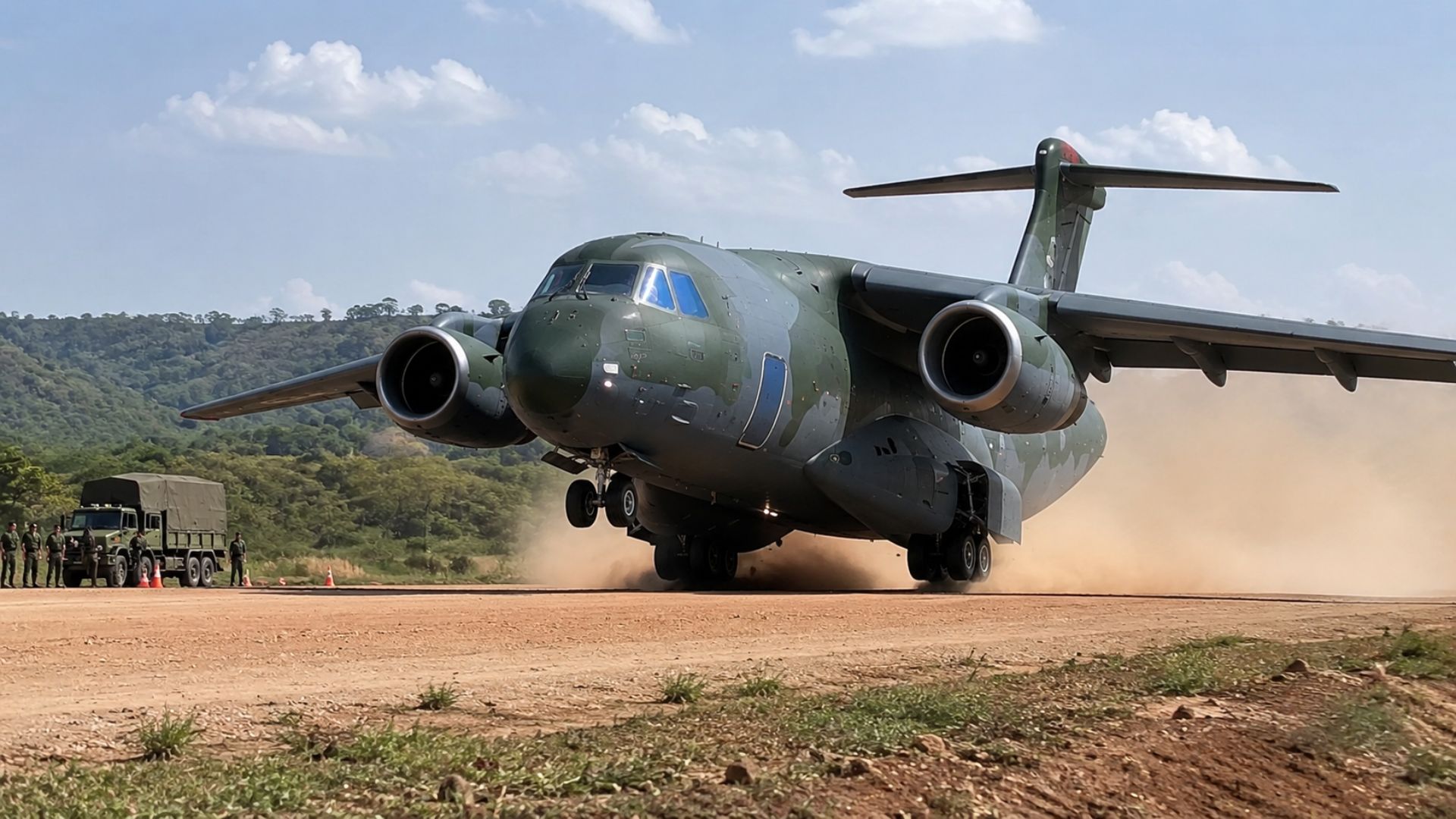

Military cargo aircraft developed in Brazil combines high speed, payload of 26 tons, and operation on unpaved runways, while Embraer records new contracts and selections of the KC-390 Millennium in NATO countries and other international markets.
Embraer uses the KC-390 Millennium to expand its presence in the global military transport market, with an aircraft developed in Brazil for missions of cargo, in-flight refueling, aeromedical evacuation, firefighting, search and rescue, and humanitarian support.
In operation with the Brazilian Air Force since 2019, the cargo aircraft combines a speed of 470 knots, a payload of up to 26 tons, and the ability to land on temporary or unpaved runways, according to data released by the manufacturer.
The company’s most recent institutional campaign presents comparisons with traditional turboprop cargo aircraft, a segment in which the KC-390 appears as a military transport option with higher cruise speed and different mission configurations.
-
Brazilian Engineers Lead $200 Million Project to Bring Water from São Francisco River to Transform Supply in Northeastern Cities

-
Brazilian University Tests Recycled Plastic Component for Homes, Aiming for More Sustainable Single-Family Housing Construction
-
Apple, Samsung, and Sony Warn: Wet Bluetooth Earbuds Can Be Damaged if Stored Before Fully Drying
-
Brazil Develops AI-Driven Technology to Measure Brain Pressure Non-Invasively, Detecting Nanometric Deformations in Real Time to Aid Early Medical Intervention


In the program’s communication, the manufacturer highlights three technical points of the aircraft: flight performance, operational versatility, and lower operating cost compared to previous models used in similar roles.
KC-390 advances in contracts with NATO countries
In Europe, the program has gained contracts and selections involving countries of the North Atlantic Treaty Organization, which expanded the aircraft’s presence in air forces that follow common military interoperability standards.
Portugal received the first C-390 in NATO configuration in 2023, while the Netherlands, Austria, the Czech Republic, and Sweden joined the list of clients or partners of the program in the following years.
In October 2025, Sweden formalized the purchase of four C-390 aircraft, in an agreement associated with a joint European initiative with the Netherlands and Austria for the operation and support of the platform.
The Swedish contract also included seven purchase options, a mechanism that allows for new acquisitions within the same cooperation arrangement and may expand the fleet linked to the European group in the coming years.
During the ceremony in Uppsala, Sweden’s Defense Minister, Pål Jonson, stated that the acquisition is part of the modernization of the Swedish Air Force and should enhance interoperability with European partners.
On the same occasion, the president of Embraer Defense & Security, Bosco da Costa Junior, declared that Sweden’s entry reinforces the C-390’s position in the European military tactical transport market.
Speed and payload differentiate the Brazilian freighter
Designed for medium-capacity military transport, the KC-390 can carry troops, vehicles, palletized cargo, and equipment on logistical missions, in addition to operating in different flight profiles according to the chosen configuration.
According to Embraer, the aircraft can transport up to 26 tons and fly at 470 knots, a speed equivalent to about 870 km/h, above that recorded by turboprop freighters used in similar functions.
This combination reduces travel time on logistical routes and can increase response capacity in emergencies, especially in operations that depend on the rapid transport of supplies, personnel, or equipment.
In addition to the freighter function, the plane can be reconfigured for parachute drops, aeromedical transport, humanitarian missions, search and rescue, firefighting, and in-flight refueling.
Among the operational characteristics disclosed by the manufacturer is the ability to operate in environments with limited infrastructure, a condition required in some military and humanitarian support missions.
The aircraft can operate on temporary or unpaved runways, including compacted soil, dirt, and gravel, a relevant feature for air forces that need to land outside conventional airports.
International operations and demonstrations of the program
After entering service in Brazil, the C-390 also began operating in Portugal and Hungary, countries that incorporated the aircraft into their respective military fleets in later stages of the program.
In a statement released in December 2024, Embraer reported that the fleet in operation had accumulated more than 15.5 thousand flight hours, with a mission capability rate of 93% and a mission completion rate exceeding 99%.
In April 2026, the manufacturer stated that the KC-390 had completed an international demonstration tour after flying more than 47 thousand nautical miles, performing 54 flights, and visiting 11 countries.
The campaign totaled around 140 flight hours and included operations in different weather conditions, with presentations held in severe cold environments in the Arctic and in hot and humid regions of Asia.
During this schedule, Embraer reported that the aircraft transported containers, medical modules, light and heavy vehicles, and palletized cargo, in demonstrations aimed at potential military operators.
The tour was used by the company to introduce the aircraft to new markets and demonstrate tactical and logistical transport configurations, without altering the technical data already disclosed for the program.
Client list surpasses initial disclosed contracts
The list of countries associated with the C-390 has changed since the first contracts mentioned by Embraer, as new selections and orders have been announced in manufacturer communications and international agency reports.
In December 2024, the company reported that an undisclosed customer had become the tenth nation to select the aircraft, following Brazil, Portugal, Hungary, South Korea, Netherlands, Austria, Czech Republic, Sweden, and Slovakia.
In May 2026, Reuters reported, via InfoMoney, that the United Arab Emirates made a firm order for the KC-390, the first disclosed purchase of the aircraft by a Middle Eastern country.
The report also pointed out that the cargo plane had already been ordered, besides Brazil, by Portugal, Hungary, Netherlands, Austria, Czech Republic, South Korea, Sweden, Lithuania, Slovakia, and Uzbekistan.
Another ongoing process involves Greece, where a Parliament commission approved on June 11, 2026, the acquisition of three C-390 aircraft, according to information published by Reuters.
The same report stated that the Greek purchase still depended on the approval of KYSEA, the country’s main decision-making body for defense and foreign policy matters, a necessary step before the process could be concluded.
The increase in the international portfolio occurs amid programs to renew old military fleets, especially in Europe, where governments are considering replacements for transport aircraft that have been in service for several decades.
Netherlands and Austria formalized in July 2024 the joint purchase of nine C-390, with five for the Dutch and four for the Austrians, with deliveries scheduled between 2027 and 2030.
Embraer does not disclose all contract values but includes the C-390 among the main platforms of its defense division, alongside other products aimed at armed forces and government operators.
With clients and selections in South America, Europe, Asia, and the Middle East, the program expands the Brazilian presence in a military transport segment that includes manufacturers from the United States and Europe.