Portuguese
  Spanish


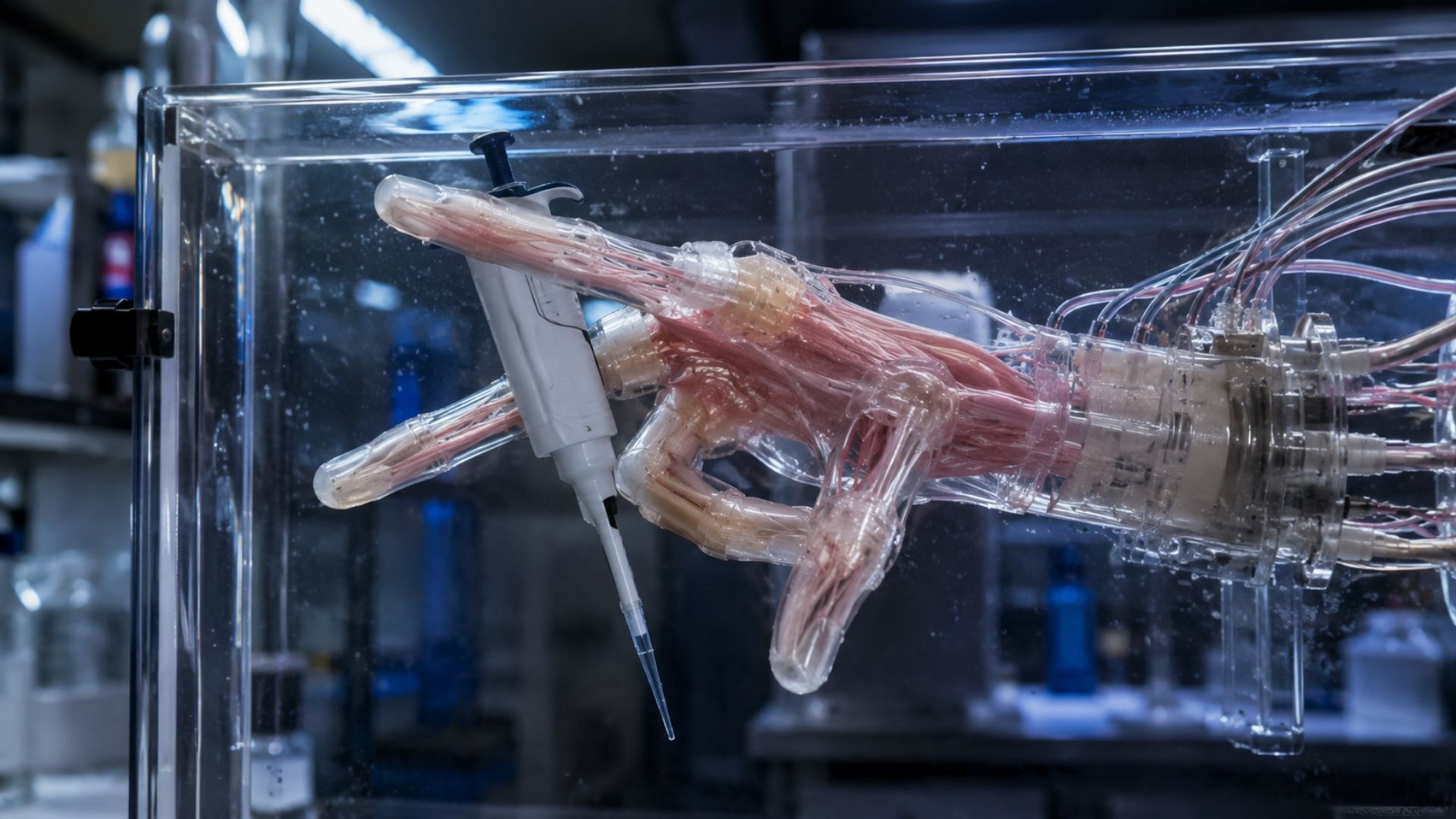

Scientists from the University of Tokyo and Waseda rolled strips of lab-grown human muscle, like a sushi roll, and created the first 18 cm biohybrid hand. Powered by electrical stimuli, it makes the scissor gesture and manipulates objects, in a robotics breakthrough published in Science Robotics.
A hand that mixes plastic and living human flesh went from the Japanese laboratory straight to the frontier of science. Researchers from Tokyo created the first biohybrid hand powered by cultivated human muscle, capable of making gestures and grabbing objects. The achievement was announced by the University of Tokyo.
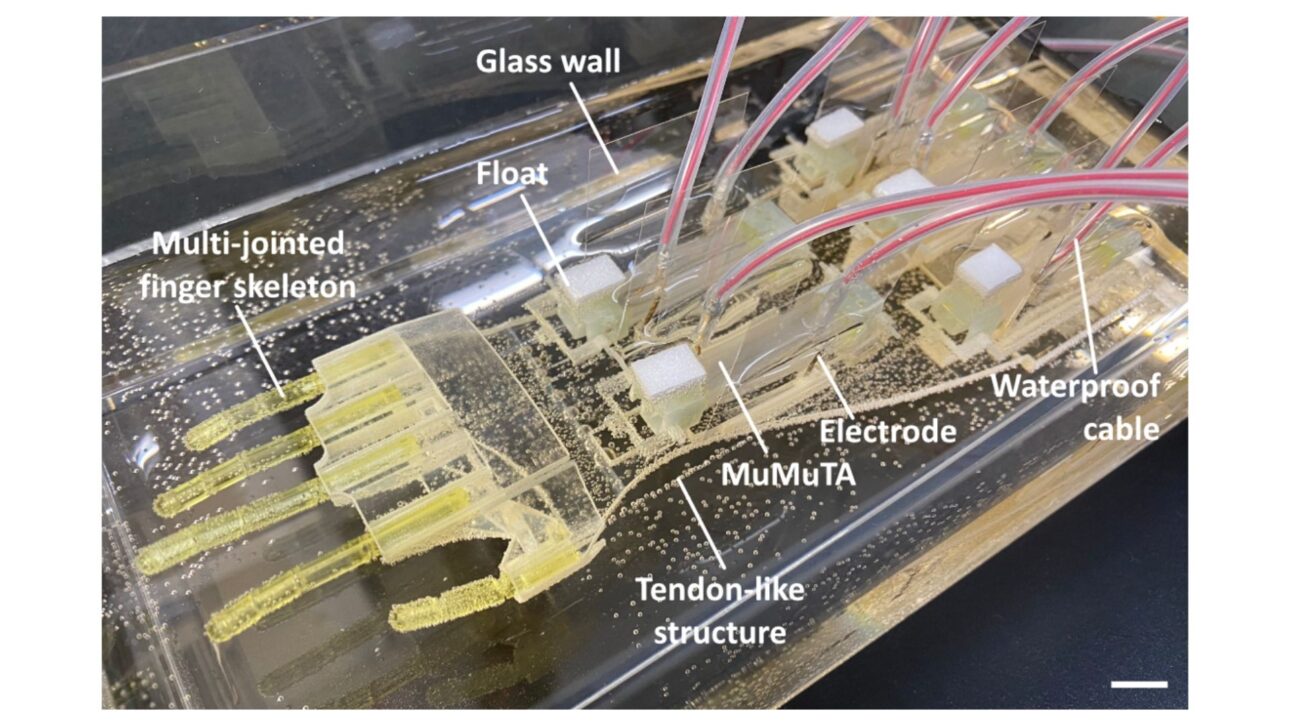
The secret lies in a curious technique inspired by cooking. To strengthen the fingers, the scientists rolled thin strips of human muscle as one does with a sushi roll, forming bundles that function like tendons. Each movement of the hand arises from the contraction of this living tissue. More than a curiosity, the work is a milestone for biohybrid robotics. Published in the journal Science Robotics, in February 2025, the research showcases an 18-centimeter hand that makes the scissor gesture and even manipulates objects. Next, see how this biohybrid hand works and why it is so important.
What is the biohybrid hand created in Tokyo
Science Robotics
The invention unites the artificial and the living in a single structure. The biohybrid hand combines a 3D-printed plastic base with “tendons” of human muscle cultivated in the laboratory. It is not a common robot made of metal and motors, but rather a partially living machine.
-
Brazil Faces Norway in World Cup at Stadium Linked to Jimmy Hoffa’s Mysterious Disappearance

-
Retired Woman Leaves French Public Housing Due to Fear, Lives in Van for Weeks, Prompting Response from Local Authorities and a Priest
-
9-Year-Old Fabio Isaac Wins Gold at Copernicus Math Olympiad in Singapore, Representing Peru Against Global Young Talents
-
Brazilian Physics Student Builds Realistic Cardboard Replica of Honda Africa Twin Using Mathematical Calculations




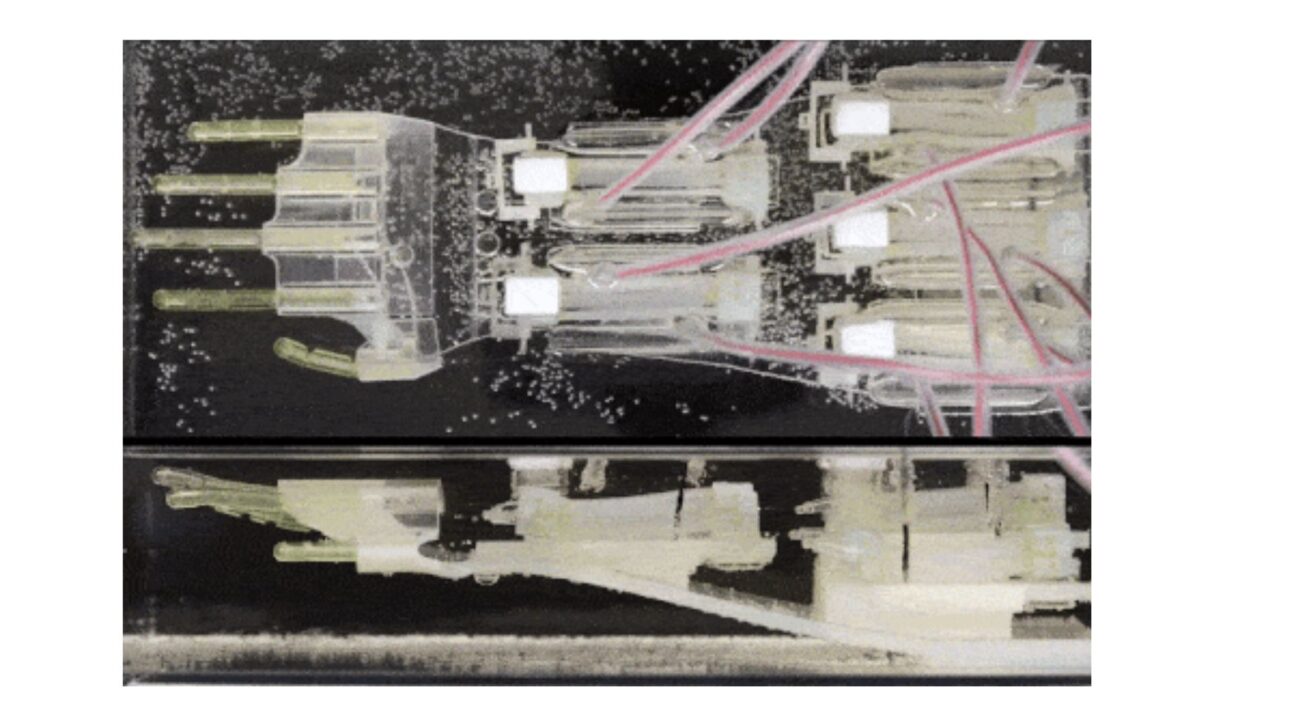
The dimensions follow the scale of a real hand. The device is about 18 centimeters long and features fingers with various joints, which can move individually or together. Thus, the hand can both make gestures and try to hold objects.
The work is the result of a partnership between major research centers. The biohybrid hand was developed by scientists from the University of Tokyo and Waseda University in Japan, under the leadership of Professor Shoji Takeuchi. It is a reference team in the area of living tissues applied to machines.
The research was taken seriously by the scientific community. The study was published in Science Robotics, one of the world’s leading journals in robotics, in February 2025. Publication in such a prominent outlet shows the significance of the advancement achieved by the researchers from Tokyo.
Calling this a robot is no longer entirely accurate. The biohybrid hand falls into a new category, between a machine and a living organism, because part of it literally feeds and breathes. For many scientists, it is the beginning of a robotics that uses not only metal and silicon but also biology.
The MuMuTA technique: muscle rolled like sushi
Science Robotics
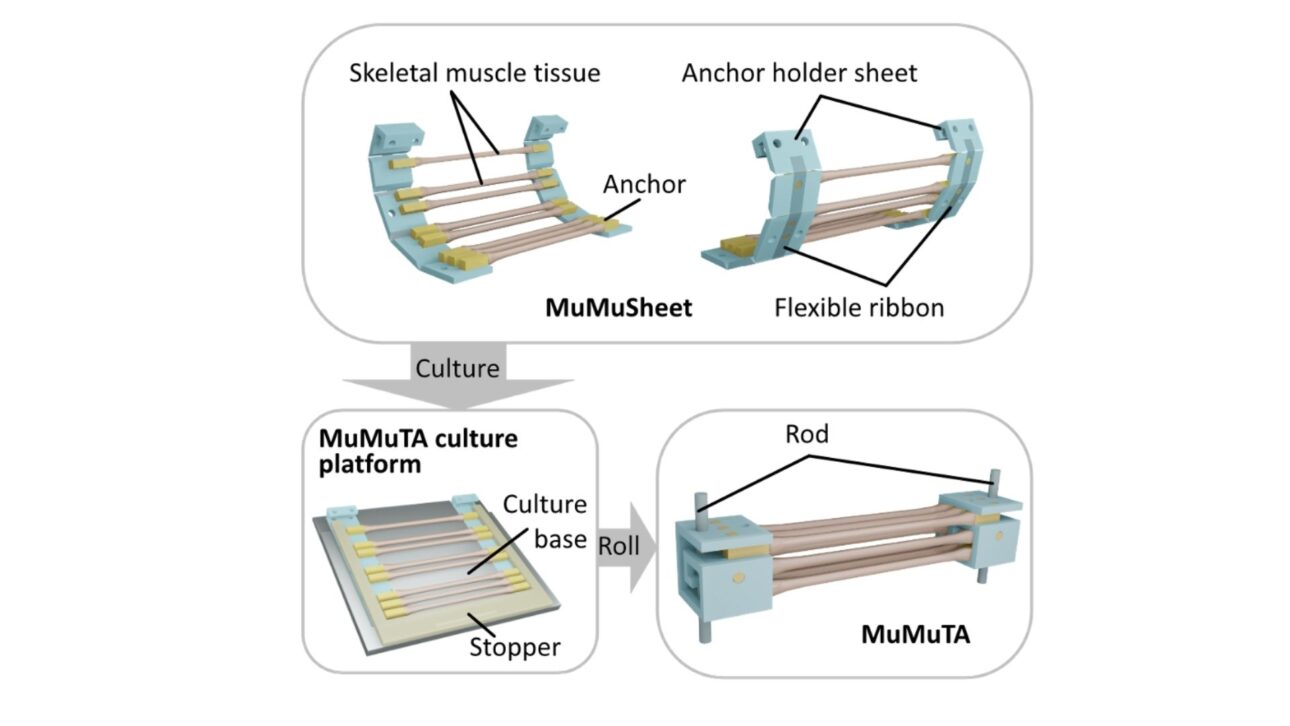
The heart of the invention even has its own name. The researchers named the technology MuMuTA, an acronym in English for “multiple muscle tissue actuators.” These are bundles formed by several strips of human muscle that work together to generate force.
The comparison with Japanese cuisine is not by chance. According to Professor Takeuchi, the strips of cultivated human muscle are rolled into a bundle, like a sushi roll, to form each tendon. This way of rolling increases the amount of tissue and, consequently, the contraction force.
Science Robotics
The trick solves an old problem in this type of research. Alone, thin strips of muscle are too weak to move a hand. By stacking and rolling several of them, the scientists achieved a set strong enough to bend the fingers of the biohybrid hand.
The result is an “artificial muscle” that is actually alive. Unlike motors or pistons, the MuMuTA is made of real human cells, which contract as they would inside the body. This is the big breakthrough of biohybrid robotics: using biology itself as a motor.
Science Robotics
Before this technique, muscle-powered robots were tiny. The thin strips of tissue only had the strength to move small parts, which stalled progress in the field. By rolling the human muscle like sushi, the scientists in Tokyo made a leap in scale towards hand-sized structures.
How muscles move fingers
The movement begins with a slight electric shock. In each bundle of human muscle, researchers insert gold electrodes on both sides. By passing an electric current, the tissue contracts, exactly like a muscle reacts to a stimulus from our nervous system.
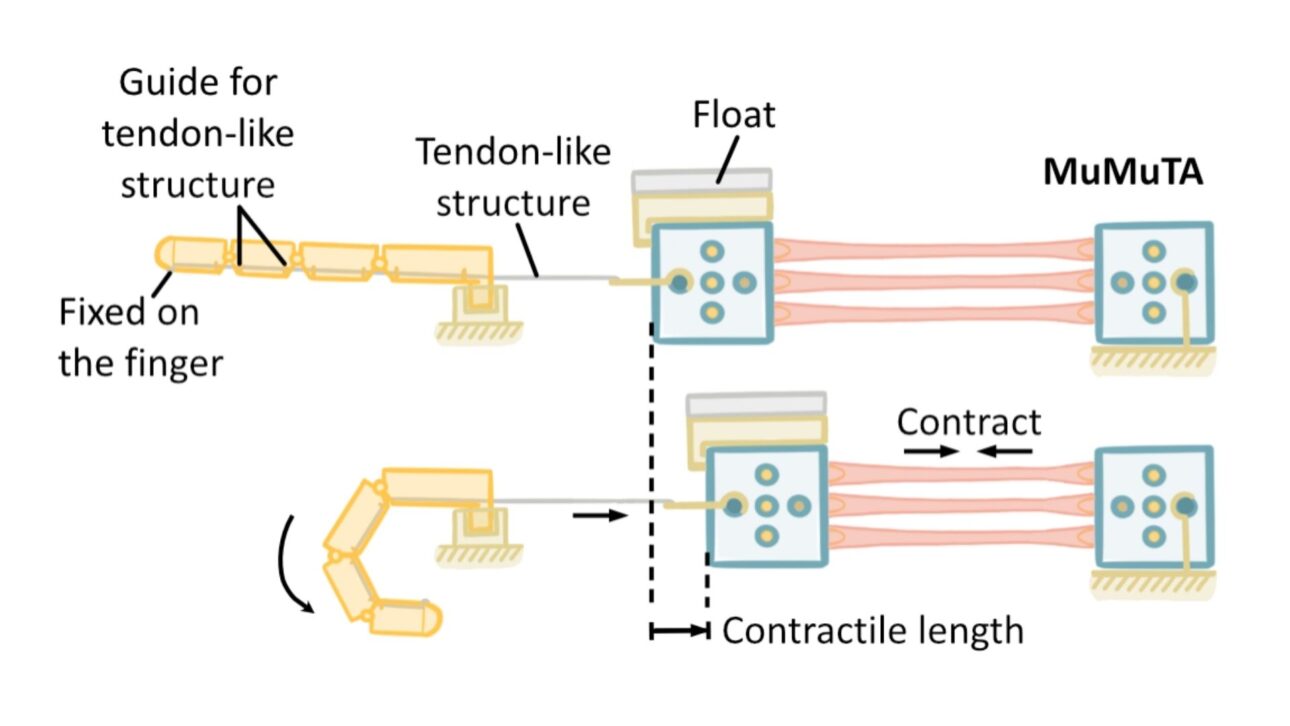
This contraction is converted into movement by cables. Each MuMuTA generates a small traction, with a force of about 8 millinewtons and shortening of approximately 4 millimeters, according to the study. A cable system transforms this pull into the flexion of the biohybrid hand fingers.
The assembly resembles the anatomy of an arm. The bundles of muscle are attached to the forearm of the structure, with a pair for each finger, functioning like the tendons that connect muscles and bones. By activating a pair, the scientist makes the corresponding finger bend.
By controlling which muscles are stimulated, one can “conduct” the hand. By activating separate fingers or in combination, researchers can produce different gestures and movements. This is how the biohybrid hand stops being a decoration and starts performing real tasks.
Varying the electric stimulus is like conducting an orchestra. By adjusting the current sent to each bundle, the scientists control the strength and timing of each contraction, coordinating the fingers. It is this fine control that allows the biohybrid hand to move from a simple spasm to a precise and useful gesture in robotics.
Scissors gesture and a pipette in hand
The demonstrations show what the prototype is capable of. According to the scientists, the biohybrid hand can make the scissors gesture, like in “rock-paper-scissors,” moving two fingers while keeping the others retracted. It’s a fine control, difficult even for traditional machines.
Besides gestures, the hand picks up objects. The device managed to manipulate items, such as holding a laboratory pipette, using the combined strength of the fingers. Grasping something gently, without crushing it, is a classic challenge in robotics, and the living tissue performed well.
These feats seem simple but hide enormous complexity. Reproducing the dexterity of the human hand is one of the greatest obstacles in engineering, and achieving this with cultivated muscle, not motors, makes the result even more impressive. Each gesture is a small scientific victory.
The human hand is a masterpiece difficult to imitate. It combines dozens of muscles and joints that work together with a precision that machines still poorly replicate. Reproducing part of this dexterity with living human muscle is what makes the feat of the scientists from Tokyo attract so much attention.
It is worth remembering that this is a research prototype. The biohybrid hand is not yet a ready-to-use prosthesis but a proof of concept. The goal of the scientists from Tokyo was to show that the path is possible, opening doors for future advancements.
Fatigue in 10 Minutes, Recovery in 1 Hour
Being made of living tissue, the hand also gets tired. One of the most interesting findings of the study is that muscle strength decreases and shows signs of fatigue after about 10 minutes of continuous electrical stimulation. Just like our body, effort takes its toll.
The good news is that this fatigue is temporary. According to the research, the human muscle of the biohybrid hand recovers in about an hour of rest, returning to contract with strength after this interval. It behaves very similarly to a real muscle after a heavy workout.
This detail is both a limitation and a proof of authenticity. On one hand, it shows that the hand cannot yet work non-stop; on the other, it confirms that the tissue behaves like real living muscle, with fatigue and recovery. It is biology functioning inside the machine.
For the scientists, understanding this fatigue is essential. Knowing how long the muscle lasts and how much rest it needs helps plan future uses and improve tissue resistance. Each piece of data brings biohybrid robotics closer to practical applications.
This cycle of effort and rest is familiar to any athlete. After many contractions, the muscle accumulates fatigue and needs a break to perform again, just like a person after lifting weights. Seeing this in a cultivated human muscle tissue shows how much it imitates real life.
Why Use Living Human Muscle
The choice of material is not random. Using cultivated human muscle, rather than from other animals, makes the model closer to our body, which is valuable for medical studies and for future prostheses made to measure for people. It is a central point of the work.
Keeping the tissue alive, however, requires special care. Since it involves real cells, the biohybrid hand needs to operate immersed in a culture liquid, which nourishes the muscle and keeps it functioning. This liquid environment also helps the muscles, which are delicate, to move the fingers with less effort.
The investment in living tissue has advantages over pure machinery. Biological muscles are soft, efficient, and capable of self-repair, something that motors and gears do not do. If robotics learns to use this material well, it can create lighter and more natural devices.
That is why the area is called biohybrid. It lies halfway between the living being and the robot, combining the best of both worlds: the precision of engineering and the softness of biology. The hand from Tokyo is one of the most advanced examples of this crossover.
One of the greatest advantages of living tissue is its ability to repair itself. Unlike a motor, which breaks and requires a new part, the human muscle can, in theory, heal small damages, as it does in the body. This self-repair capability is a long-standing dream of robotics, difficult to achieve with common materials.
There is also the question of efficiency. Muscles convert chemical energy into movement very economically, something that not every electric motor can match. For robotics, harnessing this natural efficiency of the human muscle is quite an attractive prospect in the long term.
What it’s for: prosthetics, medicine, and robotics
The possible applications excite researchers. The most evident is the development of more natural prosthetics, which could one day use the patient’s own human muscle to move similarly to a real hand. It would be a leap for those who have lost a limb.
There is also an important use in medicine and testing. A piece of human muscle that contracts in the laboratory serves to test medicines and study muscular diseases without the need for test animals, observing how the tissue reacts to different substances. It’s science with fewer animals.
In the field of robotics, the potential is equally great. Biohybrid robots, powered by muscle, could be more delicate when handling fragile objects and more energy-efficient than purely mechanical models. The biohybrid hand is a first step in this direction.
Some scientists already envision more complete biohybrid robots in the future. Arms, legs, and even entire bodies powered by muscle could gradually emerge as the technique evolves. The hand from Tokyo is, in this sense, just the first chapter of a long story to be written.
Even so, the path to real use is long. Increasing the strength, resistance, and durability of the tissue, as well as making it work outside of liquid, are challenges that scientists still need to overcome. The work from Tokyo is a promising start, not an endpoint.
What this has to do with Brazil
The Japanese advancement resonates with research that is also growing in Brazil. Brazilian universities and centers are investing in bioengineering, 3D tissue printing, and prosthetics development, areas directly linked to what the scientists from Tokyo have done with the biohybrid hand. The topic is not distant from the national reality.
In the country, research groups are already working with biofabrication and the printing of living tissues, as well as low-cost 3D prosthetics. Combining this knowledge with what the scientists from Tokyo have demonstrated could, in the long run, bring biohybrid robotics closer to the reality of Brazilian patients.
The issue of prosthetics is especially sensitive here. Brazil has thousands of people who have lost limbs and rely on prosthetics, which are often expensive or not very functional. Technologies that make these devices more natural and accessible would have a huge social impact in the country.
There is also the value of scientific education. Closely following advances such as the cultivation of human muscle inspires Brazilian students and researchers to invest in robotics, biotechnology, and tissue engineering. This is the kind of frontier that attracts young talents to science.
Finally, there is the lesson about investing in cutting-edge research. The biohybrid hand shows how bold ideas, supported by good laboratories, can generate advances that change medicine and technology. For Brazil, it is a reminder that quality basic science opens doors to the future.
And you, would you shake hands with a robot made of human muscle?
The biohybrid hand from scientists in Tokyo shows how far science has come. By wrapping living human muscle like a sushi roll, they created an 18-centimeter hand that makes a scissor gesture, holds objects like a pipette, and even gets tired and recovers like a real muscle, marking a milestone in biohybrid robotics.
And you, would you have the courage to shake hands with a robot made with cultivated human muscle? Share your thoughts in the comments about this invention and whether you believe that, in the future, prostheses powered by living tissue will also become common in Brazil.