








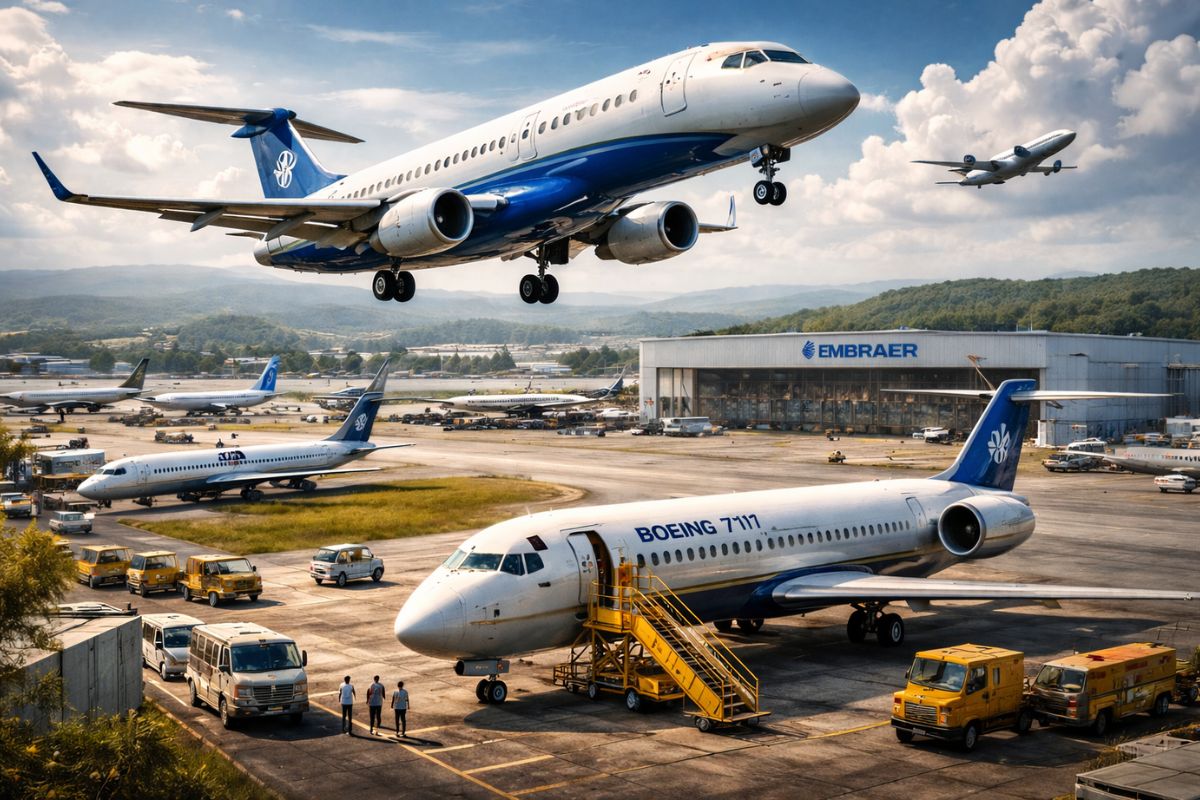
Embraer imposes efficiency with the E-Jets, reduces cost per seat and leads US airlines to abandon the Boeing 717, officially ended in 2006.
With the arrival of the E-Jets, the competition was no longer just about tradition and brand. It became about the bottom line, efficiency, and modern product, which put the Boeing 717 in a difficult position to sustain commercially until the official end of production in 2006.
Embraer established itself as a real alternative in a market historically dominated by manufacturers from the United States, and the shock was even greater when American airlines began to choose Brazilian jets for their operational economy and cabin proposal.
The scenario that opened space for the turnaround
In the early 2000s, regional aviation was experiencing an intense battle for a strategic space: short routes, high frequency, and aircraft in the range of about 100 passengers. Boeing was trying to consolidate the project that came from the MD95, rebranded as the 717, as a modern option for this segment.
-
In Somaliland’s Desert, Greenhouse Uses Sun and Seawater to Grow Lettuce, Cucumbers, and Tomatoes Without Rain: 1-Hectare Project Cools Crops, Desalinates Water, and Converts Brine into Commercial Salt

-
Trump Unveils $400 Million Boeing 747 Donated by Qatar as Temporary Air Force One Amid Boeing Delays, Sparking Debate on National Security, Costs, and Foreign Influence
-
Chinese Company Unveils Robotic Toilet That Comes to You, Featuring Lidar Sensors, Voice Command, Bidet, Hot Air Drying, UV Light, and Self-Cleaning Waste Disposal
-
Rotterdam Develops Floodable Square to Absorb Nearly 2 Million Liters of Rainwater, Doubling as Sports, Theater, and Leisure Space When Dry to Combat Urban Flooding




On the other side, Embraer was preparing a family that would change the rules of the game. It was not a “market accident”. It was a combination of industrial decision, well-positioned product, and accurate reading of what airlines really buy: efficiency per seat, reliability, and support.
The Boeing 717: strong heritage, limited commercial traction

The Boeing 717 was born from a respected lineage, a direct successor to the Douglas DC-9 and the MD-80. After the absorption of McDonnell Douglas in 1997, Boeing inherited the MD95 project, which was named 717 and entered as a bet for short-distance routes.
In the standard configuration mentioned, the model was designed for about 106 passengers and used Rolls-Royce BR715 engines. On paper, it seemed like a consistent response. In practice, commercial acceptance fell short of expectations, and by the end of production in 2006, the total delivered was 156 units, a number considered low for a program seeking scale.
The entry of the E-Jets and the perfect fit in the 717 range

The E-Jet family was introduced at the 2001 Paris Air Show and entered commercial service in 2004. The package included four variants: E170, E175, E190, and E195. The direct collision point with the Boeing 717 emerged strongly in the 100 to 118 seat range, where E190 and E195 competed for the same space.
From there, the comparison ceased to be merely technical and became an inevitable debate within companies: which aircraft delivers the best result per flight, per seat, and per operational cycle? It was in this type of spreadsheet that Embraer began to win.
Cost per seat: the factor that sealed the destiny of the 717
The central part of this story is the cost per seat per mile flown. Embraer’s E-Jets flew cheaper, and this efficiency difference went straight to the profit or loss account of the airlines.
The cited estimate indicates that the operational cost per trip of the Boeing 717 was between 15% and 20% higher than that of the E190 on equivalent routes. In an industry where margins can be tight, such a difference becomes devastating in fleet decision-making, especially when multiplied by dozens of aircraft and hundreds of flights.
Modern product, cabin experience, and design philosophy
The 717 was largely an evolution of technologies from previous decades with targeted updates. In contrast, the E-Jets were developed from scratch, using digital design tools, materials, and solutions aimed at operational modernity.
The cabin with two seats on each side of the aisle and the comfort proposal also served as a commercial argument. It wasn’t just about savings, it was an aircraft that helped sell tickets and reduce passenger resistance to “regional” flights. And, on a technical level, elements like digital avionics and system advancements reinforced the perception of a more recent generation product.
The symbolic moment in the USA and the strength of Embraer in Boeing’s “backyard”
A landmark mentioned in this journey was the choice of the E190 by an American airline in 2005 to expand secondary routes. The symbolism was significant: a company from the United States opting for a Brazilian aircraft instead of an American one based on economy and operational logic.
This type of decision, repeated by other operators, weakened the traction of the 717 and placed Embraer in a level of competitiveness that few expected to see from a manufacturer in the southern hemisphere.
Why Boeing ended the 717 in 2006
While Embraer was growing in the regional segment with a more competitive product in the range, Boeing had other priorities and bigger challenges in its portfolio, which reduced the political and commercial space to support a program with limited demand.
Without volume, the 717 did not justify aggressive campaigns, version evolution, and a long-term strategy. When production was halted in 2006, the decision was seen as a natural consequence of the market, not as a surprise.
Embraer’s trajectory beyond the 717 and what it reveals


The turnaround against the 717 did not come out of nowhere. The story involves previous decisions, such as strengthening the regional market with programs that provided scale and credibility. Embraer transformed operational success into the capacity to invest and raise the bar, targeting a more competitive and profitable seat range.
Over time, the company also expanded fronts in defense and executive aviation, building a broader ecosystem. What started as a symbolic victory against a specific jet became proof of industrial maturity, capable of sustaining support, maintenance, and global operation.
The current market and the competition that became tougher
The end of the 717 did not immediately erase aircraft. Part of the fleet continued operating for years, with gradual withdrawal. However, the segment changed. Today, Embraer no longer competes against an “aging” 717 but against modern projects that also occupy the 100 to 150 seat range, such as the Airbus A220.
This raises the stakes. Still, the logic that led to the downfall of the 717 remains valid: those who deliver better operational efficiency, support, and network fit tend to capture fleet decisions, especially in markets with tight margins and high availability demands.
In your opinion, did Embraer win against the Boeing 717 more due to cost per seat or the complete set of product and support that airlines were looking for?





Be the first to react!