Portuguese
  Spanish


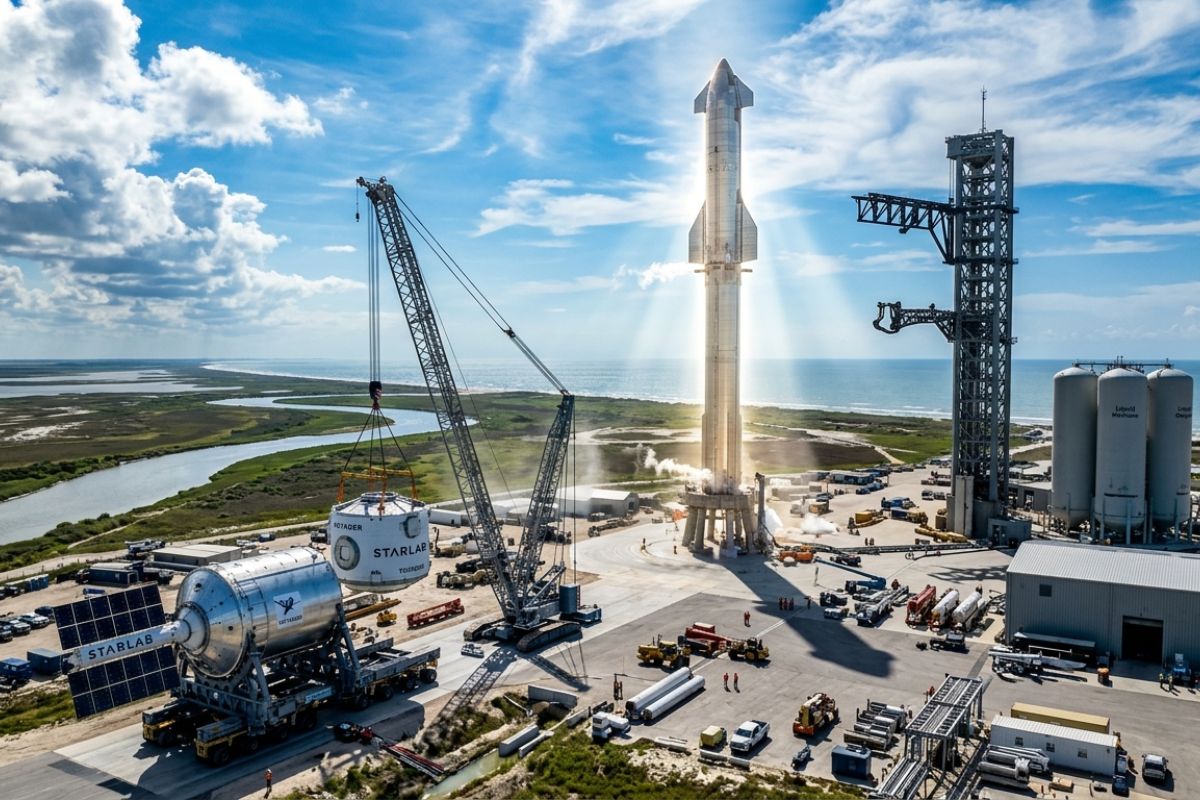

With SpaceX, Starship V3, orbital flight, Starlab and launch at the center of the discussion, $90 million contract tests the new commercial scale.
SpaceX arrives at this new moment with a clear signal to the market: Starship is starting to move from being just a promise of tests to approaching a concrete commercial role. The most relevant point is not just the $90 million value, but the fact that this number is linked to a real mission, with a large payload and strategic purpose.
At the same time, the case helps to understand why Starship V3 is being watched so closely. If the system consistently achieves orbital flight, SpaceX will compete not only on launch price but also on a new logic for much larger missions, especially those that today would require assembly in orbit, multiple flights, and a much more complex operation.
What the $90 million price really signals
For years, the discourse surrounding Starship has been dominated by very aggressive cost reduction projections. There were talks of flights below $20 million and, in even more optimistic scenarios, figures in the low millions of dollars per launch. But these estimates have always been linked to a future stage of high cadence, mass production, and full reusability, something that is still not part of the operational reality of the program.
-
China to Drill 15 Kilometers into the Earth, Set to Break Russia’s Record for Deepest Man-Made Hole

-
Researchers Use Algae to Enhance 3D-Printed Walls, Boosting Strength by 25% and Speeding Construction by 33%

-
Drill Uncovers Freshwater Rivers Hidden Beneath the Ocean Floor
-
3,000-Ton, 81-Meter Attack Submarine Begins Sea Trials, Equipped with Heavy Torpedoes and Anti-Ship Missiles


Therefore, the $90 million value carries weight. It serves as a first concrete number associated with what could be the beginning of the commercial phase of the system. It is not the idealized price of the future, but rather a value that helps anchor the discussion in the present.
In the comparison presented in the material, a new Falcon 9 costs in the range of $60 million to $70 million per launch. In other words, Starship does not yet appear as a dramatically cheaper solution for a single flight. The difference is that it targets a completely different category of mission, with another scale of payload and another market ambition.
Why Voyager bet on SpaceX so early
The most intriguing point of the agreement is precisely the timing. Voyager decided to make this commitment even with Starship still in the testing phase and without a consolidated operational history in commercial orbital missions. This shows that the decision was not just financial. There is a clear strategic bet on the unique capability that SpaceX is trying to bring into service.
The document cited in the material points to a non-cancelable launch contract worth $90 million, with a penalty of $13.5 million in case of voluntary termination. Although the text does not directly detail all the elements of the mission, the connection with Starship is treated as strongly associated with the fact that Voyager has already publicly selected SpaceX as the provider for Starlab.
This choice makes sense when observing the design of the station itself. Starlab’s proposal is to be sent into space in a single mission, without relying on orbital assembly in stages. This detail changes everything, as it reduces interfaces, eliminates part of the operational complexity, and can cut indirect costs that usually weigh heavily on space programs.
The single mission of 100 to 150 tons changes the calculation


The mass range mentioned for Starlab, between 100 and 150 tons, is central to understanding why this contract attracts so much attention. This is not about placing a conventional satellite or a medium payload into orbit. We are talking about a commercial space station with relevant dimensions and internal volume, designed to arrive almost ready in space.
If the final mass is close to 150 tons, the calculation presented in the material points to something around US$ 600 per kg. This number is the real heart of the discussion, as it shifts the comparison from the gross price per launch to the economic efficiency in very high mass missions.
This is precisely where SpaceX tries to break the historical pattern of the industry. Instead of just selling a launch, the company begins to offer the possibility of placing entire structures into orbit at once, something that can generate additional savings of hundreds of millions of dollars by avoiding multiple campaigns, orbital fits, and assembly operations.
The Starship V3 still carries risk, but the market may accept that
None of this eliminates technical risk. The material itself acknowledges that the Starship remains a prototype and that the project still faces criticism for not having reached orbit after years of development. This point remains valid and weighs in the analysis of any contract closed before the system’s full maturity.
Still, the market reading seems to be different. For some companies, accepting risk now may be the way to ensure early access to a capability that simply does not exist in another launcher. In the case of Starlab, this capability is decisive, as the mission concept depends on volume and payload that go beyond the reach of more traditional solutions.
There is also an important detail in the cost reading. The value of US$ 90 million may reflect an initial scenario where part of the system is still not operating in the most efficient way possible. In other words, the current price does not need to represent the long-term operational floor. If SpaceX can increase cadence, reliability, and reusability, the trend is that the actual cost per mission will decrease over time.
Why this contract matters beyond Starlab
The impact of this agreement goes beyond the space station itself. It serves as a test of market confidence in the Starship as a commercial platform. When a concrete contractual price emerges for a mission of this scale, the project ceases to be just a technological showcase and begins to be measured as a product.
This also helps explain why the orbital flight of Starship V3 carries both symbolic and practical weight. A success at this stage would not just be another milestone in development. It would be a direct message that SpaceX is approaching the moment when it can turn theoretical capacity into recurring revenue with truly massive payloads.
At its core, the debate is not just about a $90 million launch. It’s about opening a new market segment. If SpaceX can prove it can launch between 100 and 150 tons in a single mission regularly, the space sector enters another level of scale. And when the scale changes, the cost per kilogram, per mission, and per project also changes.
In your view, does this $90 million price put SpaceX at a real advantage, or is it still too early to say that Starship has changed the game for good?