Portuguese
  Spanish



After Facing Financial Difficulties Between 2015 and 2017, Rystad Energy Analyzed Over 50 Offshore Oil Companies and Found That There Will Be Demand for Services of US$ 442 Billion by 2025
Rystad Energy analyzed the oilfield services offshore industry sectors with the highest percentage variation in employment and found that the main driver of employment is shifting from shale to offshore.
The increase in activity in onshore shale basins like the Permian in the U.S. kept employment in the oilfield services industry stable from 2016 to 2017. However, the offshore industry has now taken the lead, gradually increasing the total number of employees at the 50 largest oilfield services companies in the world between 2017 and 2018.
-
Lenovo Unveils Legion Y700 Tablet with RGB Backlighting, 5G, and SIM Card Support
-
Lenovo Unveils Legion Y700 Tablet with RGB Backlighting, 5G, and SIM Card Support
-
Northern Brazilian City Prepares Task Force to Mitigate El Niño Impacts with Stockpiled Fish, Drone Monitoring, Firefighting, and Water Supply Reinforcement in Remote Areas

-
Brazil to Issue “Panda Bonds” in China, Aiming to Raise Up to 5 Billion Yuan at Lower Interest Rates Than Dollar Debt

“This is a clear effect of increased offshore sanctioning. We expect offshore commitments to nearly double from 2018 to 2020 and maintain high levels of spending over the next five years,” says Matthew Fitzsimmons, Vice President of Rystad Energy’s Oilfield Services team.
Rystad Energy forecasts that the demand for offshore services will reach US$ 442 billion by 2025, a 45% increase from 2018.
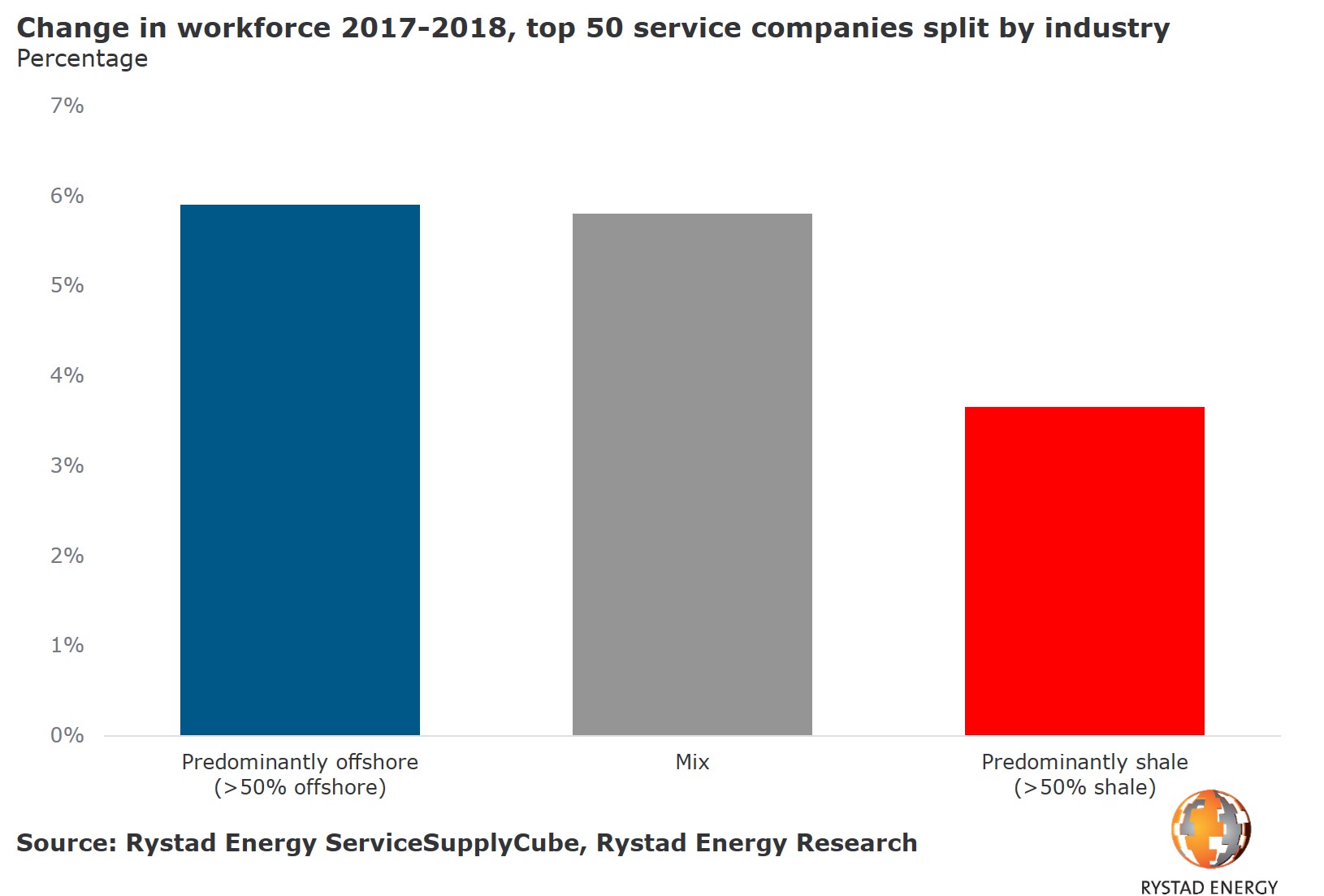
Companies in the offshore industry struggled with harsh financial realities and scaled down their operations in 2015-2017, resulting in a 31% decline in the accumulated workforce.
The tides are turning now as the offshore market gains momentum. Four of the five leading oilfield services companies with the largest workforce from 2017 to 2018 secured numerous contracts and gained notoriety.
Among the smaller players with a strong focus on offshore segments, the Norwegian shipping company Solstad nearly doubled its workforce from 2017 to 2018 – a significant increase in personnel betting on the long-term improvement of market conditions. In Brazil, it has contracts with Equinor and Queiroz Galvão; check here for the scope of services.
Similarly, the drilling contractor Seadrill saw employment grow by 15%. The company has recently secured contracts with Saudi Aramco and Equinor. However, the number of employees at the end of 2018 is only 100 more than after mass layoffs in 2016, and remains just over half of what it was in 2014. Moreover, it still has several open recruitment processes in Brazil; apply by accessing the complete article.
“We expect Seadrill’s hiring to continue until 2022, as the markets to which the company is exposed will continue to grow, offering hiring opportunities,” added Fitzsimmons.
When Seadrill resumes hiring, they will face the same hiring challenges that many offshore companies are dealing with today.
“Our informal interviews with leaders of OFS companies across the offshore industry echoed a common challenge: how to bring experienced personnel back into the industry amid current growth and how to attract new talent. History would show that to bring experienced professionals into an industry, higher wages will be necessary,” noted Fitzsimmons.