Portuguese
  Spanish


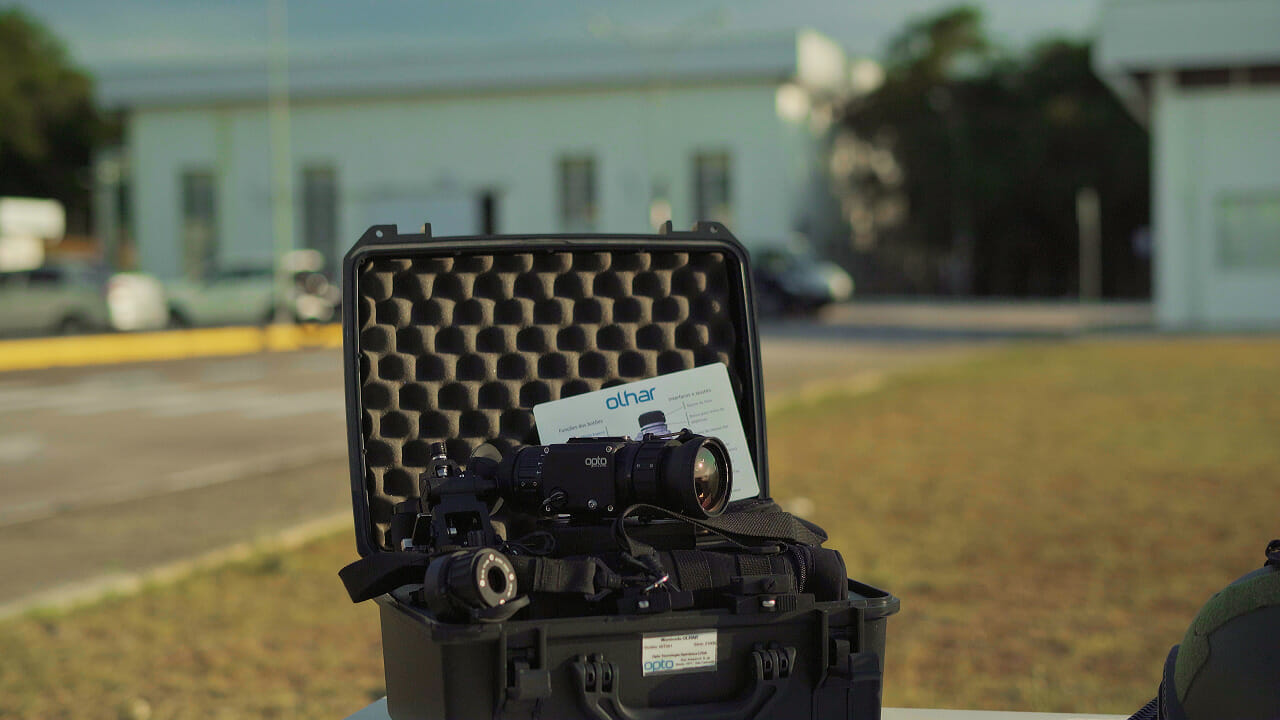

The Brazilian Army Has Just Received a New Fully National Military Technology. It Is a New Thermal Device Capable of Being Attached to Helmets, Rifles, and Machine Guns.
The Brazilian Army has received the delivery of the pilot batch of the OLHAR Thermal Image Monocular, thus marking a milestone for the country’s Defense and Security industrial base. Manufactured by OPTO Space & Defense, a company of the AKAER Group, with technology that is entirely Brazilian, the equipment delivers the most advanced in microelectronics, optics, and precision mechanics to meet the rigorous operational and technical requirements of the Brazilian Combat System (COBRA).
Third Phase of the Military Technology Initiative Is Concluded
The OLHAR is responsible for capturing the thermal emission of bodies and can be used to locate people, animals, and warm objects even under adverse conditions of low light, dust, smoke, and fog, as well as camouflage elements.
Due to its smaller dimensions, the device delivered to the Brazilian army can be operated manually or attached to helmets, machine guns, and rifles. The new military technology also features the possibility of lens exchange for high-precision shots.
-
16-Year-Old from Brazil’s Sertão Wins Young Scientist Award for AI Predicting Rainfall with 94.5% Accuracy to Aid Farmers

-
Netherlands Reports First Child Euthanasia Case Since Rule Expansion for Minors

-
Brazilian Innovator Survives Homemade Submarine Dive in Paraty Despite Hatch Leak and False Oxygen Alarm
-
China Develops Custom 140-Ton Electric Mining Truck with 770 kWh Swappable Battery, Deploys 290 Units in Xinjiang’s Largest Zinc Mine





According to the Brazilian Army in an official statement, the production of the pilot batch of the OLHAR Monocular is an essential milestone in the advancement of thermal imaging equipment in Brazil, showing that both the national industry and the Army Science, Technology, and Innovation System (SCTIEx) has full capacity to provide the Ground Force with Military Employment Systems and Materials of excellent quality.
According to the CEO of the AKAER Group, Cesar Silva, the new military technology allows for image adjustment for optimization according to the characteristics of each location, providing the Brazilian Army with the best visibility conditions in operation. The executive emphasizes that for the company, it is a source of pride to lead such a large project.
Project Has Been Under Development Since 2019
In July of this year, military personnel from the Army Technological Center (CTEx) received the pilot batch of 21 units of the monocular, completing the third phase of the project, which began in 2019. The previous two stages encompassed prototyping and evaluation of the prototypes.
According to the Brazilian Army, the testing phase showed that the equipment achieves detection, recognition, and identification distances compatible with the best thermal monoculars on the market. The fourth and last phase, which is already underway, consists of evaluating the pilot batch.
The OLHAR is part of the second generation of monoculars developed by the AKAER Group with entirely national technology. This is an evolution of the OLHAR VND-X1, which began construction in 2007 for a development project at CTEx and received funding from the Agency for Innovation, Science, and Technology (FINEP).
In 2019, the equipment evolved to the current version with improvements in various functionalities, making it lighter, smaller, and with improved resolution, along with other innovations.
Understand How Thermal Imaging Works
Infrared waves have very common uses, including remote controls, heat lamps, and Earth imaging. They are also commonly used by hunters as well as by military and police forces.
It is important to highlight that thermal imaging cannot see people through walls. It can only detect things in its line of sight that emit heat. It also cannot be used to determine if a suspect is carrying weapons somewhere on their body.
It can be used to see people in the dark and detect other heat sources well. A thermal imaging camera has a unique lens that allows infrared energy to pass through it. Then, the focused light reaches a sensor that scans the information and draws it in several thousand points in the field of view.