Portuguese
  Spanish


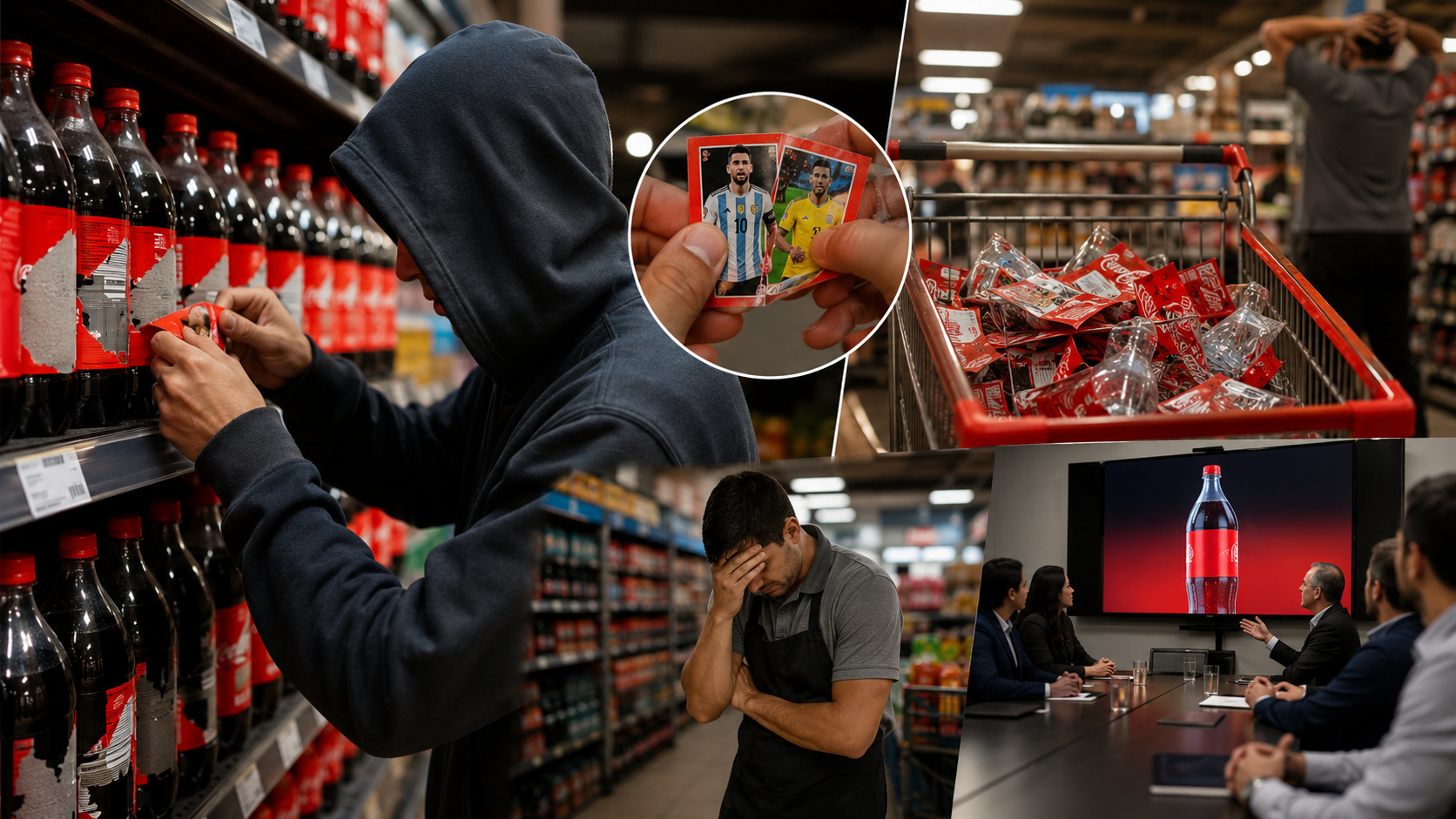

Coca-Cola promotion with 2026 World Cup stickers caused label thefts in supermarkets, retail loss, and company reaction in Brazil.
On June 10, 2026, the case gained national attention after a Coca-Cola promotion linked to the FIFA World Cup 2026 album began causing label thefts in supermarkets and wholesalers. According to iG Economia, consumers started removing labels from bottles still on the shelves to get the promotional stickers without buying the product, which caused losses for retailers and forced chains to change the display of the packages.
The mechanics of the action help explain the rush. According to the official page of Coca-Cola Brazil, the physical stickers were under the label of participating bottles of Coca-Cola Original and Coca-Cola Zero in sizes 600 ml and 2.5 liters, with one exclusive sticker per product. When the label was torn off inside the store, the bottle was left without complete identification and, in practice, lost commercial value.
Coca-Cola promotion placed exclusive stickers inside the label
The promotional action was structured to leverage the power of collecting in a World Cup year. According to Coca-Cola Brazil, the consumer needed to buy a product with a special Panini label and, inside this label, they would find an exclusive sticker to highlight and paste on the brand’s special page in the 2026 World Cup album.
-
McDonald’s Ice Cream Machines Often Break Due to a Single U.S. Manufacturer, Error Codes, and a Lucrative Repair Model

-
WD-40’s Secret Formula: How a $620 Million Business Thrives Without a Patent
-
Lonely? This Chinese humanoid robot with soft skin and AI offers 24/7 conversation and stress detection.

-
Advanced Crash Test Dummies with Fake Bones and Organs Can Cost Up to $1 Million, Mostly Produced by U.S. Firm Humanetics


The participating products were limited to specific packages, which increased the demand precisely for the promotional bottles on the shelves. This turned the label into a sought-after item in itself, even before the drink was actually purchased.
In practice, the campaign created a strong purchase incentive but also opened up space for a difficult-to-control side effect in physical retail: consumers trying to access the gift directly in the store, without going through the checkout.
Consumers began tearing off labels and left bottles without sale value
According to iG Economia, many consumers began removing the labels from exposed packages to check or remove the stickers. The problem is that the barcode was on the label itself, which prevented the normal sale of the soda after the violation.
As a result, supermarkets began to deal with damaged products, disposal of goods, and the need to record losses item by item. The loss stopped being occasional and became an operational headache in different retail chains.
The case drew attention precisely because it showed how a promotion with great popular appeal can quickly turn into a logistical problem when the promotional item is physically incorporated into the packaging.
Retail reinforced security and changed the display of promotional bottles
According to the report by iG Economy, some chains started to reinforce security in stores and change the way products are displayed to prevent thefts. There were cases where promotional bottles were moved to areas near the cash registers or to points with higher employee circulation.

Other attempts included securing the labels with adhesive tape, although the measure was described as ineffective given the volume of products and the repetition of the problem. There were also chains that stopped sending promotional items to certain units in an attempt to reduce losses.
This movement shows that the impact was not limited to Coca-Cola. Retail had to reorganize display, control, and replenishment to deal with a campaign that, although successful in attracting attention, increased the risk of damage directly at the point of sale.
Coca-Cola began reimbursing retailers for damaged products
According to iG Economy, the company began to reimburse retailers for damaged products after the wave of irregular label removal. In a large supermarket chain, items without labels were removed from the shelves and the manufacturer provided reimbursement. In a wholesale chain, the agreement included returning the products and sending new batches for replenishment.
The report itself highlights that the loss was not only in the missed sale. The chains also needed to separate the violated products, record the occurrence, and organize the exchange or reimbursement, which increased the operational cost of the campaign.
In a note mentioned by the outlet, Coca-Cola stated that removing the labels without purchasing the product contradicts the promotion rules and said that the points of sale have the autonomy to adopt the measures they deem necessary to address the situation.
Case exposed the risk of promotions based on physical gifts hidden in the packaging
The episode became a clear example of how promotional campaigns can create distortions when the prize or collectible item is physically embedded in the product packaging. On paper, the idea increases engagement and boosts purchases. In practice, it can also encourage attempts to access the giveaway irregularly within the store itself.
Since Coca-Cola linked the sticker to the inside of the label, the promotional value of the packaging ended up becoming, for part of the audience, greater than the commercial value of the soda itself. This helps to understand why the action gained so much traction and, at the same time, so much vulnerability in retail.
More than a curious case, the episode reveals a sensitive point of promotional marketing in physical environments: when the item of desire is visible, accessible, and incorporated into the packaging, the campaign operation can quickly get out of control.