Portuguese
  Spanish


The American company that dominates the manufacturing of crash test dummies on the planet makes extremely expensive dolls full of sensors that have helped save thousands of lives by making cars much safer
That dummy that appears in crash test videos, hitting its head on the steering wheel in slow motion, is much more sophisticated than it seems. A top-of-the-line crash test dummy can cost up to 1 million dollars, has an artificial skeleton and organs, and carries more than 100 sensors. And almost all used worldwide come from a single American company.
Its name is Humanetics, and this company has become a central piece of global automotive safety. Each dummy is practically a fake human being, designed to suffer in place of a real person and record each impact with scientific precision. Without these dummies, the cars we drive would be much more dangerous than they are today.
Why a crash test dummy costs a fortune
The price shocks those who imagine a simple store mannequin. But this mannequin is a highly precise engineering instrument, made to replicate how the human body behaves in a crash. According to BGR, a side dummy from the American manufacturer costs about 400 thousand dollars, and the THOR model, made to feel forces coming from all directions, can cost up to 1 million dollars.
-
Lonely? This Chinese humanoid robot with soft skin and AI offers 24/7 conversation and stress detection.

-
In a Los Angeles workshop in 1935, a man invented the peel-off label, laying the foundation for the world’s largest label manufacturer, now generating $8.8 billion and embedding chips in clothing.

-
Amazon Fish Mimics Floating Leaf to Evade Predators and Catch Prey Effortlessly
-
A Tiny Belgian Village Factory Produces Nearly 80% of the World’s Billiard Balls Using a Secret Resin for Decades-Long Durability




This value is justified by the complexity. The dummy needs to bend, crush, and react similarly to real flesh, bone, and joints, otherwise the test data loses its meaning. Each mannequin is hand-assembled, calibrated, and filled with electronics capable of measuring forces a body would experience in a collision. It’s applied science disguised as a dummy.
Bones, organs, and more than 100 sensors inside the body
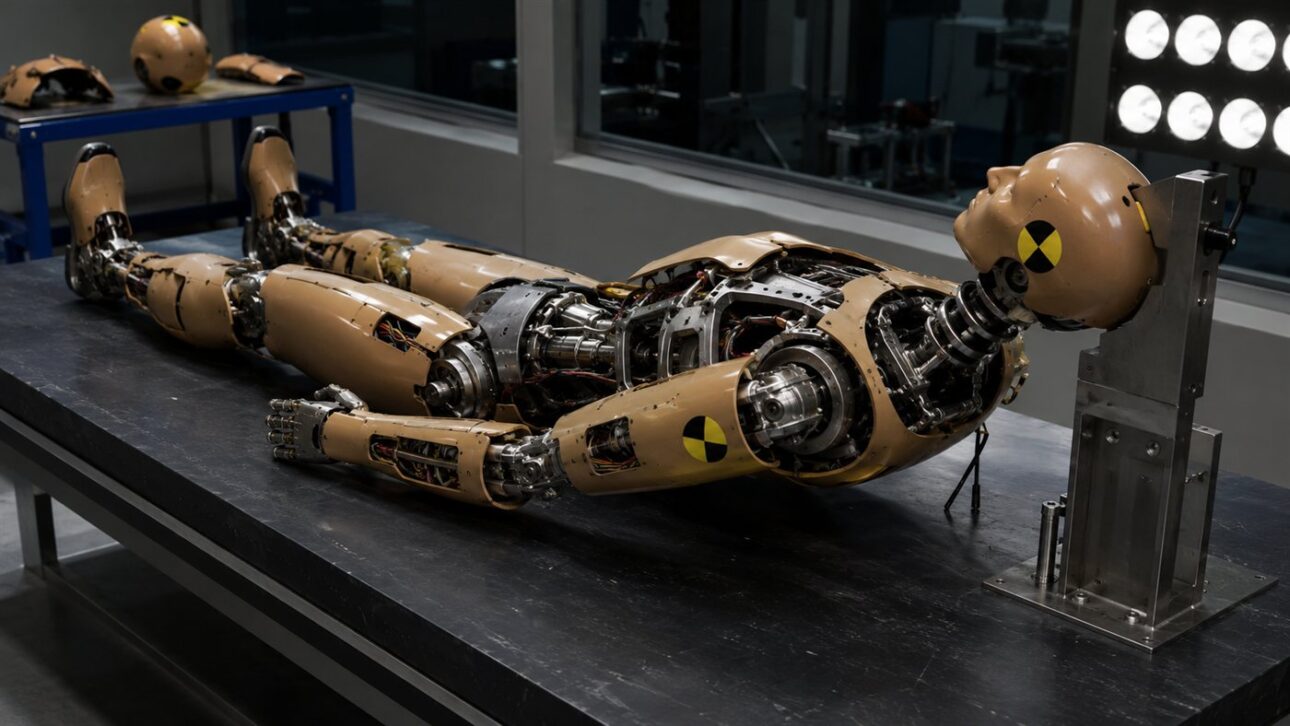
Inside, the dummy is an impressive work. It has a structure that mimics the skeleton, parts that simulate organs, and joints that move like human ones, all to respond to impact realistically. It is not a rigid mannequin, but rather a functional replica of the body.
The most important are the sensors. According to BGR, the most advanced models carry more than 100 sensors spread throughout the body, measuring forces in the head, neck, chest, pelvis, and legs. Each impact generates a mountain of numbers that engineers use to discover where the car injures and how to protect it better. The dummy not only takes the hit: it details everything that happened.
A company that dominates the world’s mannequins
The company has become practically synonymous with crash testing. Over the years, it has acquired competitors and concentrated a large part of the global production of these dummies. According to Humanetics, in 1999 it purchased the dummy business from TNO Automotive, then the largest and leading dummy company in Europe, creating the first truly global dummy manufacturer.
This dominance gives the company a discreet but enormous role in the automotive industry. When a car manufacturer wants to prove that a car is safe, it almost always crashes the vehicle against a dummy of this same origin, following standards that the company helped shape. BGR describes it as the world’s most prominent supplier of high-quality test dummies. It’s another case of a hidden giant behind something everyone knows by sight.
From airplane seat to car: Sierra Sam, 1949
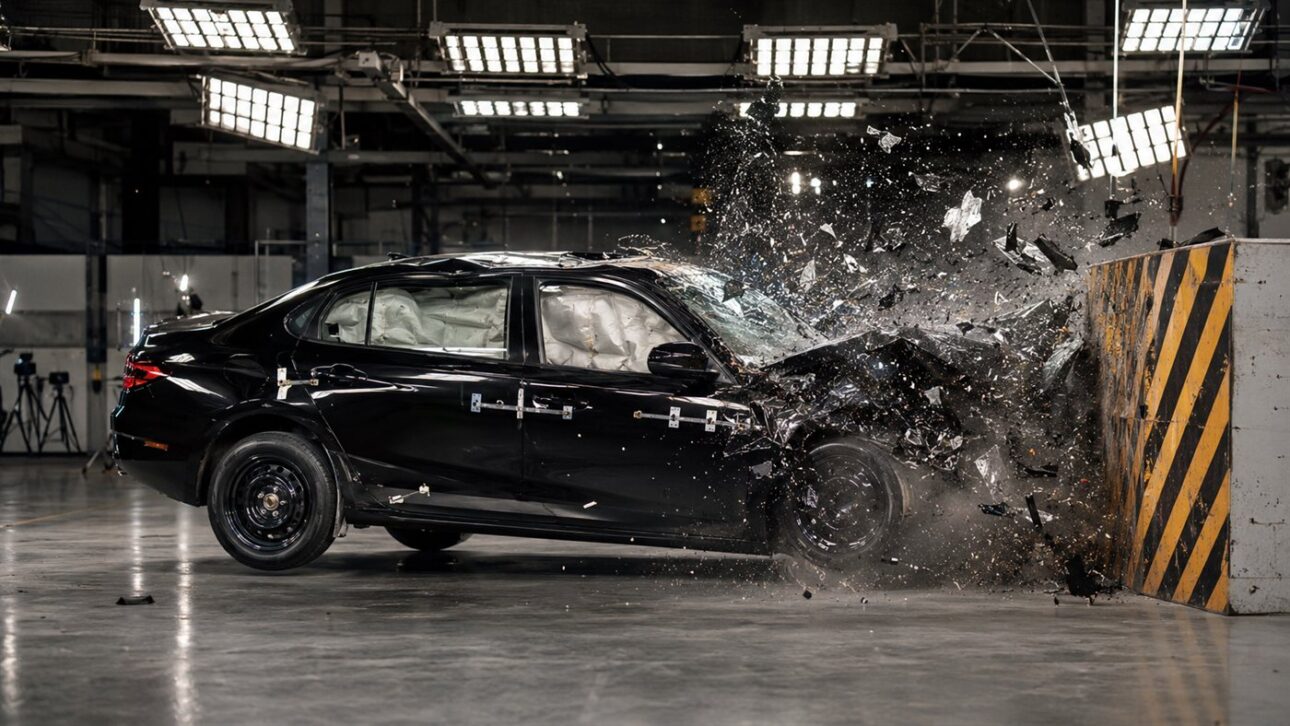
The history of dummies began far from the roads. According to Humanetics, the first test dummy, called Sierra Sam, was created in 1949 to test airplane ejection seats, aviation helmets, and pilot belts, situations where the human body experiences extreme forces. Only later did the idea migrate to the automotive industry.
Before dummies, impact tests used to involve cadavers and volunteers, which was limited and problematic. The dummy solved this by offering a standardized, repeatable body full of sensors, which can crash a thousand times without complaining. This standardization is what allowed for comparing results and turning vehicle safety into serious science, rather than trial and error.
Dummies for men, women, children, and the elderly
A little-known detail is that there is not a single dummy. There is a growing family of mannequins representing different body types: men, women, children of various ages, the elderly, and even obese people, because each body reacts differently in a collision.
This is very important for everyone’s safety. For decades, tests were mainly conducted with dummies that mimicked an average man, leaving women and children relatively less protected, something the industry is working to correct. Creating diverse mannequins acknowledges that a car needs to protect people of all sizes and ages, not just a standard.
How mannequins helped save thousands of lives
The impact of these dummies in real life is enormous. Thanks to the data they provide, cars have gained better seat belts, airbags, collapsible steering columns, and impact-absorbing structures. Each of these advancements came from thousands of simulated collisions with mannequins.
The safety improvements born from these tests have gone on to protect a huge number of people on the roads. Each dummy destroyed in a laboratory represents real accidents where someone survived because of what was learned there. It’s a silent exchange: the mannequin takes the hit so that the person doesn’t, and this logic has already saved multitudes on the world’s roads.
From physical dummy to virtual dummy
Technology is now advancing into the digital world. In addition to physical mannequins, engineers use virtual dummies, computer models that simulate the human body in collisions without needing to destroy an expensive dummy with each test. This reduces costs and speeds up research.
Even so, the physical dummy remains indispensable for validating real tests. The virtual suggests, but the real dummy confirms, actually crashing against the car. The combination of digital simulation and physical testing is making vehicles even safer, and the company that dominates the mannequins is also heavily investing in this virtual frontier.
Why a fake dummy matters so much
In the end, the story of crash test mannequins shows how the safety we take for granted was achieved at the cost of thousands of destroyed dummies. Every airbag, every seat belt, every life-saving structure went through an expensive mannequin full of sensors.
It is an unlikely hero, made of plastic, metal, and electronics, that takes the hit to protect us. Next time you get into a car and buckle your seatbelt, it’s worth remembering the dummies that made it safe. Did you imagine that a simple mannequin could cost up to 1 million dollars and help save so many people?