Portuguese
  Spanish


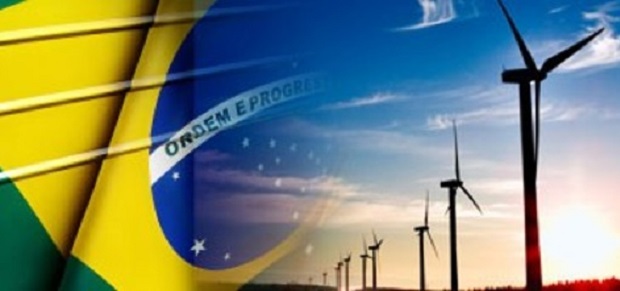

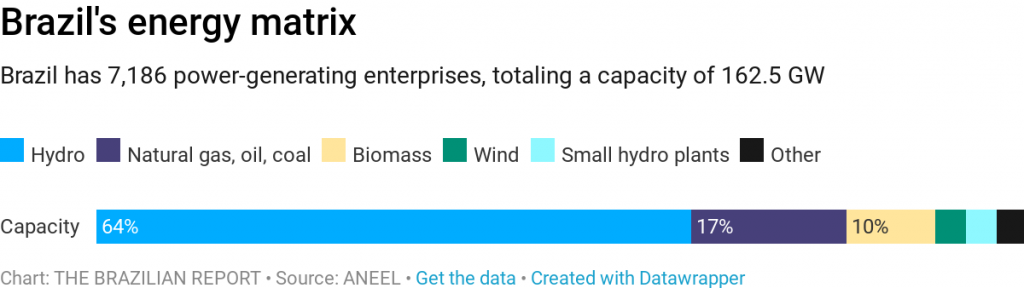
The potential of Brazil to generate wind energy is estimated at 500 gigawatts (GW), according to the Brazilian Wind Energy Association (ABEEólica), enough to meet the country’s energy demand three times over. This figure is also three times higher than the current electricity generation in the country, including all available sources such as hydropower, biomass, natural gas, oil, coal, and nuclear energy. In December 2018, the total installed generation capacity was 162.5 GW, according to the National Electric Energy Agency (Aneel). Of this total, wind energy represents 14.2 GW, equivalent to the installed capacity of the enormous Itaipu hydroelectric plant and enough to supply 22 million households. Energy generated from wind ranks fourth in Brazil’s energy matrix.
The 500 GW wind potential represents only land-based generation, carried out by wind turbines that meet current standards – ranging from 2 to 3 megawatts (MW) on 150-meter-high towers. Wind turbines are used to convert wind energy into electricity. The industry has embarked on efforts to increase the power of wind turbines to about 5 MW. With turbines twice as powerful, it would be possible to double the energy generated in a similar space and reduce operational costs. “Technical advancements can significantly expand the country’s wind potential,” says ABEEólica.
-
8-Year-Old Finds 900-Year-Old Viking Bronze Buckle on Swedish Beach While Fossil Hunting
-
China Tests Giant 582-Ton Magnets to Contain Plasma Hotter Than the Sun’s Core, Aiming to Cut Superconductor Costs and Generate First Electricity from “Artificial Sun” by 2030
-
Lenovo Unveils Legion Y700 Tablet with RGB Backlighting, 5G, and SIM Card Support
-
Lenovo Unveils Legion Y700 Tablet with RGB Backlighting, 5G, and SIM Card Support
Multinational GE announced that it will sell its new 4.8 MW turbine in Brazil, launched worldwide in 2017. The machine has a rotor diameter of 158 m, with three blades, each 77 m long. The total height of the turbine – the tower plus one of the blades pointing upward – can reach up to 240 m, the length of two football fields plus an extra 30 m.
The combination of a larger rotor and taller towers allows the turbine to utilize stronger winds and produce more energy – about 90% more than GE’s previous 2.5 MW turbine model. A 4.8 MW turbine could meet the consumption of 7,500 households.
The new turbine will be manufactured at GE’s factory in the Camaçari Industrial Hub in Bahia, and the blades will be made at its subsidiary LM Wind Power, in Ipojuca, Pernambuco. The blades will be made of carbon fiber, a material that is stronger and lighter than traditional fiberglass. The technological development was carried out in the United States, while Brazil was involved in providing data on wind characteristics, logistical constraints, and machinery availability (such as cranes) to adapt manufacturing to Brazilian operating conditions.
In October, Danish manufacturer Vestas announced that it would produce 4.2 MW wind turbines in Ceará. The company is evaluating whether to revitalize its facilities in Aquiraz, where it manufactures 2 MW turbines, or look for another location in other parts of the state. Investments in the project totaled 23 million euros (about 100 million reais) and are expected to create 200 jobs.
Cheaper Energy
A report from the International Renewable Energy Agency (Irena) states that the levelized cost of energy (LCOE) of wind energy dropped 22% between 2010 and 2017 – it is now at US $ 0.06 per kWh. The LCOE takes into account all expected costs over the life of a power plant, divided by the electricity generated (in kWh) over the period. The price of turbines, which accounts for about 70% of the investment, has been reduced by 40%.
The Global Wind Energy Council, a forum representing the sector nationally, reports that in 2017, an additional 52 GW were added to the world’s wind energy generation capacity, raising the total to 539 GW. For 2022, the estimate is that this number will reach 840 GW. Brazil is the eighth largest wind energy producer in the world and represents 2% of global production. The country has 568 wind farms with over 7,000 turbines in operation, according to ABEEólica data from 2017. The increase in generation already projected is expected to lead to an installed capacity of 17.6 GW by 2022.
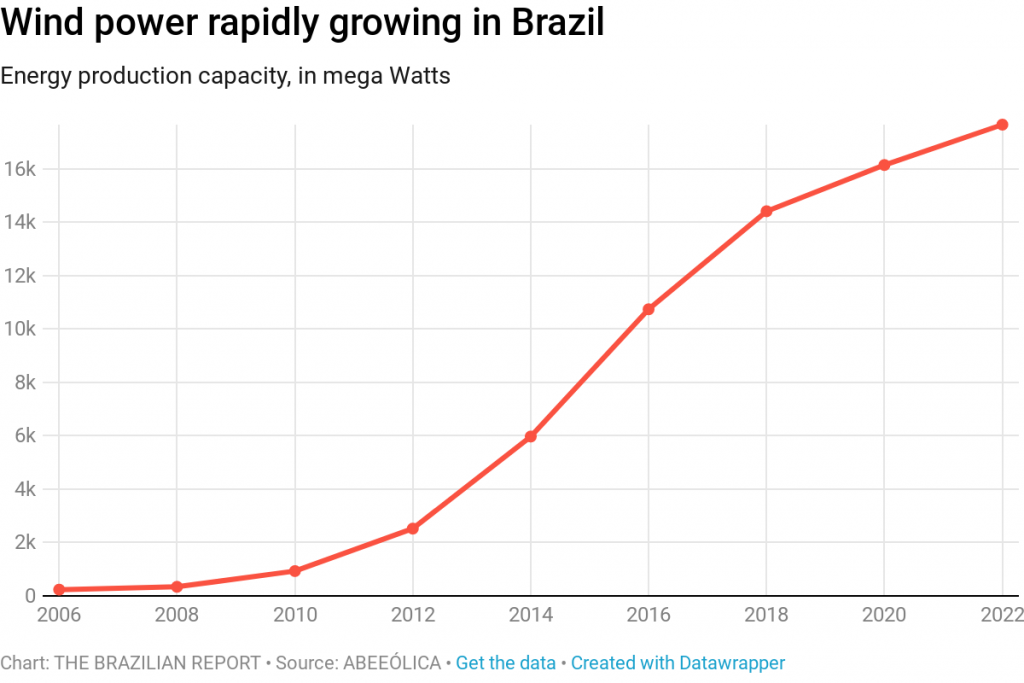
ABEEólica estimates that wind energy will be the most popular energy source in auctions held by Aneel in the coming years. This is due to the fact that wind energy has proven to be quite competitive in Brazil, with a cost of around R $ 90 per MWh, unlike hydropower, which, in the last auction in April, cost R $ 198 per MWh.
A new frontier could come from the sea. The National Institute for Space Research (Inpe) estimated – based on a 2011 study – that the wind potential off Brazil’s coast is 606 GW, with 57 GW located in a region up to 10 kilometers from the shore. However, ABEEólica is not planning to expand offshore in the short term, due to the cost of investment, which is approximately five times more expensive than onshore. Nevertheless, in August 2017, Petrobras announced the development of a project to install Brazil’s first offshore wind farm off the coast of Guamaré (RN). The hope is for it to start operating in 2022.
Driven by Need
Brazil began to pay attention to the potential of wind energy in 2001, in the wake of the energy crisis known as the “blackout.” The country needed to diversify its energy matrix (which at the time was almost exclusively based on hydropower, which struggled due to low rainfall), and wind energy was an alternative that could be quickly implemented. That year, the Emergency Wind Energy Program (Proeólica) was created, aiming to auction 1,050 MW in wind energy projects by the end of 2003. However, the initiative was not successful.
In 2002, the government launched the Alternative Electric Energy Sources Incentive Program, aimed at fostering a national wind energy industry, but local production was still incipient and costly. Moreover, wind energy was not competitive in the auctions under the new energy commercialization system adopted by Aneel in 2004.
It was only from 2009, with the first exclusive wind energy auction, that the sector began to gain momentum. At that time, 1.8 GW were sold. The following year, wind energy started to compete for contracts in renewable energy auctions and, in 2011, in general energy auctions. The sector’s growth was also a result of support from the National Bank for Economic and Social Development (BNDES), which in 2012 began to support the machinery industry.
Today, Brazil has six wind turbine manufacturers that together have the capacity to produce 1,500 units per year, enough to generate 3.5 GW. For wind turbine blades, 7,000 can be made each year. In total, more than 70 companies form the production chain of the sector, and the level of nationalization is 80%.