Portuguese
  Spanish


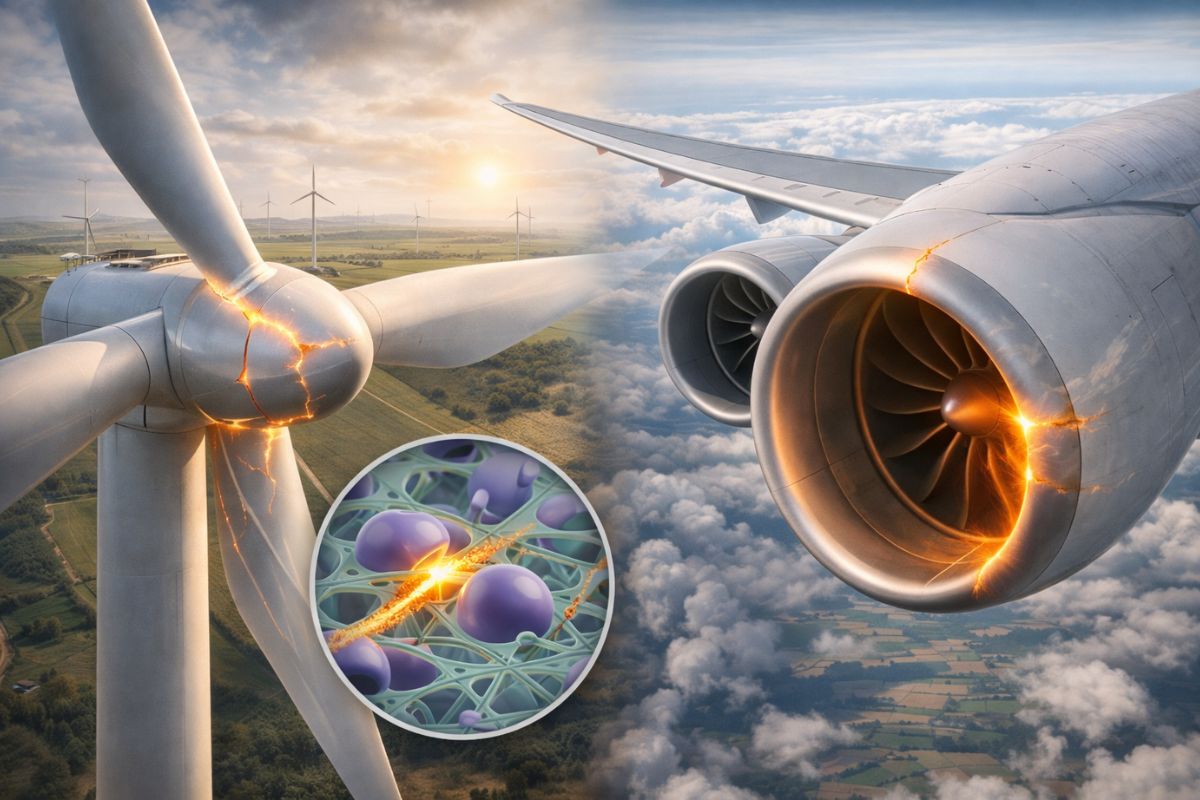

Composite developed at NC State resists 1,000 fracture and repair cycles in 40 days. Estimate is 125 to 500 years of useful life. Technology could change wind turbines, airplanes, and electric cars.
Wind turbine blades, airplane fuselages, and structural components of automobiles share a problem that engineering has been trying to solve since the 1930s: fiber-reinforced polymers, known by the acronym FRP, crack from within. The layers of carbon or glass fiber that make up these materials begin to separate from the resin that holds them together, a process called delamination. As the separation progresses, the part loses structural integrity and needs to be replaced. The typical lifespan of these components ranges from 15 to 40 years.
A study published in the Proceedings of the National Academy of Sciences by researchers from North Carolina State University and the University of Houston demonstrated that it is possible to repair this type of damage internally, in an automated way, more than a thousand consecutive times. The authors estimate that components made with this material could last 125 years with quarterly maintenance or up to 500 years with annual repairs.
How does the self-repair mechanism work?

The material developed by the team resembles a conventional FRP composite but carries two internal modifications that completely change its behavior in the face of damage.
-
She spent 73 years breathing inside an iron lung, survived the aftereffects of polio, and became the last woman in the United States dependent on the equipment before dying at 78 years old.

-
Brazilian students created a $1 filter using pine bark, cotton, and 3D-printed parts to clean cassava wastewater, reduce the toxicity of a hazardous waste, and transform contaminated water into biofertilizer.

-
Astronaut from Artemis II steps down after mission to the Moon and decision surprises after a record of 406,771 km, a historic 10-day journey, and an unprecedented achievement for Canada.

-
A fossil kept for years in a small museum in Montreal concealed 450-million-year-old soft tissue, a discovery that has only happened once before in history.


The first is an intermediate layer of thermoplastic healing agent, 3D printed directly onto the fiber reinforcement. This layer acts as a kind of integrated structural adhesive that, by itself, already makes the material two to four times more resistant to delamination than a standard composite. This means that, even before any repair is triggered, the material already withstands more than its conventional counterparts.
The second modification is a thermal heating layer embedded in the structure. When a crack is detected, the system applies localized heat that melts the thermoplastic agent. The liquefied material fills the crack, penetrates between the separated layers, and, upon cooling, solidifies again, restoring the integrity of the part. The entire process occurs without direct human intervention and without the need to disassemble the component.
What did the tests show?

To evaluate long-term performance, the team designed an automated testing system. A tensile force was repeatedly applied to the composite until it caused a delamination of 50 millimeters. Then, the heating mechanism was activated to repair the crack. The fracture and repair cycle was repeated a thousand times over 40 continuous days.
In the first 500 cycles, the repaired material showed fracture resistance superior to that of conventional composites that had never been damaged. Interlaminar toughness decreases with repetitions, but slowly enough for statistical modeling to project centuries of functional lifespan.
Jack Turicek, the lead author of the study and a PhD student at NC State, explained that the most resilient starting point is what enables longevity. Even after hundreds of repairs, the repaired material still outperforms a new composite without self-healing technology. Jason Patrick, a professor at NC State and corresponding author, described delamination as the main challenge for composites since the 1930s and stated that this technology could be the ultimate solution.
Why does it matter for wind turbines, airplanes, and cars?


The most immediate impact is on wind energy. Turbine blades are made from FRP composites and have a projected lifespan of 20 to 25 years. When they reach the end of their life, they need to be dismantled, transported, and disposed of. Since the thermosetting resins that make up most current blades cannot be easily recycled, they often end up in landfills. The International Renewable Energy Agency estimates that by 2050, the world will have to deal with 43 million tons of wind turbine blade waste.
A material that repairs itself internally and lasts for centuries would eliminate this replacement cycle. The blade would not need to be replaced every two decades. It would only need to undergo a programmed heating cycle during routine maintenance, something that already happens when turbines are stopped for inspection.
In aviation, the impact is equally relevant. Modern aircraft like the Boeing 787 Dreamliner and the Airbus A350 use over 50% composite materials in their structures. Delamination is a constant concern that requires frequent inspections and costly repairs. Patrick argues that the technology could be particularly important for spacecraft, where manual repairs are difficult or impossible.
In the automotive industry, FRP composites are used in structural components of lightweight vehicles, especially in electric models that seek to reduce weight to increase range. The possibility of self-repairing parts reduces maintenance costs and extends the lifespan of components that are currently discarded after relatively minor damage.
What does this have to do with Brazil?
Brazil is one of the largest wind energy markets in the world. As of September 2025, the country operated more than 1,130 wind farms with an installed capacity of approximately 34.6 gigawatts, according to data from ABEEólica. The Northeast region concentrates 93% of this capacity, particularly in Bahia and Rio Grande do Norte.
The first Brazilian wind farms, contracted under the PROINFA program starting in 2002, began operating in 2006. This means that many of these installations are approaching or have already exceeded their projected 20-year lifespan. Brazil will have to decide in the coming years what to do with thousands of turbine blades that will reach the end of their operational cycle. If self-repair technology reaches the market in time, it could change this equation.
In addition to wind energy, Brazil has Embraer, one of the largest aircraft manufacturers in the world. The company extensively uses composites in its commercial and executive jets. A material that reduces the need for replacement of structural components has a direct impact on fleet maintenance costs and the competitiveness of Brazilian products in the global market.
What are the limitations and the next steps?
The study was conducted in a laboratory, under controlled conditions of fracture and repair. In the real world, damage is caused by hail, bird strikes, cyclic fatigue, temperature variations, and exposure to moisture. The team acknowledges that certification testing, thermal cycling, and real damage scenarios need to be conducted before the material can be used in applications where human safety is at stake.
The technology has already been patented and licensed through the startup Structeryx Inc., founded by the researchers themselves. This step indicates that the group does not intend to keep the innovation restricted to academic publications. The research was funded by the Strategic Environmental Research and Development Program of the United States Department of Defense and the National Science Foundation, which reinforces the military and industrial interest in the application.
The distance between a laboratory result and a certified product for use in airplanes or turbines can take years. But the scale of the result, a thousand repair cycles with slow and predictable degradation, places this technology on a different level than previous attempts to create self-healing materials. If the transition to the market occurs, the way we manufacture, maintain, and dispose of machines that cost millions could change permanently. What do you think about this new technology?