






 Portuguese
  Spanish


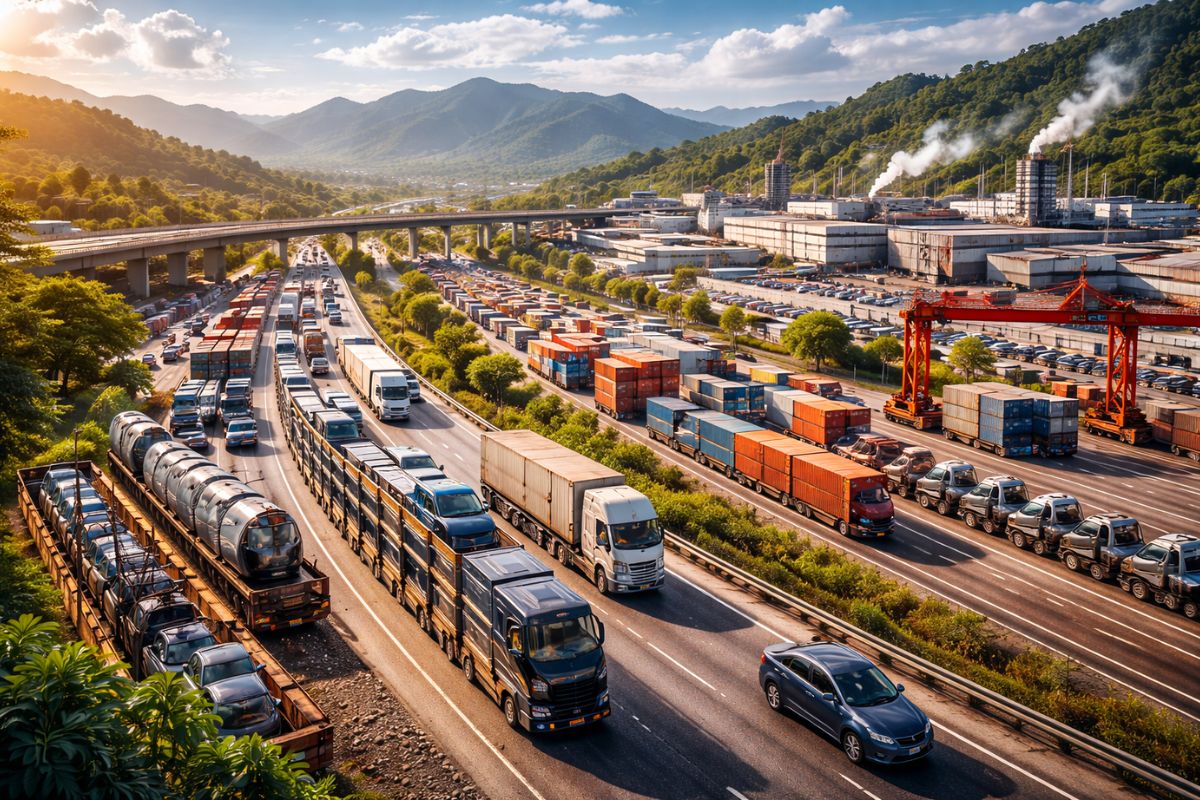


While The News Insists On Showing Only Crisis, Violence, And Bankruptcy, The Axis Of Dutra In The Fluminense Interior Has Turned Into An Industrial Corridor Of Automakers, Steel, And Logistics That Drives The Economy Of The State In Silence
When talking about Rio de Janeiro, almost everyone thinks of the same old package: beach, postcard, and police headline. Violence, crisis, bankrupt state. The repetition is so great that it has become an absolute truth for many people. What almost never appears is that there is another Rio de Janeiro, far from the sea, far from oil, and far from tourism, where money comes in every day, industry grows, and GDP turns silently. This other Rio has a clear name and address: the axis of Dutra.
In the Paraíba Valley Fluminense, the axis of Dutra has formed a strategic corridor of cities that seem to live in a different country. Itatiaia, Resende, Porto Real, Barra Mansa, and Volta Redonda make up a continuous strip of factories, warehouses, logistics centers, and industrial parks glued to the highway that connects São Paulo to Rio. While the Rio on television appears to be always on the brink of collapse, this industrial Rio continues to produce, export, and carry a good part of the Fluminense economy on its back.
The Axis Of Dutra That Does Not Appear In The News
The starting point is simple. The Axis Of Dutra In The Southern Fluminense Does Not Live Off The Beach Or Royalties, It Lives Off The Factory Floor And The Production Line. There, what shines is not sand or sea. It is steel, industrial robots, presses, assembly lines.
-
Brazil to Issue “Panda Bonds” in China, Aiming to Raise Up to 5 Billion Yuan at Lower Interest Rates Than Dollar Debt
-
NATO Faces Internal Tensions as U.S. Pushes for Increased Defense Spending, Targeting 5% of GDP by 2035, with Warnings for Countries Near 2% Level

-
Brazil to Introduce B16 Diesel with Increased Soybean Oil Content for Trucks by 2026
-
Brazil’s July Bolsa Família Payments May Include Extra $150 and $50 for Families with Children, Pregnant Women, and Updated CadÚnico Registration


These cities grew around the Via Dutra, one of the most important highways in the country, through which a gigantic slice of the Brazilian GDP passes.
Instead of kiosks and boardwalks, what dominates the landscape is truck yards, logistics warehouses, and industrial buildings. And yet, this corridor rarely makes headlines. It escapes the easy script of “Rio That Only Goes Wrong.”
Where The Axis Of Dutra Transforms Into An Automotive Pole
To understand the strength of the axis of Dutra, just look at the stretch formed by Resende, Itatiaia, and Porto Real. If anyone still repeats that Brazil “doesn’t manufacture anything,” this region dismantles the discourse in minutes.
Resende is home to Volkswagen Trucks and Buses, a world reference in modular production. The factory model there has become a case study in universities and industrial centers around the world, showing that the axis of Dutra is not a technological periphery, it is a showcase of innovation.
Right next door, in a huge industrial complex, is the Japanese company Nissan, with production aimed at both the domestic market and export.
In Itatiaia, luxury entered the route of the axis of Dutra with the Jaguar Land Rover factory, producing high-end vehicles.
And Porto Real caps this block off with Stellantis, responsible for brands like Peugeot and Citroën, surrounded by a high-level supplier chain.
We are talking about heavy robotics, automation, precision engineering, and qualified jobs that escape the logic of “gig work” and improvisation.
High GDP, Discreet City: The Silent Money Of The Axis Of Dutra


Porto Real is a good example of what this corridor represents. Small and discreet, it has previously ranked among the highest GDPs per capita in Brazil.
It is the type of city that does not shout wealth, but functions as a machine for generating revenue and employing people with formal contracts.
This pattern spreads across the axis of Dutra. The money from industry changes the urban landscape. Modern gated communities, planned neighborhoods, average income higher than the state average, and services that are usually only seen in large capitals, appear.
While other regions struggle to keep a single factory open, this stretch of Dutra has taken the opposite path: it has attracted industries and continues to attract them.
Location Is Destination: Dutra, Logistics, And The Dry Port Of Resende
One of the secrets of the axis of Dutra is something that is often underestimated: location. These cities are practically in the middle of the road between São Paulo and the capital of Rio de Janeiro, glued to Via Dutra. This reduces transportation costs, shortens distances, and increases the efficiency of any logistical operation.
Not by chance, the dry port of Resende has become a strategic asset. It transforms the city into a national hub, facilitating the import of parts and the export of vehicles and components produced in the axis itself.
The result is new money entering constantly, with qualified jobs and less dependence on volatile sectors.
Volta Redonda And Barra Mansa: Steel, Railroad, And Integrated Economy
Continuing along the Dutra, the scenery changes profile, but not economic weight. If before the highlights were the robots and automakers, in Volta Redonda, the foundation of the Brazilian heavy industry enters the scene.
The city is known throughout the country as the steel city, thanks to CSN, one of the largest steel mills in Latin America.
Without the steel produced there, much of Brazil would simply halt. Automaker, infrastructure project, railway, heavy industry: almost everything passes directly or indirectly through the production that comes out of the axis of Dutra in Volta Redonda.
That is why the city functions as a regional economic capital, with a strong commerce, renowned hospitals, and universities. It is not a tourist destination, but it is a city that works.
Next to Volta Redonda is Barra Mansa, connected by an integrated job market. Many people live in one and work in the other. Barra Mansa is a key piece in the logistics and railway system of this machinery. Together, the two create a rare pocket of economic stability in times of so much oscillation.
A “Parallel State” Within Rio, Supported By The Axis Of Dutra
Perhaps the most curious aspect of the axis of Dutra is precisely the fact that it does not depend on the capital. This industrial Rio de Janeiro functions almost like a parallel state, with its own economy, its own vocation, and its own logic.
While the news insists on showing a broken Rio, the southern Fluminense continues to produce, export, and grow.
The GDP of the southern Fluminense carries the state on its back without making noise. While other regions depend on oil royalties or tourist seasons, the axis of Dutra depends on real production, every day. It breaks the easy script that the interior is backward and the capital is the only relevant place.
In the end, just take the Dutra and look out the window to see what almost never makes the headlines. The economic future of the state passes through here, through this axis of Dutra that has become the industrial and logistical backbone of Rio de Janeiro.
Did you already have an idea of the economic weight of the axis of Dutra or do you still associate Rio almost only with beaches, crisis, and violence?







