





 Portuguese
  English
  Spanish
  5 min of reading
  0 comments


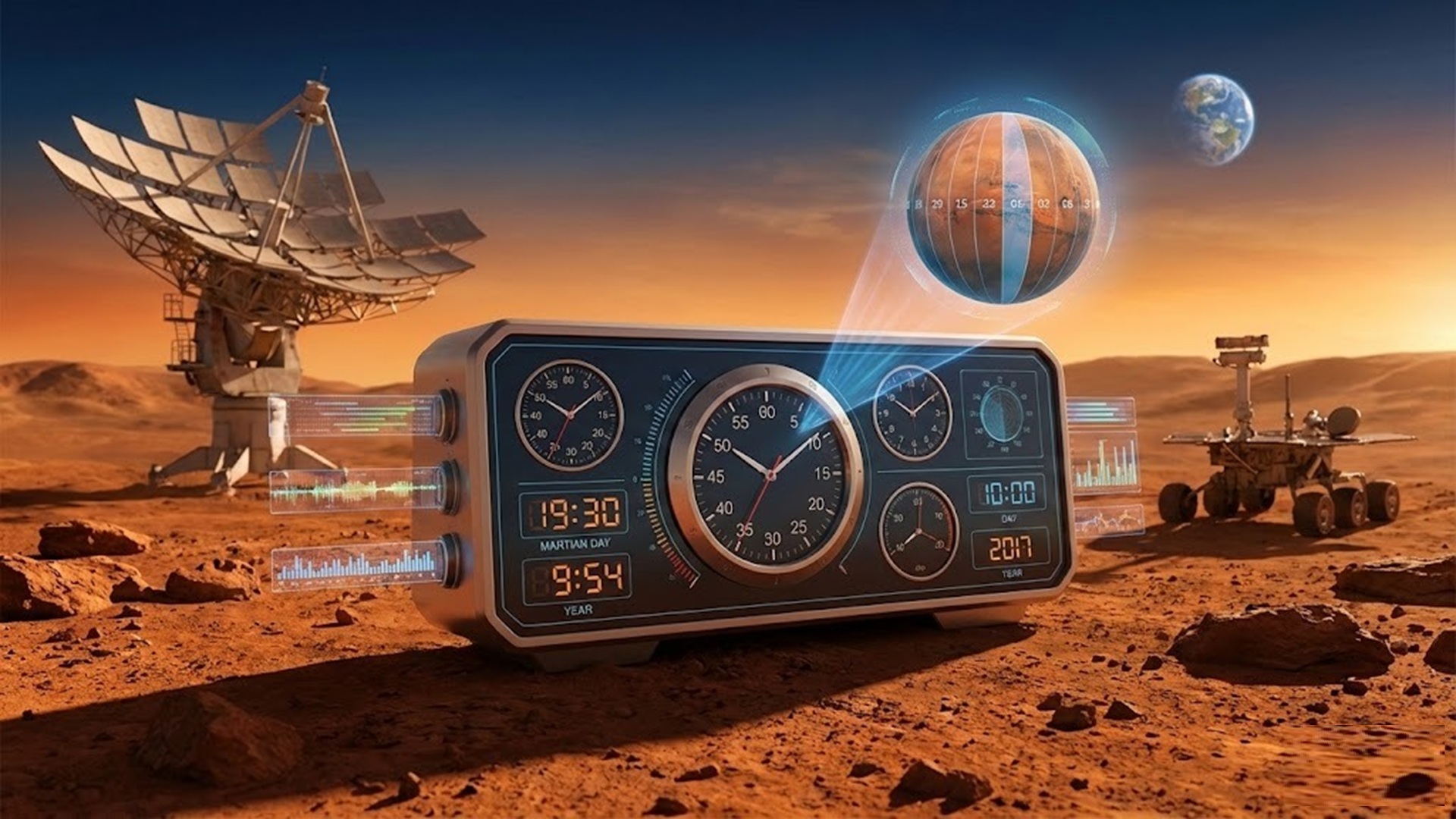
Novel Calculation by NIST Physicists Shows That Clocks on Mars Gain Hundreds of Microseconds Per Day Compared to Earth, with Variations Caused by the Planet’s Eccentric Orbit and Gravitational Interactions of the Sun, Earth, and Moon, Creating Direct Implications for Navigation, Communication, and Future Interplanetary Missions
Time does not flow uniformly in the solar system, and a new detailed calculation shows how it behaves on Mars compared to Earth, revealing measurable differences that could affect navigation, communication, and future human missions beyond the planet.
Physicists at the National Institute of Standards and Technology conducted the first complete calculation of the passage of time on Mars and determined that a clock on the Red Planet gains, on average, 477 microseconds per day compared to a clock on Earth. However, this value is not constant throughout the Martian year.
Relativity, Gravity, and the Need for Precise Martian Time
On Earth, answering the question of what time it is depends on a highly integrated infrastructure based on atomic clocks, GPS satellites, and high-speed communication systems. This precision is possible because clocks are continuously synchronized within the same gravitational and orbital reference frame.
-
A 400-meter colossus powered by natural gas has just set sail from Shanghai to Europe, carrying over 24,000 containers. It is the world’s largest dual-fuel container ship and can cross the planet without refueling even once.

-
A new study overturns the central idea we learned about planets and suggests that Earth is the exception rather than the rule; most rocky worlds in the galaxy may not have a core or mantle, just a single turbulent fluid extending to the center.
-
Scientists reanimated a 48,500-year-old virus in the laboratory that had been frozen in the Siberian permafrost since before the extinction of the Neanderthals, and it was still capable of infecting living organisms after tens of millennia dormant in the ice.
-
The oldest nuclear aircraft carrier still in operation in the world is currently on Brazilian soil making its final journey before retirement, and two American military planes landed in Salvador and Fortaleza to support the mission.



Albert Einstein’s work demonstrated that time does not pass the same way everywhere. The intensity of local gravity directly influences the speed at which a clock measures time, making synchronization a challenge even on a planetary scale.
This effect already complicates the coordination of systems on Earth and becomes even more complex when considering the expansion of human activity to other bodies in the solar system. For any sustained presence on Mars, it is essential to accurately answer one basic question: what time is it there.
The NIST Calculation and the Daily Difference of 477 Microseconds
The NIST researchers calculated that a clock located on Mars would gain 477 microseconds per day compared to an identical clock on Earth. This deviation corresponds to millionths of a second but accumulates significantly over time.
The difference is not fixed. Due to Mars’ elongated orbit and the gravitational influences of other bodies, the daily deviation can vary by up to 226 microseconds over a Martian year, which lasts 687 Earth days.
The results were published in The Astronomical Journal and complement a previous study from 2024, in which the same researchers proposed a method for precise timing on the Moon.
A Martian Reference Frame and Orbital Complexity
To perform the calculations, the scientists needed to define a reference point on the surface of Mars, equivalent to sea level at Earth’s equator. From this point, they estimated the local gravity using data accumulated over years of missions to the planet.
The gravity on the surface of Mars is about five times weaker than that of Earth, which already causes an acceleration in the passage of time. However, this isolated factor alone would not be sufficient to explain the observed behavior.
The solar system consists of multiple massive bodies that exert mutual gravitational influence. The Sun contains more than 99% of the mass of the system, but planets such as Earth, the Moon, Jupiter, and Saturn also contribute to subtle but measurable disturbances.
Mars’ position in the solar system places it in a more eccentric orbit than that of Earth and the Moon, whose trajectories are relatively stable. This eccentricity causes the distance from Mars to the Sun to vary significantly throughout the year.
Multiple Influences and the Calculation Challenge
According to physicist Bijunath Patla of NIST, considering only Mars’ gravity would not be sufficient. It was necessary to simultaneously account for the gravitational effects of the Sun, Earth, and Moon on the Red Planet.
While time on the Moon is consistently 56 microseconds faster than time on Earth, Mars exhibits much larger variations, precisely due to its elongated orbit and dynamic position relative to other bodies.
Patla described the problem as a complex mathematical challenge. A system with three bodies is already difficult to solve, and in this case, it was necessary to deal with four main elements acting simultaneously, making the work more demanding than initially expected.
After incorporating all these factors, the researchers arrived at the final value of 477 microseconds of daily gain, with annual fluctuations of up to 226 microseconds.
Implications for Missions and Communication Systems
At first glance, differences of millionths of a second may seem irrelevant. However, modern communication and navigation systems require extreme levels of precision to function properly over long distances.
Advanced communication networks, such as 5G technologies, require synchronization with an accuracy of up to one-tenth of a microsecond. In an interplanetary context, ignoring such temporal deviations could compromise the integrity of data and commands.
Currently, communications between Earth and Mars experience delays that vary from four to 24 minutes, depending on the relative positions of the planets. This scenario is compared to a message exchange model similar to maritime communications of the 19th century.
Having a reliable synchronization model between planets lays the conceptual foundation for developing coordinated networks on a solar system scale, even though practical implementation is still distant.
Interplanetary Navigation and Long-Term Preparation
For Patla, understanding the passage of time on Mars is an essential step as NASA prepares for future expeditions to the planet. Navigation and communication systems directly depend on accurate and well-synchronized clocks.
Physicist Neil Ashby, co-author of the study, pointed out that manned or robotic missions of long duration may still take decades to materialize. Nevertheless, studying these issues now allows for anticipating fundamental technical challenges.
Just as current global navigation systems on Earth rely on atomic clocks and relativistic corrections, future systems on other planets and moons will also need to incorporate these effects from the outset of design.
These calculations help establish a solid theoretical foundation so that future infrastructures are not limited by accumulated time errors, even if they seem minuscule on human scales.
Scientific Value and Theoretical Advancement
Beyond practical applications, the study has direct scientific importance. For the first time, it was possible to accurately describe how time behaves on Mars, enhancing the empirical understanding of special and general relativity theories.
According to Patla, understanding how clocks function on distant planets provides new insights into how the passage of time is perceived, calculated, and influenced by different gravitational and orbital conditions.
Although the concept of time seems simple in everyday life, its physical description requires complex calculations when applied outside the terrestrial environment. This study contributes to refining these descriptions and testing the limits of existing theories.
The results reinforce that as human activity extends beyond Earth, the very concept of time needs to be redefined based on accurate measurements, not just on conventions inherited from the home planet.
This article was based on the study “A Comparative Study of Time on Mars with Lunar and Earth Clocks,” by Neil Ashby and Bijunath R. Patla, published on December 1, 2025, in The Astronomical Journal, with DOI 10.3847/1538-3881/ae0c16, as well as institutional information released by the National Institute of Standards and Technology (NIST).







-

-

-

-

-

5 people reacted to this.