






 Portuguese
  Spanish


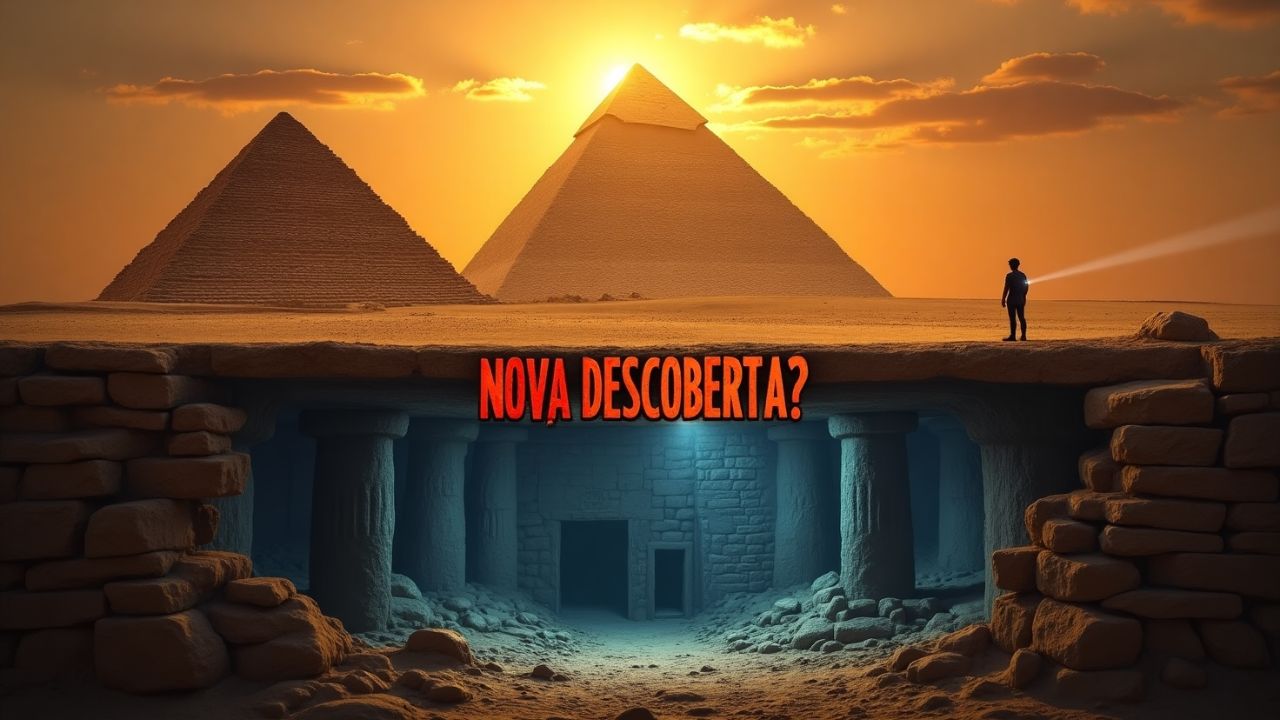


Radar-Detected Structures Beneath The Pyramid Of Khafre Include Rooms, Tunnels, And Possible Sarcophagi, Suggesting An Underground Network Of Up To 2,000 Meters Deep. Egyptian Experts, However, Contest The Validity Of The Technique And The Results In The Pyramids.
An Italian and Scottish team of archaeologists announced the possible discovery of an underground city beneath the Giza pyramid complex in Egypt. Using synthetic aperture radar (SAR) technology, the scientists claim to have identified deep structures, rooms connected by tunnels, and even a hidden sarcophagus beneath the Pyramid of Khafre. The revelation, initially published by the portal O Globo on March 23, 2025, reignites the debate on what may still be hidden in the heart of Ancient Egypt.
According to the survey data, there are at least five underground rooms, eight large vertical formations (possibly shafts), and a network of tunnels extending up to 2,000 meters deep and over 600 meters wide — something never documented beneath the Giza plateau.
Radar Reveals Structures Beneath The Pyramid Of Khafre
The study was conducted by archaeologists from the University of Edinburgh in Scotland, in partnership with researchers from the Archaeological Institute of Rome. According to the website ZAP Notícias, the researchers used high-resolution SAR technology, typically employed in deep excavations and underground geological inspections, to map the subsurface of the Pyramid of Khafre without the need for physical excavations.
-
China Develops Custom 140-Ton Electric Mining Truck with 770 kWh Swappable Battery, Deploys 290 Units in Xinjiang’s Largest Zinc Mine

-
Meta to Launch Arena, a New Prediction App Targeting 3.56 Billion Users, Competing with Polymarket and Kalshi

-
Scientist Challenges Famous Human Evolution Theory, Argues Homo Sapiens Evolved Gradually Over Thousands of Years
-
15-Year-Old American Builds Ocean Generator with PVC Pipe and 3D-Printed Propeller for $12, Wins National Prize, Presents at White House, and Makes Forbes 30 Under 30 List




The team reported that within one of the revealed pyramids, there is a large compartment containing what appears to be an unidentified sarcophagus, raising speculation about the possibility of an unexplored tomb. The data also reportedly show underground pathways interconnecting different levels of the structure, which many interpret as indications of a kind of hidden “ceremonial city.”
Possible Link To Ancient Egyptian Myths
Some researchers involved in the project suggested that the formations may be related to the Halls of Amenti, a mythical figure in Egyptian mythology representing a spiritual abode, according to records from the Pyramid Texts. The mention of Amenti rekindled the fascination of ancient theorists and alternative Egyptology enthusiasts, as reported by the New York Post and the portal R7 Notícias.
Despite the enthusiasm, other scholars and local authorities reacted with caution and skepticism regarding the claim.
Zahi Hawass And Other Experts Contest The Data Regarding The Underground City Beneath Egypt’s Pyramids


The archaeologist and former Minister of Antiquities of Egypt, Dr. Zahi Hawass, known for his decades of work on the pyramids, classified the discovery as “completely false.” According to him, “there is no validated scientific evidence” proving the existence of an underground city beneath Giza. In an interview with Al-Ahram, Hawass stated that the methods used by the foreign team “do not meet standards accepted by the international archaeological community.”
Lawrence Conyers, a radar specialist from the University of Denver (USA), pointed out that the obtained images may be misinterpreted. He stated to the New York Post that the signals detected by the SAR could be “natural formations, small cavities, or already known ruins close to the surface.”






Triste a falta de consciência desperta !!!