Portuguese
  Spanish


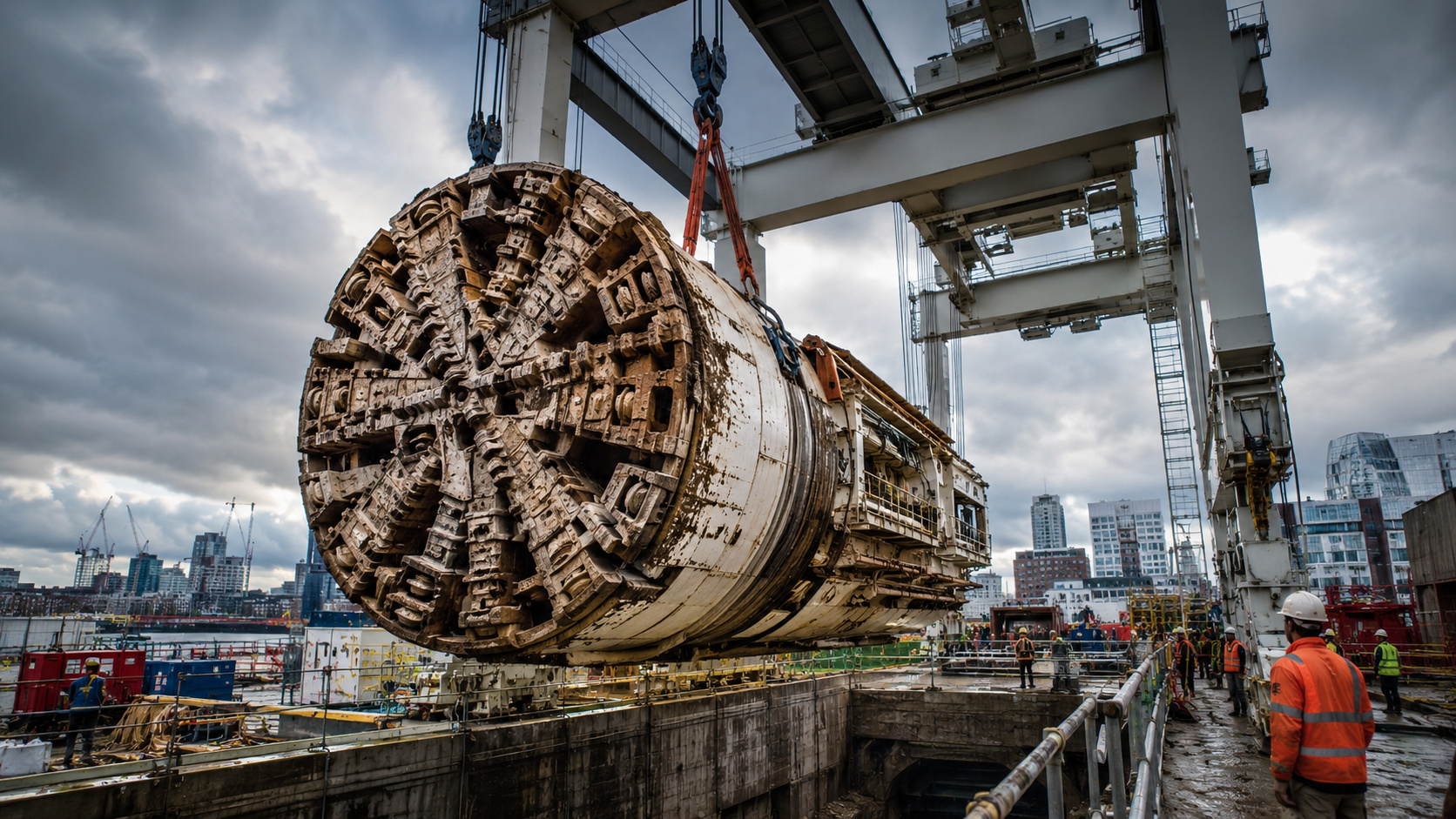


The HS2 Sushila tunnel boring machine emerged from beneath London after completing a long excavation and demonstrated how giant machines used in tunnels also need to be removed with precision, planning, and mechanical force
The HS2 Sushila tunnel boring machine became a highlight in London after digging 8 km, completing 5 miles in the HS2 project, and being hoisted whole by a giant crane. The scene showcased a rare stage of underground engineering, when a machine designed to work beneath the city needs to return to the surface.
The report was published by Construction Briefing, a publication specialized in construction and infrastructure. The removal of the machine drew attention because it visually demonstrated that a major tunnel project does not end when the excavation is finished.
The impact lies in the scale of the operation. A tunnel boring machine of this size does not come out of the underground like an ordinary machine. It requires space, calculation, heavy equipment, and a controlled sequence to be removed without compromising the project.
-
Unfinished 150-Year-Old Church in Brazil’s Bahia Stands Without a Roof After Railway Shifted Alagoinhas’ Center

-
Viking Textile Factory Unearthed in Denmark Reveals Ancient International Trade Links

-
Bruno Guimarães, 28, Misses Crucial Penalty Against Norway in World Cup After Replacing Vinicius Jr.
-
Inspired by a school lesson on Africa’s water crisis, a young boy raised money through chores to fund a well that transformed a Ugandan community.




HS2 Sushila tunnel boring machine completed 5 miles under London before emerging from the underground
The HS2 Sushila tunnel boring machine worked on an underground stage of the HS2 project in London. After paving the way for 8 km, the machine reached the end of its mission and moved on to the removal phase.


A tunnel boring machine is a huge machine used to dig tunnels. It advances through the earth while helping to form the underground path. In projects of this type, the work happens far from the public eye.
That’s why the image of Sushila being hoisted drew so much attention. What normally remains hidden beneath the city appeared on the surface as a giant industrial piece.
The operation also helps to understand that urban tunnels require much more than excavation. The process involves the machine’s entry, advancement underground, and removal at the end of the journey.
Giant crane transformed the removal of Sushila into a rare engineering scene
The giant crane played a central role in the removal of the HS2 Sushila tunnel boring machine. The machine needed to be lifted from an opening in the ground after completing its underground journey.
This type of hoisting requires precision. The tunnel boring machine is a heavy structure, made to cut through the terrain and advance in a closed environment. Removing this machine from the underground requires control and planning.
The scene seems unusual because it shows a part of the construction that almost never appears. The public usually sees the finished tunnel but does not witness the moment when the machine that opened the path needs to be removed.
In this case, the end of the excavation became the most visual point of the operation. Sushila emerged from the underground as if it were a giant piece from an underground factory.
Construction Briefing showed the rarely seen stage of the machine’s removal
Construction Briefing, a vehicle specialized in construction and infrastructure, detailed the removal of Sushila after completing about 5 miles of excavation in London. The operation gained prominence precisely for revealing the hidden side of a project of this magnitude.
The video of the removal helped to show the size of the equipment. For those who only follow the final result, it may seem that the tunnel simply appears ready. In practice, there is a sequence of complex stages before, during, and after the excavation.
Sushila represents this less visible side of urban engineering. It paved the way under London and then needed to be removed with the help of a crane.
This stage shows that an underground project continues to require strength and technique even after the machine stops digging.
How a tunnel boring machine paves the way in underground projects
A tunnel boring machine functions as a continuous excavation machine. It cuts the terrain ahead and advances gradually, creating the necessary space for the tunnel.

In large cities, this type of equipment helps reduce surface interventions. This is important because streets, buildings, service networks, and the circulation of people already occupy a lot of space.
The HS2 Sushila tunnel boring machine worked under London, a city with a complex urban structure. Therefore, each stage of the operation requires care, from excavation to final removal.
The great curiosity lies in the fact that the machine not only digs. It also needs to be rescued when it completes its underground mission.
Why the removal of the tunnel boring machine draws attention in the HS2 project
The HS2 project involves large-scale railway works in the United Kingdom. Sushila appears in this context as one of the machines used to open tunnels under London.
The removal of the machine shows that a modern railway depends on steps that go far beyond the tracks. Before the trains circulate, there is heavy work of excavation and path preparation.
The operation also makes it easier to understand the scale of an underground work. A machine that dug 8 km needed a giant crane to leave the underground.
This detail transforms Sushila into a strong image of modern engineering. It shows that what happens beneath cities can be as impressive as what appears on the surface.
The end of the excavation revealed one of the most curious phases of the work
When a tunnel boring machine reaches the end of its path, the work does not end simply. The machine needs to be removed, dismantled, or prepared for another destination, according to the planned operation.
In the case of Sushila, the entire removal by crane made the scene even more striking. The machine emerged from the underground after completing a long journey beneath London.
This moment shows that underground engineering is made up of stages invisible to most people. The completed tunnel hides machines, teams, and large-scale operations.
The HS2 Sushila tunnel boring machine drew attention because it revealed exactly this hidden side. After digging 5 miles, it became the protagonist at the moment it left the underground.
Sushila showed that great works also impress when they end
The removal of the HS2 Sushila tunnel boring machine showed that the end of an underground mission can be as interesting as the beginning. After digging 8 km beneath London, the machine needed to be hoisted by a giant crane in a rare operation.
The case helps to understand how major urban works depend on enormous machines, detailed planning, and stages that almost never appear to the public. The excavation ends, but the engineering continues until the complete removal of the equipment.
Did you imagine that a machine capable of opening tunnels under an entire city would also need a giant operation to be removed from the underground?