






 Portuguese
  Spanish
  6 min of reading
  0 comments


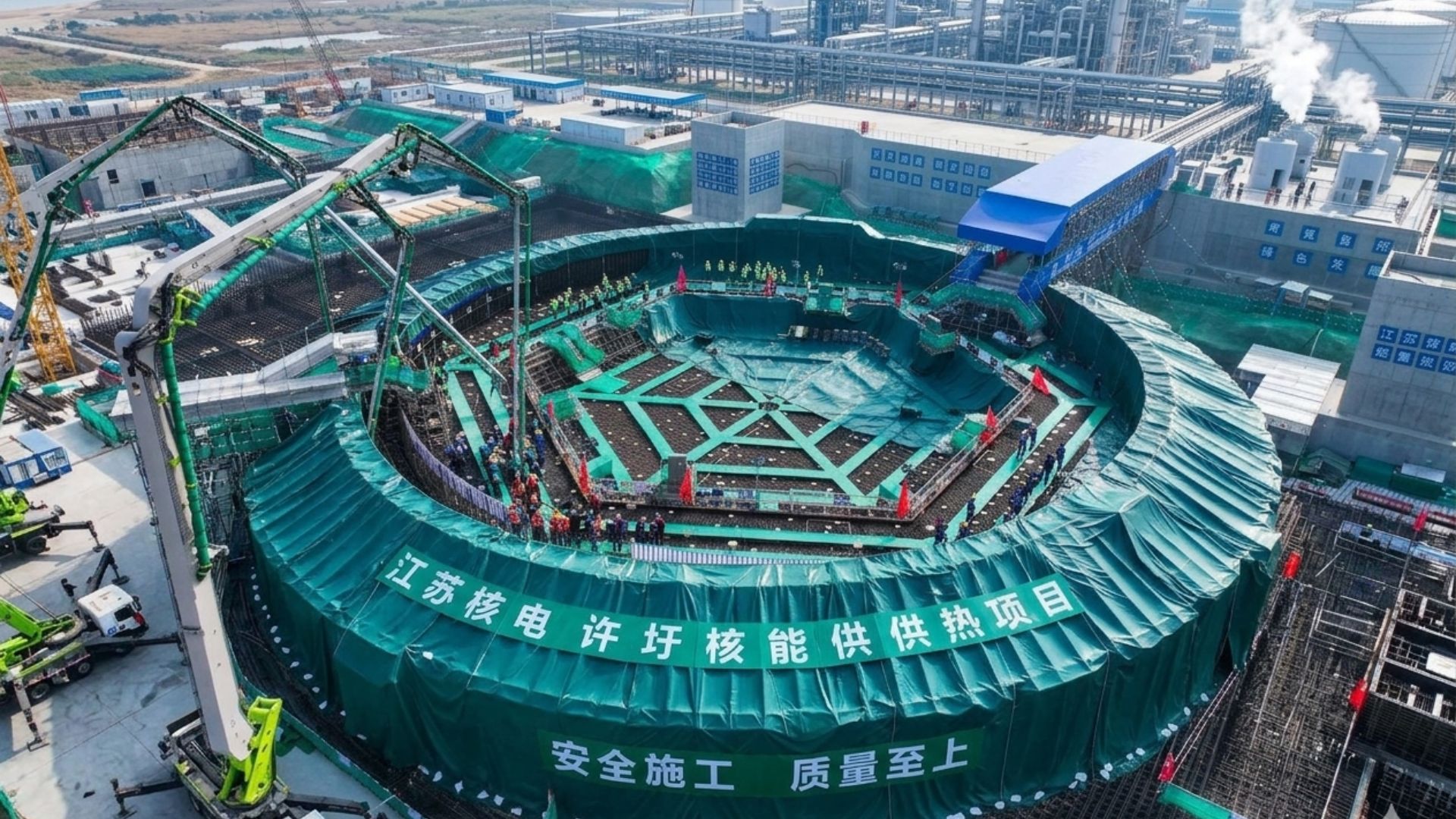
Xuwei nuclear project in China combines Hualong One and HTGR reactors to supply 32.5 million tons of industrial steam per year to petrochemicals.
According to the China National Nuclear Corporation, the first concrete of the nuclear island of Unit 1 at the Xuwei Nuclear Heating and Power Plant was poured on January 16, 2026, in Lianyungang, Jiangsu province. The project is the world’s first to integrate, on a large scale, nuclear energy and petrochemical industry, not only to generate electricity but to provide high-temperature industrial steam directly to factories.
Phase 1 combines two third-generation Hualong One reactors, each with 1,208 MW electric, and a fourth-generation high-temperature gas-cooled reactor, with 660 MW. This arrangement forms the first commercial coupling of its kind in the world, uniting conventional nuclear generation and advanced industrial heat.
When operational, the project is expected to supply 32.5 million tons of industrial steam per year and generate more than 11.5 TWh of electricity. It is estimated to save 7.26 million tons of standard coal and avoid 19.6 million tons of CO₂ emissions annually.
-
Gases created to save the ozone layer have become a new global warning: substitutes for CFCs have already released more than 335,000 tons of a “forever chemical” onto the Earth as invisible rain, contaminating everything from tap water to Arctic ice.

-
Researchers present a hydrogen ion battery capable of storing energy in two different forms, an innovative solution that promises to increase the autonomy of renewable systems and simplify energy transportation.
-
Embrapa takes cashew, peanuts, and sesame to the world’s largest seed bank in Norway, where Brazil has already stored more than 8,000 samples since 2012 against pests and climate change.

-
Finnish company creates recycled plastic and biomass blocks that fit together without cement, are 10 times lighter than common blocks, and have already been used to build schools in earthquake-affected areas.



Xuwei nuclear plant integrates nuclear energy and petrochemicals on an unprecedented scale
Since the first commercial reactors of the 1950s, the dominant logic of nuclear plants has been to use fission heat to generate steam, turn turbines, and produce electricity for the grid. In this model, much of the residual heat ends up discarded into rivers, cooling towers, or the air.


The Xuwei project changes this logic by treating heat as the main product and electricity as a complementary part of the system. For the petrochemical industry, this is decisive because processes like distillation, cracking, and polymer synthesis require high-pressure and high-temperature steam.
Generating electricity to then reconvert it into steam would be inefficient. The Chinese proposal is to deliver industrial steam directly from the nuclear system to the factories, replacing coal boilers without rebuilding the entire petrochemical infrastructure around them.
Lianyungang petrochemical hub consumes 13,000 tons of steam per hour
The location of the plant is not accidental. Xuwei is in Lianyungang, a port city in Jiangsu that China is developing as one of its seven major national petrochemical hubs.
The local petrochemical hub consumes about 13,000 tons of steam per hour to operate industrial processes. Today, this steam comes mainly from coal boilers, which provide cheap heat but with high emissions.
The shift to nuclear steam targets one of the toughest points of industrial decarbonization. Petrochemicals don’t just need clean electricity; they need continuous, stable, and large-volume process heat.
Hualong One and HTGR reactor work together to produce high-temperature industrial steam
The technical heart of Xuwei is a two-stage heating process. In the first, demineralized water is heated by the steam from the two Hualong One reactors’ circuit, generating saturated steam.

This steam is hot but still does not reach the necessary temperature for more intensive petrochemical processes. Traditional nuclear district heating applications, like those existing in Russia and China, usually stop at this stage, sufficient to heat buildings but limited for heavy industry.
In the second stage, the steam undergoes additional heat exchange with the high-temperature gas-cooled reactor, the HTGR. This reactor operates at higher temperatures than a conventional pressurized water reactor, allowing it to generate steam suitable for cracking, distillation, and polymer synthesis.
High-temperature reactor uses helium and TRISO fuel to enhance industrial efficiency
The Xuwei’s HTGR reactor uses helium as a coolant and TRISO fuel in pebbles, technology associated with fourth-generation reactors. This configuration allows for outlet temperatures higher than those achieved by conventional pressurized water reactors.
Helium plays an important role because it does not boil under the reactor’s operating conditions and allows heat to be transported at high temperatures. TRISO fuel is designed to retain fission products in multiple protective layers.
This combination makes the HTGR especially relevant for industrial use. It provides the thermal leap that transforms common nuclear steam into useful steam to replace fossil boilers in petrochemical processes.
Xuwei can replace coal boilers without rebuilding petrochemical plants
One of the most important aspects of the project is that it does not require a complete reconstruction of petrochemical plants. The industrial infrastructure already relies on steam networks, and Xuwei is designed to directly supply this demand.
This makes the transition more practical. Instead of electrifying each chemical process individually, the nuclear plant takes on the role of coal boilers, delivering the same thermal input that factories already use.
The estimated saving of 7.26 million tons of standard coal per year shows the scale of the replacement. If it works as planned, Xuwei will prove that nuclear energy can decarbonize industrial heat, not just electricity generation.
China accelerates nuclear energy with 58 reactors in operation and 33 under construction or approval
Xuwei was approved by the Chinese State Council in August 2024, along with 11 other reactors. In April 2025, 10 more units were approved; in 2023, another 6 had been approved.
China has been approving 10 or more reactors per year for four consecutive years, a pace that no other country has sustained in the recent history of nuclear energy. The country currently has 58 reactors in operation and 33 additional units under construction or with confirmed approval.
Ten years ago, China had 34 reactors operating and still relied on foreign technology for a significant part of its expansion. Now, the Hualong One, used in Xuwei, is a domestic design, exported to Pakistan and discussed with other markets.
Hualong One and HTGR show China’s transition to domestic nuclear technology
The Hualong One represents the maturity of the Chinese third-generation nuclear industry. It combines national technology, construction scale, and export capacity, becoming one of the country’s main nuclear platforms.

The HTGR in Xuwei is based on the learning from the HTR-PM reactor, from the Shidao Bay complex, which began commercial operation in December 2023. This project was presented as the world’s first commercial fourth-generation pebble-bed reactor.
The combination of the two in Xuwei is strategic. China combines a reactor that is already scalable and exportable with advanced high-temperature technology to create a new nuclear application aimed at heavy industry.
Chinese nuclear speed contrasts with delays in projects in the United Kingdom, France, and the United States
The speed of Chinese deployment contrasts with the recent experience of Western countries. The Hinkley Point C plant in the United Kingdom was approved in 2016 and had not yet entered operation by 2026.
In France, Flamanville 3 took more than 17 years between the start of construction and the first fuel load. In the United States, Vogtle 4 took more than 12 years and cost more than double the original budget.
Xuwei followed a different pace: it was approved and had the first concrete poured in less than 18 months. China’s most technically innovative nuclear project advanced on a timeline that many Western countries cannot achieve even with conventional plants.
Why no other country had integrated nuclear energy and petrochemicals on this scale
The difficulty of a project like Xuwei is not just in the technology. The core components already existed; the greater challenge lies in political, regulatory, and industrial coordination.
A nuclear plant that supplies steam to petrochemical factories requires long-term contracts, safety rules for the steam distribution system, liability in case of interruption, and operational integration between reactors and chemical plants.
In countries where nuclear energy, petrochemicals, and industrial infrastructure are fragmented among private companies, this arrangement is difficult. In China, CNNC is state-owned, and the Lianyungang petrochemical hub is part of a national infrastructure strategy, allowing direct coordination.


Be the first to react!