Portuguese
  Spanish


While cities like Tokyo, New York, and Frankfurt may take up to 18 months and spend billions of dollars to build a single large-scale water-cooled data center, Google and SpaceX confirmed in May 2026 formal negotiations to launch entire artificial intelligence processing facilities into low orbit before 2030, using Elon Musk’s company’s Starship V3 rockets and solar power 36% more efficient than on Earth’s surface. According to the original report by the Wall Street Journal and technical coverage by Tom’s Hardware portal, the partnership is expected to mark the first concrete step in a long-term transformation of the global high-performance computing infrastructure.
Google’s project was internally named Project Suncatcher and officially announced by CEO Sundar Pichai at the end of 2025, with plans to launch two prototype satellites by early 2027 to validate the real operation of artificial intelligence loads in an orbital environment. If the tests go as expected, the complete processing network will go into operation over the next decade.
SpaceX, in parallel, filed a formal licensing request with the U.S. Federal Communications Commission for a megaconstellation that could reach up to one million satellites for artificial intelligence processing in orbit, an unprecedented scale in space history that will depend entirely on the operational success of the Starship V3 rockets.
-
Polar Air Mass to Hit Brazil: Temperatures to Plummet in Nine States, Near Freezing in the South with Frost Risk Until Monday

-
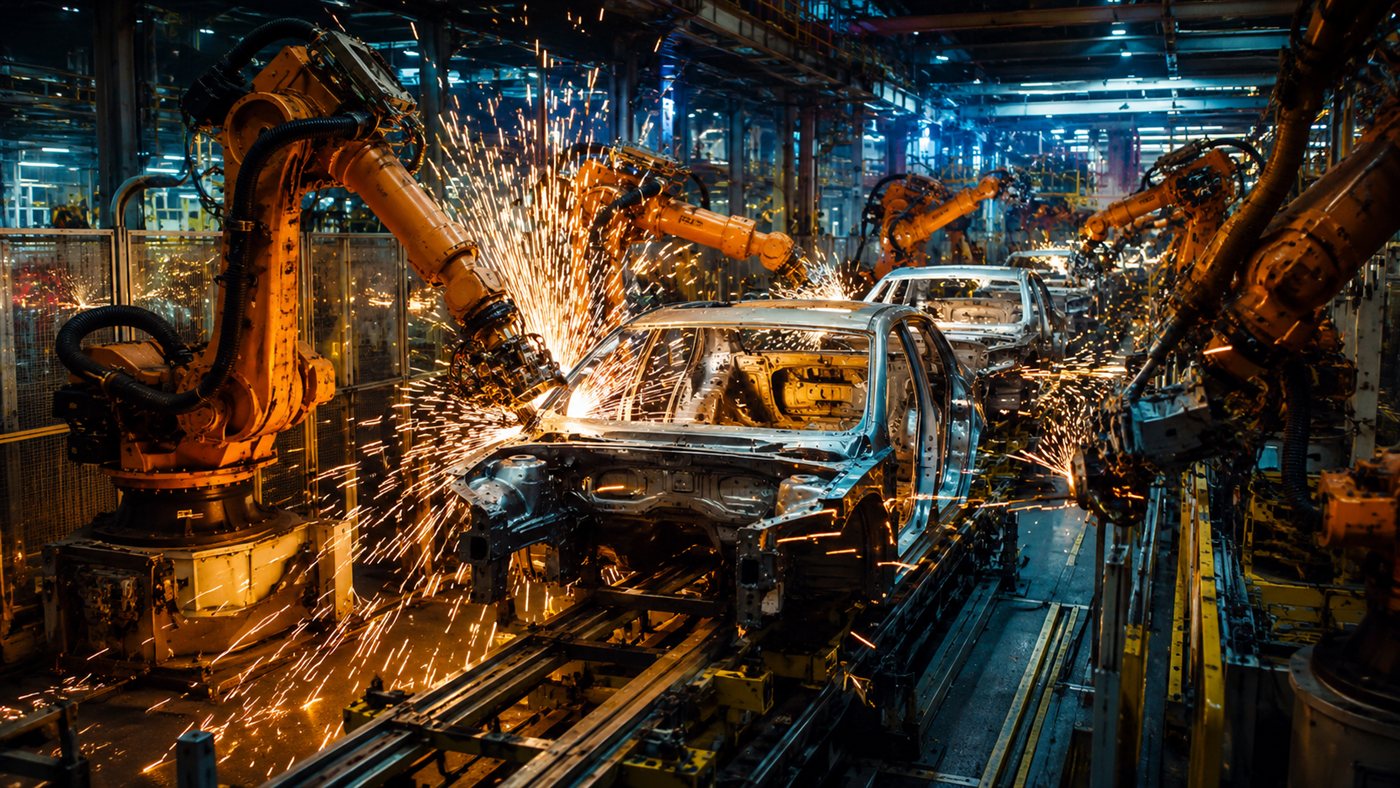
Chinese “dark factories” produce electric cars 24/7 with minimal human intervention, as Zeekr assembles 800 units daily, raising concerns in Brazil.

-
Spectacular Green Aurora Seen from Space Illuminates International Space Station, Captivates French Astronaut

-
In Tasmania, a Beach Features a Natural Stone Mosaic Formed by Earth’s Cracks Millions of Years Ago



Why processing data in orbit solves three terrestrial problems at once
Terrestrial data centers face three increasingly severe structural limitations. The first is the absurd consumption of electricity, expected to reach 15% of all global electricity generated by 2030, according to estimates by the International Energy Agency. The second is the consumption of potable water for cooling systems, in direct conflict with water scarcity in several metropolitan areas. The third is the growing social resistance in communities that see new data centers as unwanted neighbors.
In low orbit, these three problems practically disappear. Energy comes directly from the sun, with irradiance 36% greater than on the Earth’s surface thanks to the absence of atmosphere and clouds. Cooling uses the vacuum of space as a natural dissipator through infrared radiation, without the need for circulating water or air. And there is no nearby human community to oppose new satellites.
Researchers have discovered that the more the artificial intelligence industry grows on the surface, the harder it becomes to obtain environmental approval for new data centers in regions with mature electrical infrastructure. This regulatory friction is currently the main barrier to the growth of available computing capacity for companies that want to train increasingly larger models.

The unique challenge of vacuum radiative cooling
In a terrestrial environment, data centers use a combination of industrial air conditioning, chilled water pumped through heat exchangers, and, in extreme cases, direct immersion of servers in dielectric liquid. In orbit, none of these options work, and engineers must resort to radiative cooling, a technique that dissipates heat by direct emission of infrared photons into the vacuum of space.
The solution requires radiation surfaces with a much larger area than conventional servers, with specialized panels to radiate heat without reflecting incident sunlight. This engineering is already mastered by the space industry on a small scale, in space telescopes like the James Webb, but needs to be industrialized for data centers with computational power comparable to terrestrial ones.
According to coverage by Data Center Dynamics on SpaceX’s request to the FCC, the expected operational life of each processing satellite is approximately five years, limited by the degradation of electronic components exposed to cosmic radiation and the exhaustion of propellant used for orbit maintenance.

The decisive weight of Starship V3 in economic viability
The success of Project Suncatcher and the SpaceX megaconstellation depends almost entirely on the operational performance of the Starship V3, the third generation of the super-heavy rocket under development at the Boca Chica base in Texas. SpaceX has set an internal goal to launch the first commercial unit of the V3 in the first half of 2026, although the company has a history of delaying similar timelines in the recent past.
The Starship V3 promises to reduce the launch cost per kilogram placed in low orbit to levels up to ten times lower than the current Falcon 9 rocket, thanks to the complete reuse of the first and second stages in short operation cycles. This economic leap is the mathematical condition for orbital data centers to become competitive with terrestrial infrastructure before 2035.
According to Google’s own projections, space infrastructure could become financially more advantageous than terrestrial by around 2035, considering free solar energy, cost-free radiative cooling, and the absence of local property taxes. This calculation crucially depends on SpaceX meeting its launch cost reduction targets.

The latency issue that still restricts real-time applications
The main permanent technical limitation of orbital data centers is the additional latency imposed by distance. Radio signals need to travel up to 400 kilometers to reach low Earth orbit and return, adding milliseconds of delay to each computational transaction between user and orbital server.
For many use cases, especially training large artificial intelligence models and batch processing, this additional latency is completely irrelevant. Training a language model that takes weeks in a terrestrial data center does not become significantly slower if the server is in orbit. The gain in energy efficiency and space availability far outweighs the extra milliseconds.
It is worth noting that other discoveries about advanced space technology, artificial intelligence, and critical infrastructure frequently appear in our Curiosities and Science sections, connecting global technological advances to contemporary debates on energy and sustainability.
Why this shift is of direct interest to Brazil
Brazil has a growing stake in large-scale terrestrial data centers, with confirmed projects in São Paulo, Fortaleza, Camaçari, and Rio Grande do Sul, partly connected to renewable energy infrastructure and industrial hubs. If Google’s and SpaceX’s orbital bet proves commercially viable, a significant portion of these terrestrial investments may migrate to a hybrid architecture over the next decade.
On the other hand, Brazil maintains a clear vocation to host processing centers that require low regional latency, especially in real-time artificial intelligence applications for the entire Latin America market, a market of nearly 700 million people that prefers geographically close processing. This vocation is likely to survive even in a scenario of heavy orbital expansion.
The operational entry of orbital networks before 2030 is expected to reorganize global computational processing flows, with a direct impact on the final cost of artificial intelligence services, on the demand for renewable electricity, and on capital allocation in critical infrastructure over the next ten years. Brazil needs to decide early whether it wants to be an active part of this transformation or just a user of the networks developed in the northern hemisphere.