





 Portuguese
  English
  Spanish
  6 min of reading
  0 comments


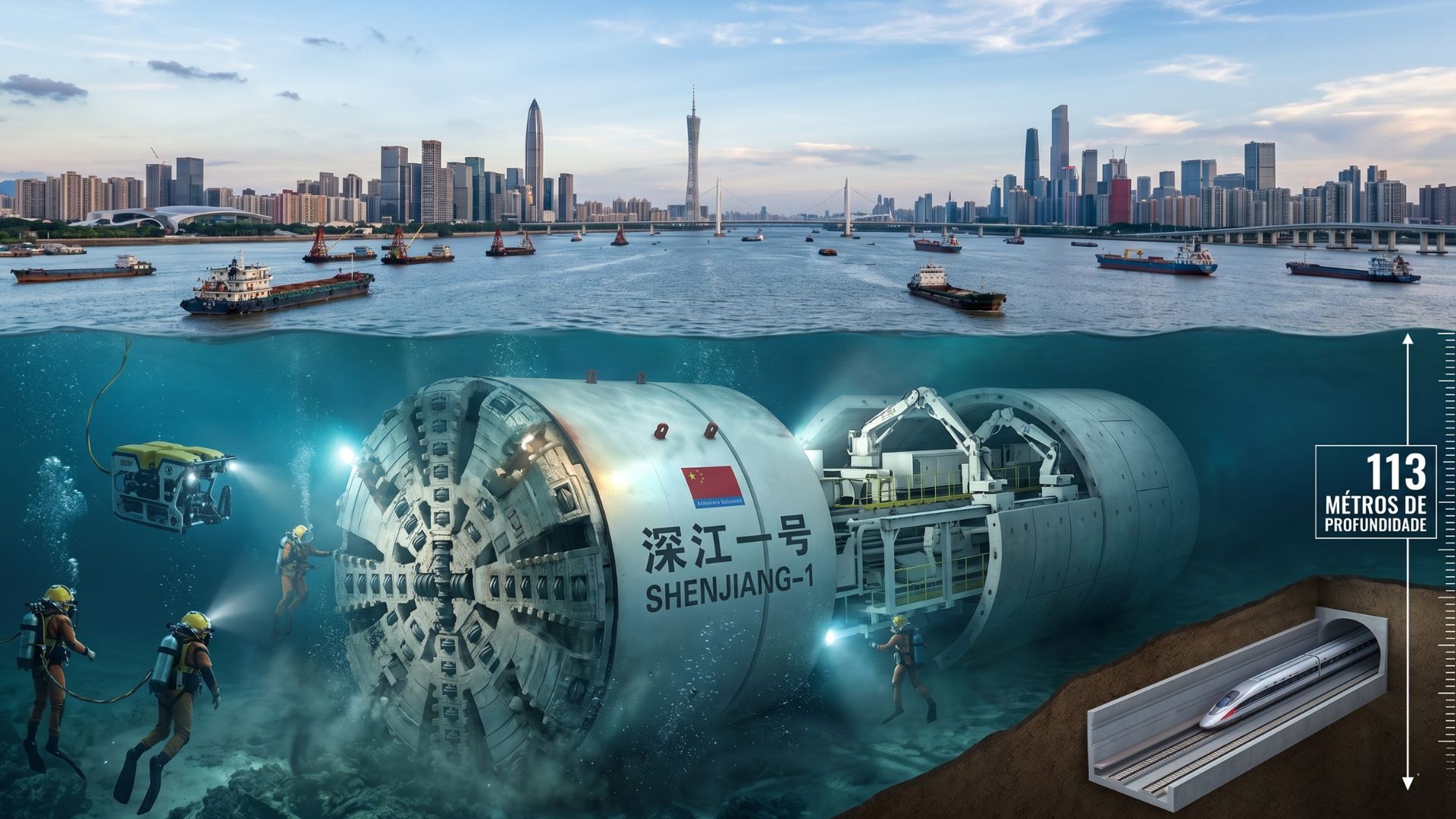
Pearl River underwater tunnel reaches 113 meters below the seabed, uses a 13.42-meter Chinese tunnel boring machine, and will reduce travel between Shenzhen and Jiangmen to less than 1 hour.
According to CGTN, the Pearl River Estuary underwater tunnel, part of the 116 km Shenzhen-Jiangmen high-speed railway, reached a record depth of 113 meters below the seabed in April 2026. This set the world record for the deepest high-speed railway tunnel ever constructed. The tunnel boring machine Shenjiang-1, developed and manufactured entirely in China, has a cutting diameter of 13.42 meters and worked non-stop for four years to advance the first 4 km of the section. The average pace was only 2 meters per day, reflecting one of the most hostile geological conditions ever faced by a tunnel boring machine.
The underwater tunnel will have a total length of 13.69 km and will cross the Pearl River Estuary between Dongguan and Guangzhou, in the Guangdong-Hong Kong-Macau Greater Bay Area. The deepest point is yet to come: engineers project that the tunnel will reach 116 meters below the seabed before ascending towards the other shore.
Pearl River underwater tunnel sets world record for railway depth
The depth of 113 meters below the seabed is not just a record figure. It completely changes the engineering required to keep the excavation front stable, protect the concrete lining, and ensure the tunnel withstands decades of railway operation.
-
China will bury 770,000 km of urban pipes between 2026 and 2030 in a billion-dollar plan targeting floods, old networks, and safer cities.

-
What if a skyscraper could arrive almost ready at the site? Singapore is preparing prefabricated towers with 56 floors, 200 meters high, and complete modules to challenge traditional construction.
-
Commercial buildings emptied by remote work are in Australia’s sights, which wants to transform unused offices into apartments to alleviate the housing shortage.
-
A cabin of just 20 m² built over a vineyard operates without connection to the power grid, accommodates a complete bedroom, kitchen, and wine cellar, and features on the roof a replica of the footprint left on the Moon by astronaut Eugene Cernan in 1972.




Hydrostatic pressure increases by about 1 bar every 10 meters of depth. This means that, at 113 meters below the seabed, the pressure on the structure approaches 11 bar, similar to the pressure faced by divers at extreme depths.
Under these conditions, no worker can normally enter the excavation front. The entire operation needs to be remotely controlled, with the tunnel boring machine’s chamber pressurized by bentonite mud to balance the water and soil pressure.
Shenjiang-1 operates under extreme pressure to excavate high-speed railway tunnel
The Shenjiang-1 tunnel boring machine was designed to work in an environment where pressure failure could cause sudden water ingress, soil instability, and structural risk. Therefore, the excavation system needs to maintain a continuous balance between mechanical advancement, mud pressure, and material removal.
The tunnel lining is made up of precast concrete rings composed of nine segments. Each piece needs to be installed with millimetric precision to withstand high loads and ensure a designed lifespan of 100 years.

This precision is even more critical because the tunnel will accommodate high-speed trains. Any misalignment accumulated over the 13.69 km could compromise the smoothness of the tracks and operational safety at high speeds.
Geology of the Pearl River Estuary has 13 layers and 6 fault zones
The Pearl River Estuary has one of the most complex geological profiles in southern China. The Shenjiang-1 needs to traverse marine sediments, sedimentary rocks, metamorphic materials, and igneous formations accumulated over millions of years.
The section comprises 13 distinct geological layers, 5 types of composite rock, and 6 fault zones. Each layer reacts differently to excavation, requiring constant adjustments in the rotation of the cutting wheel, mud pressure, and advancement speed.
Soft clay can flow when disturbed, fine sand can liquefy under vibration, fractured rock can collapse into blocks, and intact granite quickly wears down tools. This combination explains why the tunnel boring machine advanced only 2 meters per day in part of the work.
Bentonite slurry maintains pressure and prevents water ingress in the underwater tunnel
The slurry shield excavation method is essential in deep underwater tunnels and saturated soils. Bentonite forms a paste capable of supporting the excavation face and preventing water and soil from entering the tunnel.

The first circuit delivers fresh slurry directly to the pressurized chamber. This slurry creates a support barrier against external pressure, continuously calibrated to maintain balance with the surrounding water and terrain.
The control needs to be extremely precise. If the pressure drops, the front may destabilize; if it rises too much, it can cause soil deformations and affect excavation safety.
Two mud circuits keep the Shenjiang-1 working 24 hours a day
The second circuit transports to the surface the mud loaded with debris, mixed with the excavated material. This mixture rises through pipes to a separation plant, where the bentonite is treated and pumped back to the tunnel boring machine.
The volume of material removed is equivalent to filling a tanker truck every hour of operation. Meanwhile, behind the excavation chamber, workers install the concrete segments with the help of a robotic erector.

This system cannot stop in critical sections. The excavation works like a continuous underground factory, where pressure, mud, concrete, sensors, and mechanical advancement need to operate without interruption.
Seven innovations were created for the Shenzhen-Jiangmen high-speed tunnel
The development of the Shenjiang-1 required specific solutions from China Railway Construction Corporation for a rare combination of depth, pressure, and geological complexity. The machine needed to solve problems that conventional tunnel boring machines do not face simultaneously.
The first innovation was the quick-change system for cutting tools under ultra-high pressure, without workers entering the chamber. In conventional tunnel boring machines, this type of maintenance usually requires specialized divers and long decompression protocols.
The second was the in situ disassembly system of the tunnel boring machine in a confined space under the seabed. This solution is necessary because not all points of the estuary allow traditional arrival shafts for machine removal.
Chinese tunnel boring machine uses real-time monitoring and geological emergency protocols
The other innovations include settlement control in ultra-complex soils, real-time monitoring of excavation parameters, thermal management of the pressurized chamber, redundant communication at great depth, and protocols for geological emergency response.
These solutions have been documented as replicable technologies for future underwater projects. This indicates that China is not treating the Shenzhen-Jiangmen tunnel as an isolated project but as a laboratory for a new generation of underwater tunnels.
The accumulated learning can be applied in railway, road, and logistical crossings in other complex estuaries. The Shenjiang-1 not only excavates a tunnel but tests the industrial limit of Chinese tunneling under high pressure.
Greater Bay Area Guangdong-Hong Kong-Macau relies on the tunnel to integrate its shores
The Shenzhen-Jiangmen railway is a priority project of China’s strategy to integrate the Greater Bay Area Guangdong-Hong Kong-Macau, a region with about 86 million inhabitants and a combined GDP close to US$ 2 trillion.
The Pearl River estuary acts as a central geographical barrier. The eastern shore, where Shenzhen and Hong Kong are located, and the western shore, where Guangzhou, Jiangmen, and Zhongshan are located, are close on the map but separated by lengthy crossings.
Today, the journey may require a ferry or road trips of more than 2 hours. With the railway, the time between Shenzhen and Jiangmen will drop to less than 1 hour, and the stretch between Qianhai and Nansha can be completed in about 30 minutes.
Shenzhen-Jiangmen railway should reduce travel time and reshape the regional economy
The reduction in travel time is expected to change the economic logic of the Greater Bay Area. Workers living in Jiangmen will be able to access jobs in Shenzhen more easily, while companies can choose locations previously limited by the estuary barrier.
The tunnel can also reduce logistical costs between the two shores, bringing production chains, free trade zones, and industrial hubs closer together. In a region with high economic density, every minute saved in transportation has a direct impact on productivity.
The project is not just an underground crossing. The Pearl River underwater tunnel will influence where companies set up, where people live, and how one of China’s most productive regions will distribute growth in the coming decades.




-

-

-

-

17 people reacted to this.