






 Portuguese
  Spanish


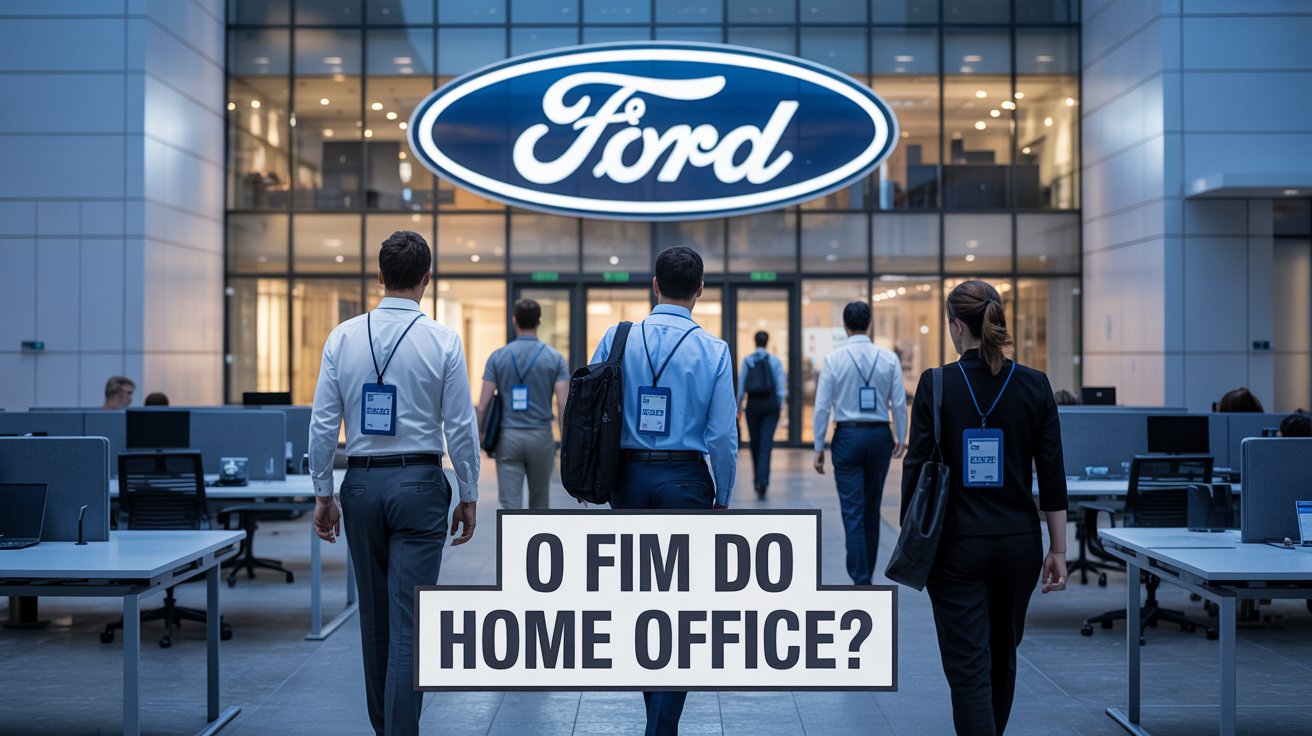

Ford Adopts New Global Policy for In-Person Administrative Work and Changes Employees’ Routine, Reigniting Discussions About Flexibility and Productivity in Large Automotive Companies.
Ford has decided to end the predominant home office model in its administrative offices.
Starting September 1st, the North American multinational has determined that most administrative employees must return to in-person work at least four times a week.
The announcement, made internally on Wednesday, represents a significant change from the hybrid system in place since 2022 and follows a trend of adjusting corporate policies among major global companies in the post-pandemic era.
-
Brazilian Civil Servant Earns $2,800 Monthly but Seeks Legal Help as Bank Loans Consume Nearly 80% of Income

-
Brazilian Pet Industry Giant with $6 Billion Valuation Targets 24 Million Customers, Launches Franchise Model with Six Revenue Streams and $7.80 Subscription Plan for National Expansion

-
Daughter of a Mechanic, Roberta Pirolla Turns Passion for Cars into a Million-Dollar Vehicle Wrapping Business Set to Grow 75% in a Male-Dominated Industry

-
At 30, Thyago Plácido turned Innova into a solar energy operation serving central Brazil with over 300 projects completed.


Change in Home Office Rules at Ford
The previous policy, implemented by Ford in April 2022, allowed in-person attendance for three days a week.
Now, the new guidance reduces remote work to just one day, reinforcing the physical presence of professionals on company premises.
According to Ford’s management, the goal is to increase collaboration, strengthen teams, and accelerate internal transformation to make the company more profitable and resilient in the face of fluctuations in the global automotive market.
In an official statement, representatives of the automaker stated that in-person collaboration is considered strategic to accelerate cultural change and boost the performance of administrative teams.
“We believe that working together, in person, every day, will help accelerate Ford’s transformation,” said spokesperson Ian Thibodeau.
The company, however, did not disclose the exact number of employees affected by the measure, but internal sources indicate that the decision impacts thousands of employees in various countries.
Ford’s Financial Scenario and Motivation for Changes
The context underpinning the decision involves the company’s financial performance.
In the first quarter of 2025, Ford reported a net income of $471 million, representing a 64% drop compared to the same period the previous year.
The lower result led the automaker to suspend forecasts for the fiscal year 2025, justifying the caution due to instability in U.S. tariff policies, as well as volatility in the international vehicle market.
In addition to changes in the work routine, Ford has also implemented cost-cutting measures and enhancing internal performance.
Among these, it stands out the announcement that bonuses paid to managers could be reduced by up to 65%, becoming fully tied to individual and collective performance.
The initiative reinforces the company’s focus on results and the improvement of internal processes.
Other Automakers and the End of Flexible Home Office
The transformation scenario is not exclusive to Ford.
Other automakers, such as Stellantis, are also adopting similar policies.
In March of this year, Stellantis informed employees that in-office attendance would be required between three and five days a week, depending on the area and responsibilities.
The guidance, signed by CEO Antonio Filosa, argues that the in-person environment is crucial for the company’s competitiveness in the global market.
The stricter stance on home office has become a trend among vehicle manufacturers operating across different continents.
Pressures in the Automotive Sector and Challenges for Large Companies
The change comes at a time when the global automotive industry faces significant challenges, including pressures for innovation, technological advances, adaptation to electrification, and fluctuations in demand from traditional and emerging markets.
Automakers are seeking strategies to maintain productivity and collaboration, even after years of experience with flexible and digital models during the Covid-19 pandemic.
The return to in-person work is viewed by some executives in the sector as a mechanism to strengthen organizational culture and ensure agility in decision-making.
Employees’ Reaction and Impacts on the Work Environment
However, the reaction among employees of large corporations is not homogeneous.
While some areas acknowledge the benefits of in-person interaction, other sectors still prefer the flexibility offered by home office, arguing gains in quality of life, time and cost savings, as well as greater concentration for complex tasks.
The topic has become recurring in debates about labor relations, including among unions and employee representatives.
Ford itself had already relaxed the work model in response to the pandemic, when health measures required social distancing and movement restrictions.
With the gradual return to in-person work in 2022, the company adopted a hybrid system as the standard, gradually adjusting the rules as vaccination advanced and operations normalized.
Now, with the more restrictive decision, only one day of remote work will be authorized, leaving employees to adjust to the new routine.
Global Trends for Work Models in 2025
The announcement by Ford is part of a broader movement observed in multinationals from the United States, Europe, and Asia, which have begun to reassess the flexibility policies adopted in recent years.
The most common argument for the return is the need to strengthen teams, improve financial results, and keep pace with the rapid changes demanded by the global automotive market.
The automotive industry is experiencing a period of intense transformations, with challenges related to sustainability, digitalization of processes, production of electric and autonomous vehicles, and increasing competition for talent in technology areas.
In this scenario, the adopted work format can directly impact companies’ capacity for innovation and adaptation.
The Future of In-Person Work at Automakers
In addition to Ford and Stellantis, other manufacturers and large tech companies have also adjusted their policies, whether by requiring a return to in-person work or opting for more restrictive hybrid models.
The debate about productivity, employee engagement, and well-being remains open and promises new developments in the corporate sector.
It remains to be seen whether the mass return to offices will be able to meet the expectations of companies and workers, or if further changes in labor relations are yet to come in the global corporate environment.
What will be the future of home office in large industries in a context of global transformation?


