Portuguese
  Spanish


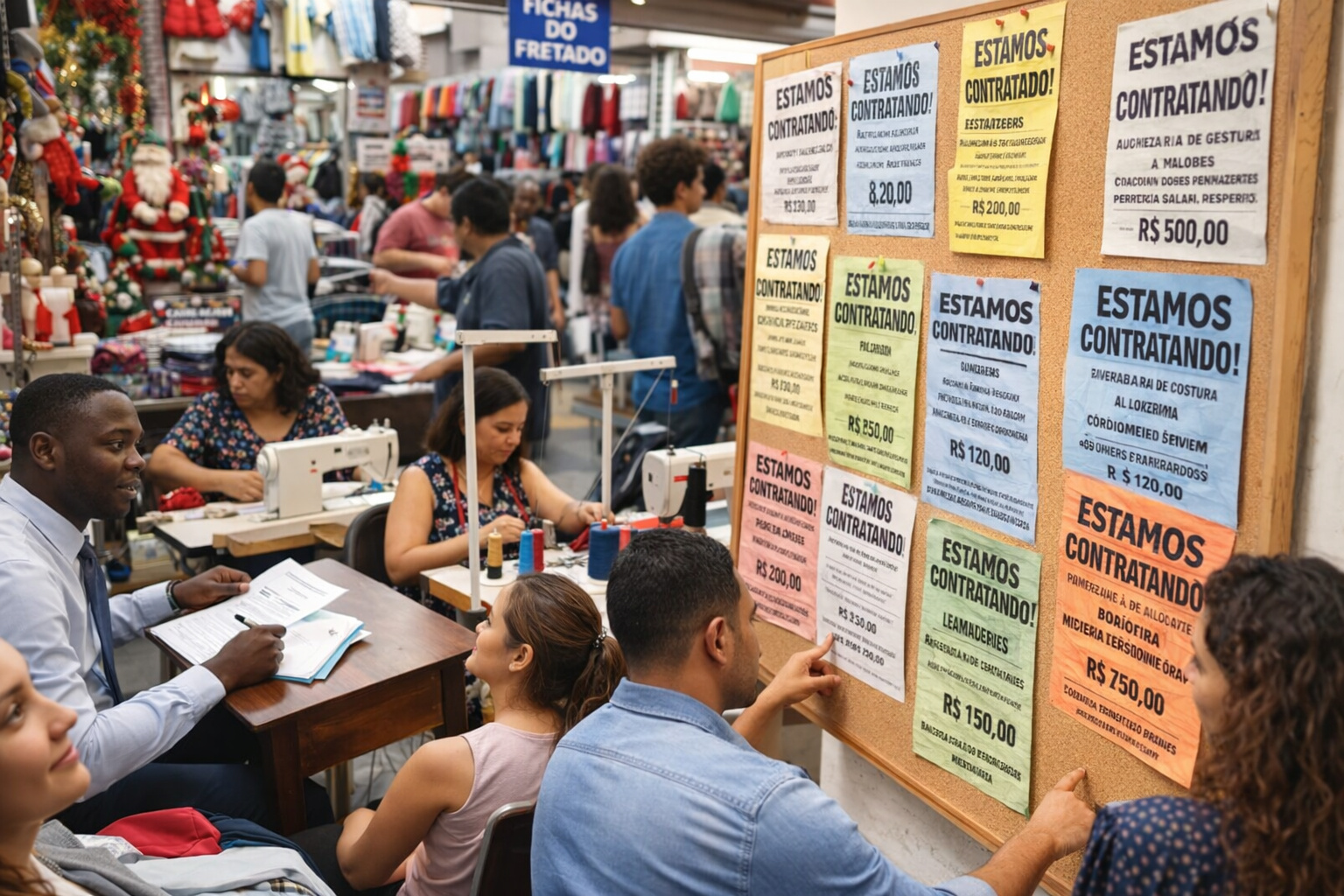


Lack Of Workers In Essential Sectors Forces Companies To Compete For Candidates And Accelerate Internal Changes To Maintain Operations During High Demand
A deep change in the Brazilian labor market has drawn the attention of companies. This transformation occurs because many of them face increasing difficulties in hiring employees. The high demand for labor, especially at the end of the year, intensifies the competition for professionals. Therefore, expanded benefits and new strategies have become essential to keep operations running.
The pressure has increased in regions with high commercial circulation. Thus, thousands of positions remain open without enough candidates. In Brás, São Paulo, about 10,000 opportunities remain unfilled. Bom Retiro presents a similar scenario. “We are facing a labor shortage, especially in technical positions,” explains Cinthia Kim. She highlights that the search for workers has become a constant challenge.
Candidate Shortage Reveals Behavioral Change
Businesswoman Camila runs a store and a sewing workshop. She has 17 employees but needs to hire three more. Many interviews, however, end without attendance. Therefore, the pace of hiring becomes slow.
-
Brazil’s 2026 Tax Refund: Record 9.58 Million Filers in Largest Payout Ever, But a Key Detail on Priority Recipients Draws Nationwide Attention

-
Itaú Alters Hybrid Work Model, Increasing Office Days from 2028, Prompting Employees to Adjust to New Routine
-
Facing Labor Shortage, Japan Plans to Invest $34 Million to Attract Foreign Workers in Construction, Healthcare, Industry, and Commerce

-
Brazilian City Makes Remarkable Leap, Becomes 4th Wealthiest in the Country with GDP of R$ 134.1 Billion




Several candidates claim that distance is a problem. Others cite difficulties with transportation. Some still prefer jobs close to home, even with lower salaries. Additionally, many opt for home office or freelance work. This reduces adherence to traditional hiring models.
This movement leads companies to turn to temporary work. Consequently, freelancers become essential for maintaining basic production and service routines. Elismayane Lima Bezerra states that she has worked as a registered employee but had to shift to freelance. She made this decision due to family demands. Tatiane Aparecida also works only on available days, and this depends on her son’s routine. For this reason, she emphasizes the need for flexibility.
Low Unemployment Intensifies Competition Among Companies
The low unemployment rate in the country creates a scenario of limited supply of professionals. Thus, the competition for qualified workers increases significantly. Experts point out that self-employed activities, such as app drivers and delivery workers, expand options for candidates. This makes it more difficult to attract fixed labor.
This combination of factors leads companies to adopt different retention mechanisms. Therefore, expanded benefits and operational adjustments have become decisive strategies.
Structural Adjustments Become Essential To Attract Workers
A logistics company restructured its work schedule. It replaced the 6×1 regime with a 5×2 schedule. This provided better quality of life for employees. “5 by 2 is very good; it’s really life,” asserts Caíque Dias. He emphasizes that the routine has become more balanced.
The company also implemented bonuses. The amount of R$ 250 for attendance motivated workers. Another bonus of R$ 150 for referrals helped strengthen the workforce. As a result, the work environment became more stable.
In addition to these benefits, there were improvements in chartered transportation. Thus, the commute became more comfortable. Isabel Menendez, HR Director at Loggi, explains that several adjustments were made. “We made a series of changes, not just in salaries, but also in benefits,” she states. She emphasizes that “everyone wins” with the implemented adjustments.
Impacts Of This Change On The Corporate Environment
The internal reorganization shows how the lack of workers has transformed the traditional logic of the market. In this way, flexibility has become a structural requirement for many companies. The combination of increased benefits and remodeling of work hours indicates that the corporate environment will need to continuously adapt. This will be necessary to avoid stoppages and maintain productivity.
The pressure tends to grow as the behavior of workers evolves. Therefore, new strategies will need to emerge to balance costs, efficiency, and job satisfaction.
In light of this scenario, a central question remains. To What Extent Will Companies Be Able To Sustain This Pace Of Adjustments To Ensure A Stable Workforce In Such A Competitive Market?