





 Portuguese
  English
  Spanish
  4 min of reading
  0 comments


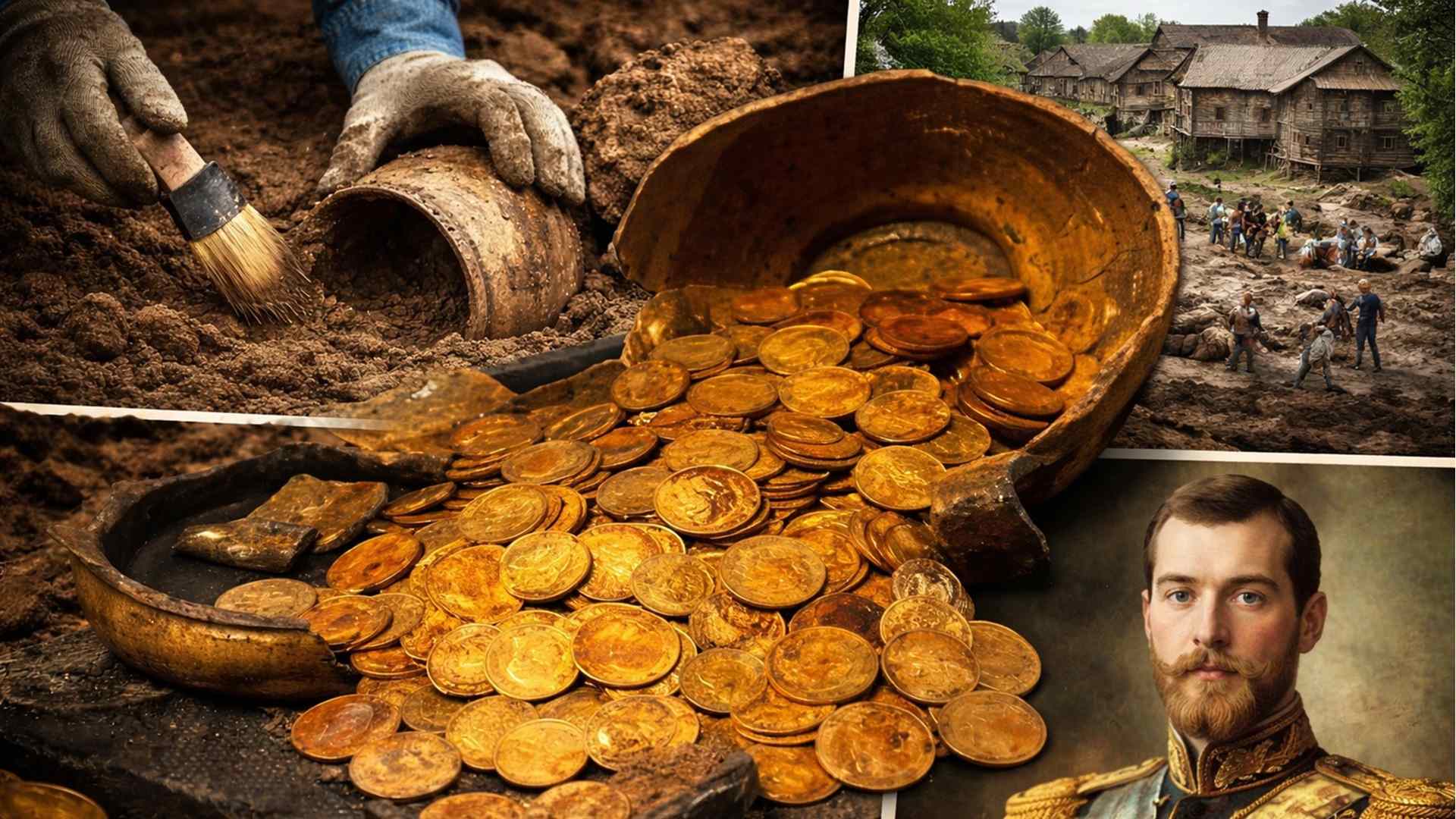
Archaeological Excavation Conducted in 2025 on Sadovaya Street in the Historical District of the Left Bank of Torzhok in Tver, Russia, Revealed a Treasure Composed of 409 Gold Coins Dated Between 1848 and 1911, Hidden During the Turbulent Period of the Russian Revolution and Possibly Buried by an Owner Who Never Managed to Return to Recover His Wealth
Archaeologists found a treasure with 409 gold coins buried beneath a historic house in Torzhok, Tver region, during a rescue excavation carried out in 2025. The collection of coins dates back to the Russian Revolution and includes pieces minted between 1848 and 1911.
Discovery of the Treasure Beneath a Historic House in Torzhok
The discovery of the treasure occurred during archaeological work conducted prior to the start of construction on Sadovaya Street in the historical district of the left bank of Torzhok.
The excavation was conducted by the Institute of Archaeology of the Russian Academy of Sciences in cooperation with the Historical and Ethnographic Museum of the Russia.
-
Far from football, São Paulo idol and former national team player becomes a wine producer in Italy, transforms the nickname “Prophet” into his own brand, and now runs a winery, restaurant, and hotel in Piedmont.

-
Train of up to 111 tons leaves China for Brazil, crosses almost 20,000 km in up to 70 days by ship, and arrives in São Paulo in such a tight operation that a truck even had to deflate its tires to pass under a viaduct.
-
A small town with 800 inhabitants in the interior of the United States is giving away free land, with water, electricity, and paved streets, and even offers a cash allowance for families with children, all to attract residents and escape the depopulation threatening rural villages.

-
At about 9 meters deep in the sea of Sicily, divers recovered a 2,500-year-old marble horse attributed to the colossal Temple of Zeus in Agrigento, a piece that, if confirmed, would be the largest archaeological discovery in the region in a century.




The investigated area covers approximately 2,712.51 square feet and was analyzed as part of a preventive excavation. During the work, the archaeologists dismantled the stone foundation of an old wooden house that existed on the site.
It was at this moment that an unexpected object emerged. A small jar with a narrow neck known as a “kandyushka,” with brownish-yellow enamel, appeared broken on the stones, revealing a treasure composed of dozens of scattered gold coins.
Collection of Gold Coins Linked to the Russian Revolution
The treasure altogether comprised 409 gold coins associated with the period of the Russian Revolution. According to the archaeologists, this is possibly a so-called “returned treasure,” a term used when the owner hides valuables with the intention of recovering them later.
In this case, it is believed that the owner intended to return to retrieve the hidden wealth. However, the turbulent events of the time appear to have prevented this from happening, leaving the collection of coins buried for over a century.
The Russian Revolution marked the end of the monarchy in the country and led to the establishment of a Marxist government. The period is known for dramatic episodes linked to the imperial family, including the story of Princess Anastasia, daughter of Tsar Nicholas II.
Dates and Characteristics of the Coins Found
According to Natalia Sarafanova, head of the archaeological team from Novotorzhsk, most of the coins belong to the reign of Emperor Nicholas II. However, the treasure includes pieces from different periods of Russian imperial history.
The oldest coin identified in the collection is a five-ruble piece dated 1848, minted during the reign of Emperor Nicholas I. Another coin was issued during the reign of Alexander III.
A large portion of the coins was produced during the reign of Nicholas II. Among them, the most recent was minted in 1911, just a few years before the fall of the Russian monarchy.
Monetary Reform of 1897 Appears in the Treasure of Coins
The treasure also includes coins created during the monetary reform of 1897 led by Prime Minister Sergei Witte. Among the examples found are two coins worth 7.5 rubles and another ten coins valued at 15 rubles.
Summing up all the pieces, the face value of the treasure amounts to 4,070 rubles in gold. According to estimates presented in the official statement, this amount corresponds to approximately 250 thousand dollars in current values.
The collection found represents one of the most significant sets of gold coins associated with the period of the Russian Revolution. Therefore, the archaeological material attracted immediate attention from researchers and cultural institutions.
Mystery About the Owner of the Treasure Remains Unresolved
Despite the detailed discovery of the treasure and the coins, the identity of the owner remains unknown. Historical records indicate that there were 24 residences in the block where the collection was buried.
Among the possible residents were clergy, merchants, a treasurer, accountants, and artisans. Even with this reduced list, identifying the exact owner remains difficult, as the addresses from 1917 did not follow the same organization as today.
Investigations continue in search of clues that may clarify the origin of the treasure. In the meantime, the Historical and Ethnographic Museum of All Russia, located in Torzhok, is preparing a public exhibition to present the coins to the public.









-

-

-

7 people reacted to this.