Portuguese
  Spanish




Case Involving Office in Mumbai and Oil Tanker Near Singapore Raises Alerts About Sanctions, Tracking Manipulation, Poor Working Conditions, and Risks Faced by Crews in Obscure Maritime Operations
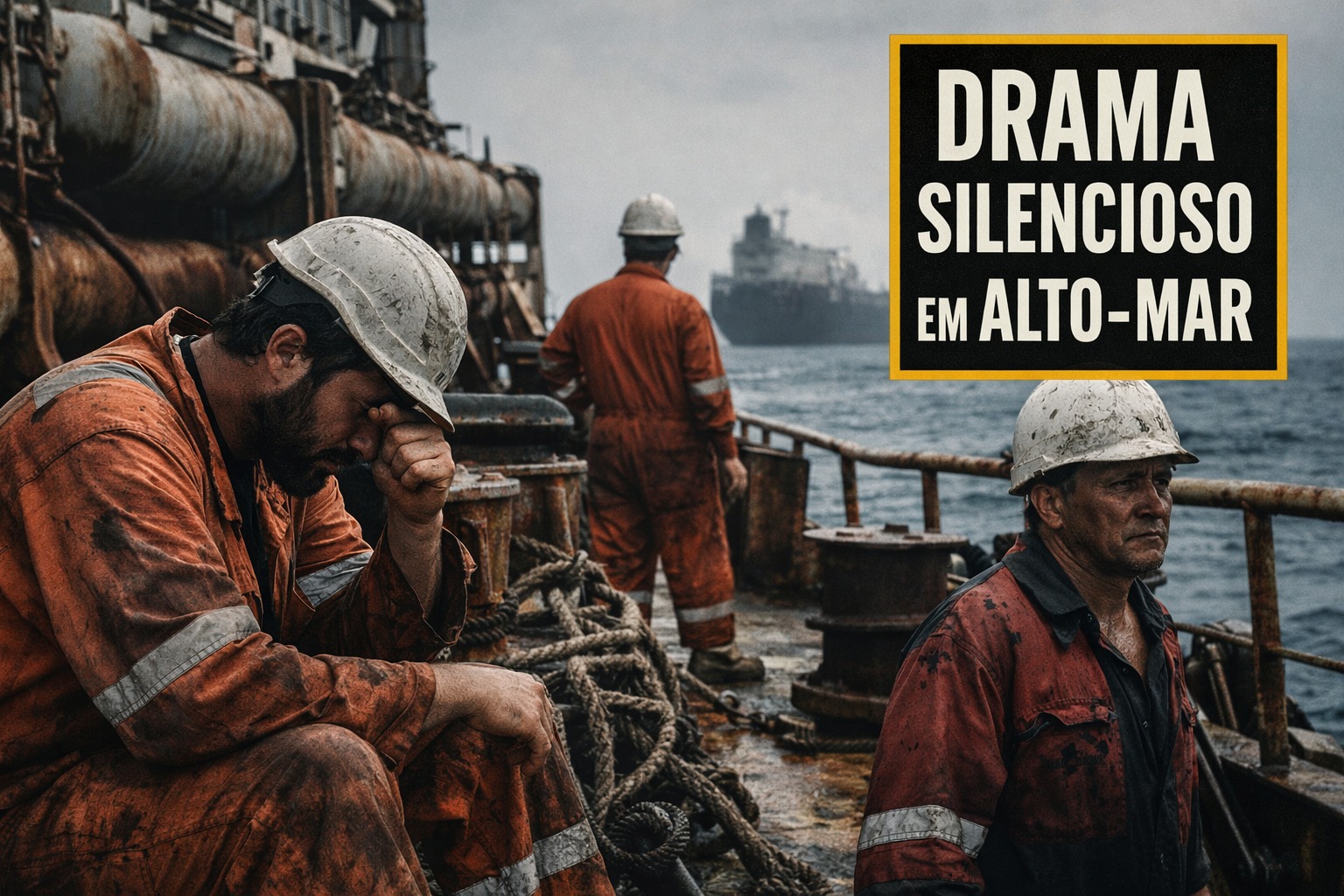
At the end of January, an urgent email broke the routine of an office in Mumbai. The message, attributed to a crew member of an oil tanker near Singapore, described a tense situation: overdue wages, degrading treatment, and supplies nearing the limit. The alarmed tone was not uncommon for those who deal daily with complaints from seafarers. Still, there was something different about this case.
A Warning That Crossed Borders
The Indian team works for the International Transport Workers’ Federation (ITF), an organization that represents seafarers globally. Complaints are part of the usual flow.
What caught attention was the reach of the recipients. In addition to several offices of the ITF itself, the email had also been forwarded to agencies linked to the enforcement of international sanctions, amplifying the weight of the account.
-
A Brazilian street cleaner built a machine to recycle PET bottles in the hinterlands of Paraíba, transforming the trash he swept from the streets into threads, brooms, and equipment sold even outside Brazil, and began earning about R$ 7,500 per month with his own invention.

-
In a city where every piece of land is worth gold, he began buying plots in the 1960s and built a real estate empire with over a thousand properties.

-
An artist sank over 500 life-sized human statues at the bottom of the Caribbean Sea, and what seemed like macabre art turned into a living reef covered with corals that attracts divers from all over the world.

-
A fossil kept for years in a small museum in Montreal concealed 450-million-year-old soft tissue, a discovery that has only happened once before in history.


In the body of the text, a disturbing statement: the ship operating under the name Beeta would actually be the Gale, a vessel sanctioned by the United States.
The suspicion aligns with an increasingly cited phenomenon in oil shipping, the so-called “ghost fleet,” formed by ships that adopt strategies to obscure the identity, origin, and destination of their cargoes.
The Expansion of the “Ghost Ship Fleet”
Recent estimates from TankerTrackers.com indicate 1,468 vessels operating in this circuit, nearly three times the number recorded four years ago. This contingent represents about 18 to 19% of the global commercial cargo fleet.
According to Michelle Wiese Bockmann from Windward AI, these ships account for approximately 17% of all crude oil transported by sea.
Although the issue has gained visibility amid recent conflicts, experts remind us that the roots trace back to the 2010s.
Countries under sanctions, such as Iran and North Korea, began to resort to similar methods. Today, the practices have become more sophisticated.
Among the characteristics most associated with these operations are aging ships, with an average age close to 20 years, irregular maintenance, opaque ownership structures, frequent name changes, flag swaps, and identification numbers, along with insurance below Western standards — in some cases, nonexistent.
Invisible on the Radar
Another recurring tactic is the manipulation of AIS, the automatic identification system responsible for transmitting the positions of vessels.
By turning off or tampering with the signal, the ship becomes harder to track. For those on board, this can mean almost complete isolation and additional difficulties in reporting problems.
Seafarers are often hired for periods of six to nine months. They do not always have clarity about the type of operation they will face.
Denis, a Russian engineer who worked on the oil tanker Serena, claims he only discovered after boarding that the ship was under sanctions. Pressured by the need to keep his job, he decided to stay.
Onboard Accounts
Over time, according to Denis, the conditions worsened. Spare parts stopped arriving, essential equipment failed, and safety systems began to malfunction.
During a stop in Vladivostok, the crew attempted to fix a winch used for lowering lifeboats but without success.
Despite this, an inspection certificate was issued. Denis reports never having clearly identified the ship’s owner or to whom he could formally turn.
For ITF inspectors, similar stories arise frequently. Nathan Smith sums up the perception of many crew members: at sea, they become functional prisoners of decisions made on land, often by shell companies that dilute responsibilities.
“Zombie Ships” and Swapped Identities
Within this universe, analysts also describe the so-called “zombie ships.” After facing sanctions, these vessels disappear from systems and reappear with a new identity, sometimes using registration numbers linked to decommissioned ships.
The Gale is cited as a typical example. Data from Kpler indicates that the oil tanker adopted multiple identities and operated under a flag considered false.
Reviewed records point to incidents of spoofing, a technique that simulates unreal geographic positions.
In screenshots, the ship first appeared to the east of Singapore and, minutes later, near the Indian coast, thousands of kilometers away. For analysts, the pattern is consistent with deliberate manipulation.
Transfers at Sea
“Ship to ship” operations are also central elements. By transferring cargo at sea, the tracking chain becomes fragile.
Regions in Southeast Asia are often cited as sensitive areas for this type of activity.
Governments, in turn, are intensifying responses. Among the measures discussed are additional sanctions, requirements for proof of insurance, and, in specific situations, seizure of vessels.
The actions involve high costs, legal challenges, and diplomatic risks.
As the debate progresses, the lives of seafarers remain at the silent center of this machinery. Amid uncertain contracts, long hours, and variable conditions, many continue navigating in a sector where, far from shore, basic rights can become unstable.
Amid complex routes and swapped identities, the onboard stories remain, often known only when a distress call breaks the digital silence — and reaches the inbox of some distant office.
With information from BBC.