






 Portuguese
  Spanish


With 10,000 Horsepower and 5,800 Tons, the Mega-Shredder Lindemann Revolutionizes Recycling by Crushing Up to 450 Cars Per Hour. This Giant Machine Transforms Entire Vehicles into Raw Materials and Moves the Global Steel and Aluminum Industry.
Few people imagine that the fate of an end-of-life car can be decided in a matter of seconds, thanks to the largest Mega-Shredder Lindemann in operation in the world.
Installed at the Sims Metal Management facility in Jersey City, United States, this 10,000-horsepower recycling machine that crushes 450 cars per hour has changed the landscape of the automotive industry and scrap reuse.
Weighing an impressive 5,800 tons, it is heavier than a Boeing 747 and represents the pinnacle of technology aimed at sustainability in the heavy recycling sector.
-
Metal Detectorist Uncovers Up to 15,000 Roman Coins in Wales, Potentially the Largest Find of Its Kind in the Country

-
Top U.S. Bank Executive Fired After Dumping Trash on Street, Taking Bin Home, and Receiving Two Fines
-
Brazilian Man Arrested After FBI Alert on AI-Reported Plot to Harm Son and Attack Schools, Churches, and Officials
-
2,500-Year-Old Bronze Artifacts Unearthed by Detectorist in Eastern Poland





How the Mega-Shredder Lindemann Works
The operation of the Mega-Shredder Lindemann is a spectacle in itself.
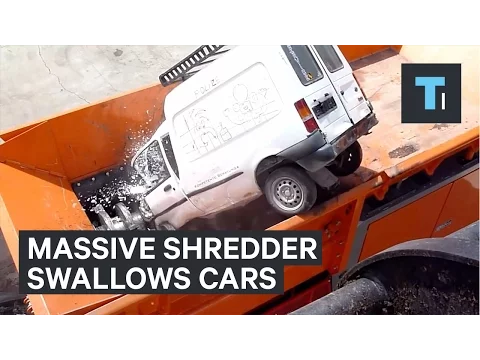
Entire vehicles, including bodies, engines, and tires, are fed into a conveyor belt and disappear amidst a deafening noise.
In less than ten seconds, each automobile is transformed into pieces of metal, plastic, and rubber that will be sent to new industries, restarting the production cycle.
This agility is crucial in a country that needs to discard millions of vehicles every year.
Record Productivity and Energy of a City
At the Sims Metal Management facility, the Mega-Shredder Lindemann operates full-time and can process around four thousand tons of materials daily.
The energy consumed during one hour of operation would be enough to power a city of up to 15,000 inhabitants, revealing the magnitude of the infrastructure needed to handle so much power and productivity.
It is no wonder that the 10,000-horsepower machine that crushes 450 cars per hour has become a global benchmark for efficiency and innovation.
Technology, Strength, and Safety in Recycling
The strength of the Mega-Shredder Lindemann is impressive due to its power.
To maintain continuous operation, the equipment is equipped with state-of-the-art hydraulic systems and high-performance electric motors, controlled by computers that monitor temperature, vibration, and consumption in real-time.
If any unidentified material is inserted along with the cars, automatic sensors interrupt the cycle in milliseconds, preventing damage and unexpected stoppages.

Environmental Impact and Circular Economy
The environmental impact of this innovation is undeniable.
Recycling entire vehicles significantly reduces the need for metal mining, decreases the volume of waste in landfills, and contributes to the circular economy.
It is estimated that, just at this facility, more than 250,000 tons of steel, aluminum, and copper are reused each year, generating income for hundreds of workers and driving a production chain that depends on this constant flow of raw materials.
What Happens After Crushing Cars with the Mega-Shredder Lindemann
After passing through the Mega-Shredder Lindemann, the metallic residues are separated by large electromagnets, while plastics and rubbers go on to mechanical sorting.
The steel fragments return to the steel industry, where they are transformed into beams, pipes, and automotive parts.
The aluminum is exported to Asian countries, where it will have a second life in electronics and soda cans.
Nothing is wasted: even the dust generated is filtered to prevent air pollution.
Safety, Innovation, and Future of the Mega-Shredder Lindemann
Safety is another central factor in the operation of the Mega-Shredder Lindemann.
To operate it, strict protection protocols are required.
Workers receive continuous training, use personal protective equipment, and monitor the operation via remote systems, reducing direct exposure to the risky environment.
Throughout the plant, temperature, smoke, and vibration sensors ensure early detection of any anomalies.
The technology of the Mega-Shredder Lindemann evolves every year.
Newer models already use artificial intelligence to identify non-recyclable materials and even automatically separate higher-value components.
The trend is that soon machines like this will become even faster, more efficient, and sustainable, increasing the capacity to process waste and reducing industrial production costs.
In addition to the environmental gain, there is technological advancement that positions this sector among the most innovative in the world.
Given the fascination and the environmental impact brought by the Mega-Shredder Lindemann, are we prepared to see even larger and more powerful machines changing the way we recycle everything around us?


