Portuguese
  Spanish


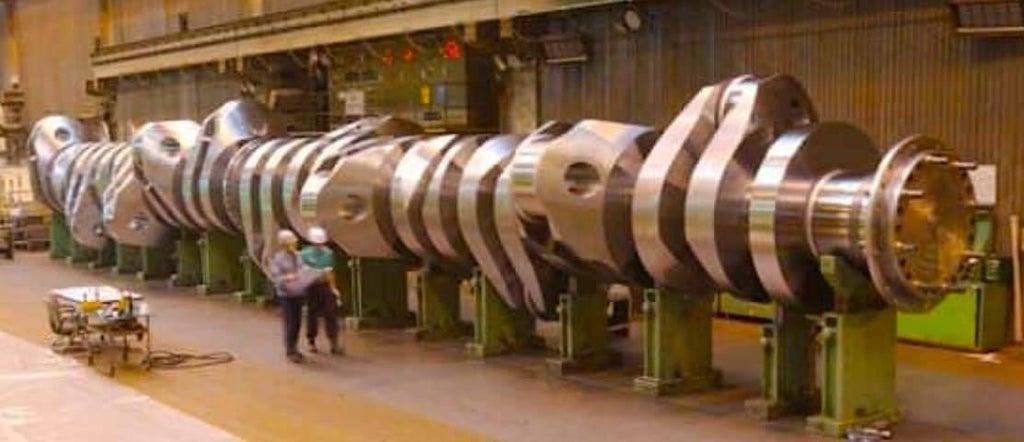


Giant Engines Are Essential For Industries And Maritime Transport, Requiring Robust And High-Strength Components. The Largest Crankshaft Ever Built Belongs To A 107,390 Horsepower Diesel Engine, Impressing By Its Size And Capacity To Withstand Colossal Forces.
On social media, an image of an enormous crankshaft is often shared. Therefore, we decided to seek more information to better understand this engineering marvel. It is the crankshaft of the Wärtsilä-Sulzer RTA96-C engine.
With 13.5 meters in height, 26.59 meters in length, and a weight exceeding 2,300 tons, the Wärtsilä-Sulzer RTA96-C is one of the greatest achievements of modern engineering. It produces an impressive 80.1 megawatts (107,390 horsepower) and powers some of the largest container ships ever built.
The Wärtsilä-Sulzer manufactures several models of this series, all in-line, ranging from six to 14 cylinders. However, the most famous image of this engine circulating on the internet is actually from the smaller version with six cylinders, and not from the complete version with 14 cylinders.
-
Brazil Constructs First Japanese SABO Barrier in Nova Friburgo to Prevent Landslides, a $3 Million Concrete Trap for Rocks, Logs, and Mud

-
Brazilian Navy’s Technology Plays Strategic Role in Future of Small Modular Reactors, Boosting Nuclear Energy Capacity with Innovative Solutions for Power Generation and Industrial Applications

-
China Surpasses U.S. and Russia Combined in Submarine Production
-
Xiaomi Unveils Smart Glasses in Brazil with 12MP Camera, 4K Video, and AI Features, Challenging Ray-Ban Meta


Impressive Technical Specifications
The dimensions and capacity of this engine challenge any comparison with conventional engines. Here are the key numbers:
- Configuration: Two-Stroke Turbocharged Straight Diesel Engine, 14 Cylinders
- Cylinder Diameter: 960 mm (38 in.)
- Piston Stroke: 2500 mm (8.2 ft)
- Displacement: 25,592 liters (1,556,002 in³)
- Speed: 15–102 RPM
- Power Per Cylinder: 5,720 kW
- Total Power: 80,080 kW (107,390 hp)
- Torque: 7,603,850 Nm at 102 RPM
- Fuel Consumption: 250 tons per day
- Crankshaft Weight: 300 tons
- Weight of Each Piston: 5.5 tons
- Height of Each Piston: 6 meters
- Fuel Type: Heavy Fuel Oil
With a torque of nearly 8 million newton meters, this engine is equivalent to more than 11,000 Toyota LandCruiser Series 300 operating simultaneously.
Structural And Functional Differences
Although it follows similar principles to common diesel engines, the Wärtsilä-Sulzer RTA96-C has notable differences:
- The piston is not directly connected to the connecting rod, but rather to a sliding crosshead, which reduces lateral wear and improves cylinder durability.
- Conventional diesel engines often experience ovalization of the cylinders over time due to the lateral movement of the connecting rod. The crosshead solution avoids this problem.
- This is a two-stroke diesel engine, with uniflow exhaust, similar to Detroit Diesel engines.
- The intake system is done through ports in the cylinders, while the exhaust gases exit through valves at the top of the cylinder head, hydraulically activated.
Efficiency And Economy
One of the most impressive characteristics of this engine is its thermal efficiency above 50%. This means that more than half of the energy contained in the fuel is directly converted into motion.
For comparison, common automotive engines have a maximum efficiency of approximately 25%.
Its fuel consumption is a crucial factor for its operation. A cargo ship can spend millions of dollars on fuel per trip, making the engine’s high efficiency essential.

The Engine Behind The Emma Maersk
The Emma Maersk, which was once the largest container ship in the world, is one of the sea giants powered by the Wärtsilä-Sulzer RTA96-C.
With a length of 397 meters and a gross tonnage of over 170,000 tons, this ship can transport up to 15,000 containers in a single trip.
At full speed, the engine can propel the ship to 25.5 knots (approximately 50 km/h), an impressive number for a vessel of this size.
The engineering of this engine has revolutionized maritime propulsion, ensuring that modern ships can operate more efficiently and with a lower environmental impact.