






 Portuguese
  Spanish


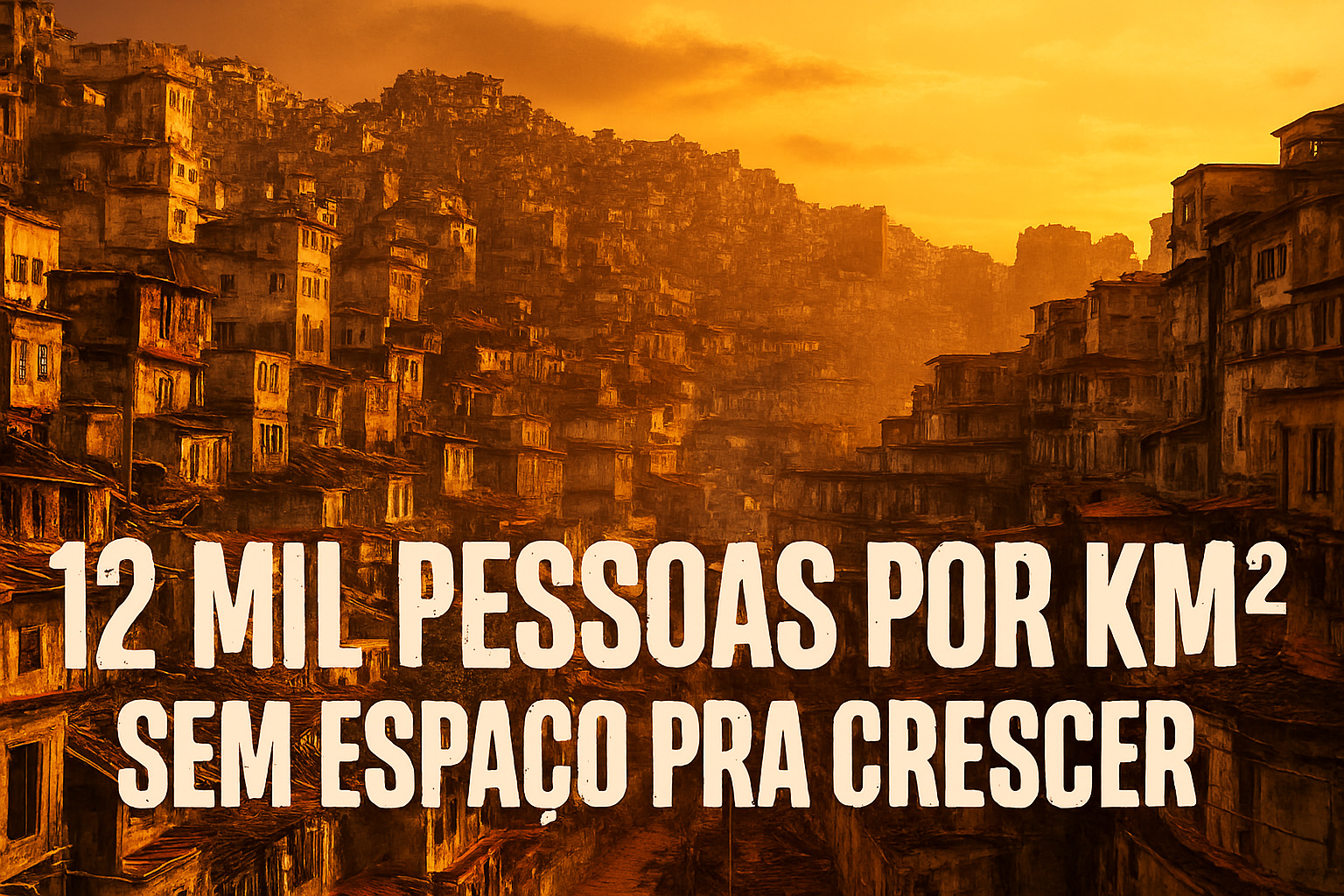

With 12,000 People Per Km², Diadema (SP) Surpasses Singapore, India, Bangladesh, Japan, and South Korea in Density and Faces the Challenge of Growing Among Hills, Alleys, and Narrow Streets Without Space to Expand.
In the heart of the São Paulo Metropolitan Region, there is a municipality that, at first glance, seems like a simple extension of the capital. But a closer look reveals that it is one of the most impressive urban phenomena in the country. With 12,176 inhabitants per square kilometer, according to IBGE, this city surpasses the population density of global megacities like Japan and South Korea, and daily experiences the effects of limited space: heavy traffic, cramped housing, and streets so narrow that they barely allow two cars to pass side by side.
The city in question is Diadema (SP), one of the most compact and densely populated in Brazil. With only 30.7 km² of total area and an estimated population of over 390,000 people, the municipality has turned into a true urban anthill, where physical growth is practically impossible — and vertical and social growth have become the only viable options.
A Small Territory That Became an Industrial Powerhouse
The history of Diadema begins with a characteristic that still defines the municipality: the lack of space. Officially created in 1959, after splitting from São Bernardo do Campo, the city grew rapidly driven by the industrialization of the ABC Paulista. In the 1970s and 1980s, the advance of factories, rural exodus, and migration of workers from the Northeast caused the population to explode — literally.
-
Going to travel and leave your pet alone? Brazilian city creates strict rule, targets temporary abandonment, and can fine dog and cat owners up to R$10,000.

-
Traffic jammed between BH and Nova Lima may get significant relief with the Viaduto Ferradura, a R$ 48 million project that promises to connect MG-30 and MGC-356 without passing through the Belvedere junction.

-
Rio Pinheiros catches the attention of those passing by the bike path with less strong odor, more capybaras and birds on the banks, a reduction of up to 55% in organic matter, and a record removal of trash in São Paulo.
-
Heavy metals in the sea, fishermen without income, and concerned residents: chemical contamination in São Tomé de Paripe leads Salvador to declare an environmental emergency for 90 days and mobilize municipal agencies.



In less than three decades, Diadema jumped from 35,000 inhabitants to nearly 400,000, a growth of over 1,000%. Factories established themselves in peripheral areas, while workers built their homes on steep terrains and irregular lots.
The result was a dense and disordered urbanization, marked by alleys and short streets that meander between hills.
Today, Diadema houses one of the largest clusters of small and medium industries in the State of São Paulo, with a focus on the metallurgical, automotive, plastic, and chemical sectors. There are thousands of microenterprises and warehouses scattered among residential areas, in an urban mosaic where work and housing coexist without defined boundaries.
Where Space Is Limited, Growth Is Vertical
With virtually all of its territory occupied, the municipality has begun to bet on verticalization as an expansion strategy. Mid-rise buildings replace old single-story houses, and areas that were once industrial are starting to host popular condominiums and housing complexes. The problem is that, even with new buildings, the population density remains extremely high.
The density of Diadema (12,176 inhab/km²) already exceeds that of cities like Hong Kong (7,200 inhab/km²) and Seoul (10,000 inhab/km²), according to data from IBGE and UN-Habitat. In neighborhoods like Serraria, Eldorado, and Canhema, the occupancy is so intense that the distance between one house and another barely reaches one meter.
This extreme concentration brings constant challenges: the supply of water and energy, garbage collection, stormwater drainage, and urban transport need to operate with millimetric precision to serve a population compressed between walls and slopes.
A Human Anthill with the Pace of a Metropolis
Despite its small size, Diadema has the life of a large city. More than 100,000 vehicles circulate daily on narrow streets, hundreds of bus lines connect the municipality to São Paulo and neighboring cities, along with a commercial network that keeps growing.
In the center, popular markets and street vendors share space with banks, clinics, colleges, and shopping malls. During peak hours, the sidewalks are filled with pedestrians, and the sound of horns and motorcycles echoes everywhere.
The feeling is of a metropolis condensed into a minimal space. Everything is just a few minutes away, but everything is always crowded. Diadema has become a synthesis of modern urban Brazil: cramped, pulsating, challenging, and resilient.
Social Advances and Urban Challenges
During the 2000s, Diadema gained national prominence by drastically reducing violence rates. In 1999, it was considered one of the most violent cities in the country; ten years later, it became an example of public safety, thanks to integrated policies on urbanization, culture, and community policing.
The city also stands out for preventive health programs and access to technical education. The Municipal Human Development Index (IDHM) rose to 0.757, close to that of developed countries, indicating that even under urban pressure, it is possible to improve the quality of life with consistent policies.
But challenges remain. The lack of green areas, increasing traffic, and real estate speculation pressure a territory that already has nowhere to grow. Verticalization helps, but also increases the demand for infrastructure — a constant dilemma for a city compressed between hills and highways.
A City Without Space, But Full of Life
Diadema is a rare example of compact urbanization in a country used to horizontal growth. It is a city that has learned to reinvent itself within its own limits, stacking dreams, families, and stories in every available square meter.
Among alleys and narrow streets, concrete reigns, but life, culture, and movement also pulse. The sounds of motorcycles, children playing, and businesses stretching onto sidewalks are part of a routine where every space matters, every meter is contested, and each resident becomes part of a large collective machinery.
If space is lacking, humanity abounds. Diadema shows that even in cities where the sun hardly reaches the ground, there is still room to grow — not sideways, but upwards, forward, and primarily within itself.





I just wanted to drop by and say how much I appreciate your blog. Your writing style is both engaging and informative, making it a pleasure to read. Looking forward to your future posts!