






 Portuguese
  Spanish


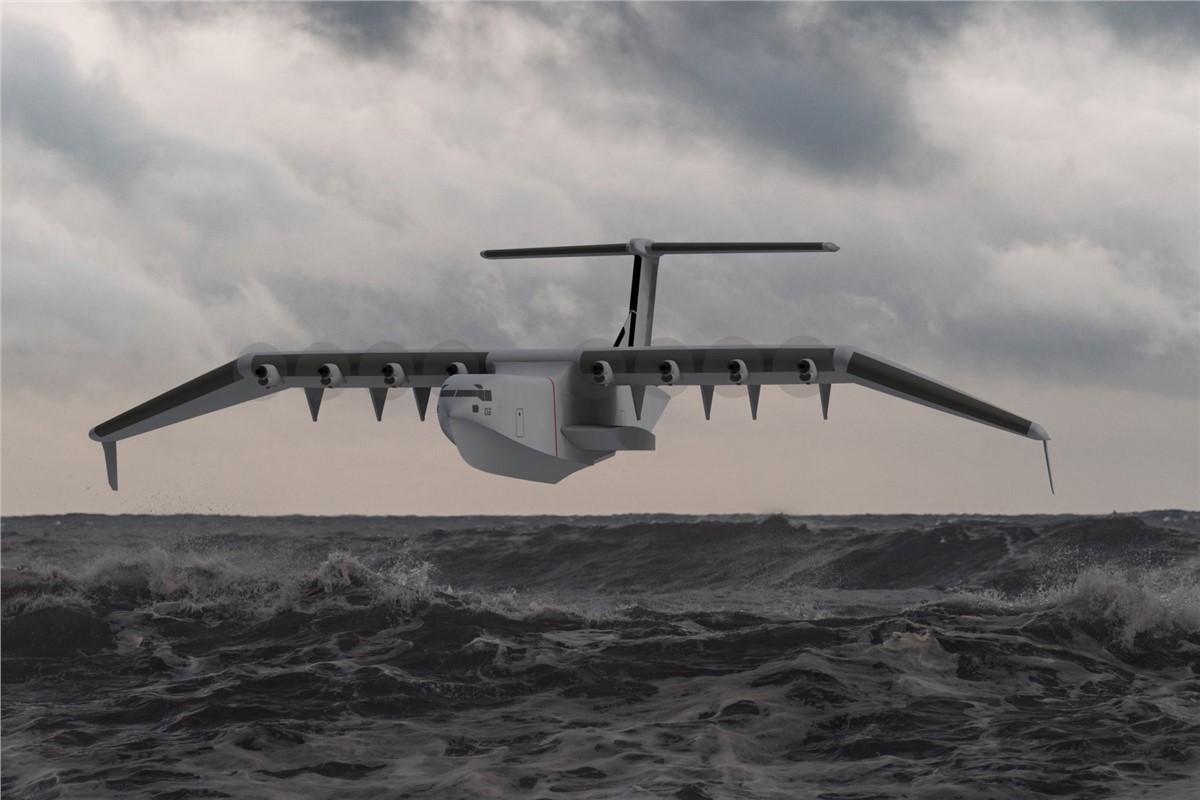

The DARPA (Defense Advanced Research Projects Agency) of the United States Selected Teams of Companies to Work on the Liberty Lifter Project.
The agency will fund the development of a large seaplane, capable of operating in all respects like a ground effect vehicle.
According to DARPA’s announcement, this is still the first phase of the program, lasting about 18 months, including six months of conceptual project work, and nine months of project maturation.
There will then be more than three months for manufacturing planning and additionally, the analysis of test/demonstration planning. The two participating teams presented different concepts in response to DARPA’s request.
-
New Smart Radar Begins Issuing Fines to Solo Drivers in Carpool Lanes, Uses Cameras to Count Occupants, Changing Traffic Enforcement Rules on Busy European Roads

-
Brazil Welcomes Spanish Wamos Air and Nigerian Air Peace, Potentially Transforming International Routes and Increasing Competition
-
Why can the crane operator only obey the correct signalman on the construction site: among dozens of workers, a hand raised by the wrong person can confuse the maneuver and turn a load of tons into an immediate risk.
-
What changes with the new public transportation rules that can reduce pressure on fares and pave the way for zero fare in Brazil?



The most exotic design was from General Atomics and Maritime Applied Physics Corporation, which designed the seaplane with: two fuselages, a mid-wing, 12 engines, turbo-shaft in pusher configurations, aiming for optimization of stability and navigation, with a retractable nose that features horizontal and vertical stabilizers.
What Happened to the Giant Seaplanes?


This model has a single fuselage with a T-tail, equipped with around eight turboprops mounted on a large high wing, with the wingtips turned downward.
Even with the designs being quite different from one another, the companies meet DARPA’s objectives. The Liberty Lifter demonstrator will also be a large flying boat, similar in size and capacity to the C-17 Globemaster III transport aircraft, which, according to the U.S. Air Force, can carry over 77 tons.
“We are excited to kick off this program and look forward to working closely with both teams as they mature their design concepts from starting point to Phase 1,” says the program manager, Christoper Kent. “Both teams have taken distinct design approaches that will allow us to explore a relatively large design space during Phase 1.”
As scheduled, Phase 1 will transition to Phase 2 by mid-2024, with ongoing detailed design, manufacturing, and demonstration of a full-scale experimental aircraft.
Additionally, DARPA also anticipates partnering with one or more armed forces and international partners for the various activities and development of the Liberty Lifter concepts.
Even as this project continues, the designs are quite exotic and draw significant attention to the ground effect vehicles from the Soviet Union, with the even older Hughes H-4 Hercules. Also known as the Spruce Goose, which is an aircraft developed in the mid-1940s, was once considered the largest in the world, although it only flew once.


