Portuguese
  Spanish


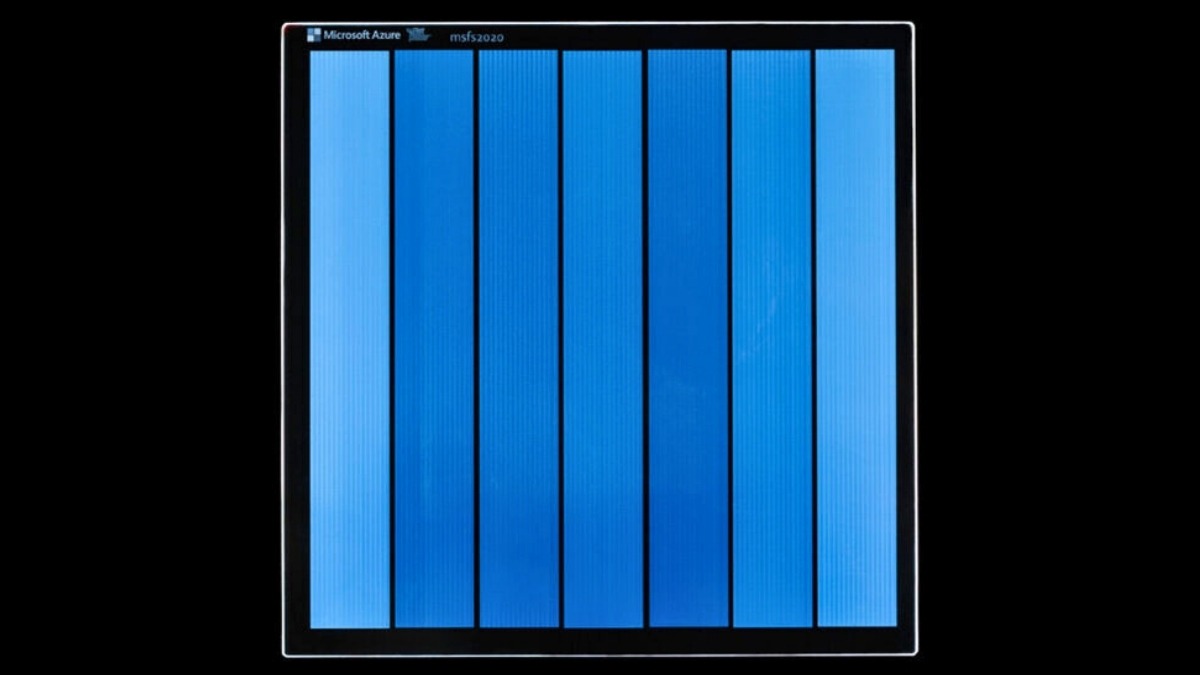


Study by Microsoft Research Demonstrates That Silica System Uses Femtosecond Lasers to Store Up to 2 Million Books in a Glass Square the Size of the Palm of the Hand, with Tests Indicating Data Stability and Readability for Over 10,000 Years
Scientists at Microsoft Research, in the United States, demonstrated the Silica system, capable of storing the equivalent of 2 million books in a thin glass square the size of the palm of the hand, with data that can remain readable for over 10,000 years, according to a study in Nature.
The research describes how a tiny glass square can function as a long-term storage medium. The system, called Silica, writes and reads information in common glass pieces using extremely short laser pulses to record data in depth.
According to the article published in Nature, the tests conducted indicate that the data recorded in this glass square will remain readable for over 10,000 years. The project presents a complete platform, bringing together encoding, writing, reading, decoding, and error correction.
-
For the first time, scientists have seen the ocean floor open up in real-time—plates moving apart by two meters in a few days and 160 million cubic meters of lava emerging on the seafloor.

-
Iraq floats and sinks under an arm of the Euphrates 10 giant concrete boxes of 46,000 tons and 125 meters each to assemble a 2.4 km submerged tunnel and open a new land route between Asia and Europe.

-
Scientists use more than 20,000 artificial birds and solar speakers to “trick” seabirds, reactivate nesting routes, and revive a colony on an island that seemed abandoned.
-
She spent 73 years breathing inside an iron lung, survived the aftereffects of polio, and became the last woman in the United States dependent on the equipment before dying at 78 years old.




How the Glass Square Uses Ultra-Short Laser Pulses
The Silica system employs ultra-short laser light pulses to inscribe information inside the glass. Each pulse lasts for quadrillionths of a second, known as femtoseconds or 10⁻¹⁵ s.
To illustrate this time scale, comparing ten femtoseconds to one minute is equivalent to comparing one minute to the entire age of the universe. These pulses allow for changes in the molecular structure of the glass only in the focused region.
The ultra-short flashes can also generate even shorter bursts, lasting attoseconds, which are equivalent to 10⁻¹⁸ s. In 2023, the Nobel Prize in Physics was awarded to Ferenc Krausz, Anne L’Huillier, and Pierre Agostini for pioneering work related to these bursts.
In the context of the glass square, lasers produce light with a wavelength that normally passes through the material without interaction. However, when precisely focused, they create an intense electric field capable of modifying the local molecular structure.
3D Writing in the Glass Square via Voxels
The technique alters only a tiny three-dimensional volume, often less than a millionth of a meter on each side. This volume is called a voxel, which can be produced in controlled positions within the glass.
The use of laser-engraved voxels for three-dimensional storage is not a new idea. In the 1990s, Eric Mazur and colleagues at Harvard University investigated volumetric optical storage using femtosecond lasers.
The work demonstrated that permanent data structures could be inscribed in common glass. In 2014, Peter Kazansky and researchers from the University of Southampton reported storage in fused quartz glass with an apparently unlimited lifespan.
In 2024, Kazansky founded the company SPhotonix to commercialize what they describe as 5D glass nanostructuring. A similar device appeared in the film Mission: Impossible – Dead Reckoning Part One, as a vault capable of holding a powerful AI.
Silica System Integrates Encoding, Reading, and Error Correction in the Glass Square
The Silica project does not claim to be a new scientific discovery. The team presents a comprehensive demonstration of practical technology applicable to the real world, bringing together all the essential elements of femtosecond laser and glass-based storage.
Integrated components include data encoding, writing, reading, decoding, and error correction. The work assesses strategies for reliability, writing speed, energy efficiency, and data density in the glass square.
A microscope is used to read the information recorded in the material. The research analyzed two main types of voxels created by laser inside the glass.
The first type consists of elongated structures resembling voids, formed by laser micro-explosions. This method allows for a storage density of 1.59 gigabits per cubic millimeter.
The second type is based on subtle changes in the local refractive index of the glass. These recordings can be made more quickly and with lower energy, although they store less data per cubic millimeter.
This method achieves about 65.9 megabits per second. According to the authors, this speed could be increased with the use of more laser beams.
Tests Indicate Stability of Over 10,000 Years for Data in the Glass Square
Accelerated aging experiments indicate that the recorded data remains stable for over 10,000 years, even in the case of the more sensitive phase voxels. This period exceeds the lifespan of conventional media, such as magnetic tapes and hard drives.
Dense, fast, and low-energy archival data storage is presented as a practical application of ultrafast lasers. Currently, these devices can be purchased ready for industrial use.
The author Alex Fuerbach, a professor at the Macquarie University Photonics Research Center, reports that in the late 1990s, few laboratories had the capacity to build femtosecond lasers.
After decades of technological development, ultrafast lasers with reliability, power, and appropriate repetition rates have become commercially available. This advancement enables applications such as the glass square for long-term storage.
As ultrafast photonics matures, new applications are likely to emerge. The Silica system consolidates decades of research into an integrated glass storage platform, demonstrating the potential of a small glass block as a durable medium for large-scale data.