





 Portuguese
  English
  Spanish
  3 min of reading


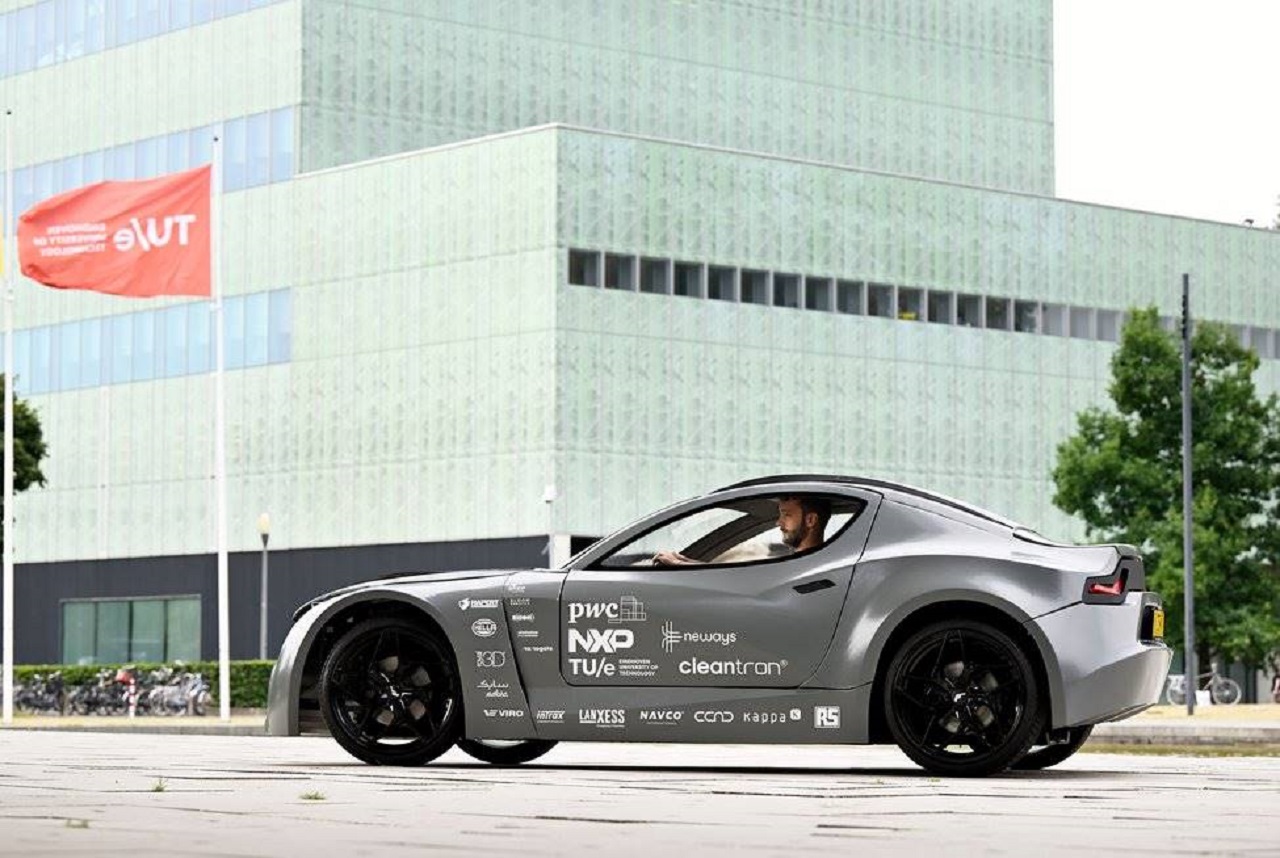
Students from Holland Developed an Electric Car Capable of Storing Carbon Dioxide While Driving Through the Streets, Potentially Revolutionizing the Automotive Industry and ESG Goals.
Students from the Eindhoven University of Technology developed an electric car that, in addition to not polluting the environment, can also remove and store carbon dioxide while moving. The prototype is named Zem.
Students’ Electric Car Uses a 2.3 kWh Battery
This is the seventh iteration of students from the university linked to more sustainable and less polluting vehicles. The EM-07 is the response to the challenge of developing a zero-carbon car.
The vehicle’s chassis was developed using additive manufacturing techniques to mitigate waste and generate minimal polluting emissions, also utilizing recycled plastics that can later be repurposed for other projects. Inside, there’s pineapple leather, and the windows are made of polycarbonate instead of glass. The electronic and entertainment components are modular and can also be reused.
-
T-Cross gets Rock in Rio edition with exclusive details, themed seats, 17-inch wheels, and price maintained by Volkswagen at R$ 142,990.

-
Cheaper than HB20, Onix, and Argo: with a 1.6 flex engine of up to 120 hp, 6-speed automatic transmission, well-known mechanics, and affordable maintenance, this hatch remains among the most sought-after used cars in Brazil: meet the Volkswagen Gol 2022 automatic.

-
New Jeep Scrambler SRT resurfaces with a 6.4 Hemi V8 engine producing 470 hp, rear seats that rotate 180°, a cabin for four occupants, and a removable roof in a project planned for 2030.

-
Cheaper than a Kwid, this Japanese sedan offers a giant 482-liter trunk, a 1.6 flex aspirated engine, automatic CVT transmission, and six airbags; the Nissan Versa Sense is ideal for those who prioritize interior space, comfort, and affordable maintenance costs.



The details about the electric car’s motor and power supply have not been disclosed. However, it is estimated that the vehicle capable of storing carbon dioxide is using nine modules of 2.3 kWh, a 22 kW motor, and the differential, responsible for converting the speed coming from the axle into two different speeds, from an old Audi. It is also estimated that a regenerative braking system and photovoltaic cells on the roof and hood are utilized.
Filters to Store Carbon Dioxide Must Be Changed Every 320 KM
For every 20,600 km traveled, the students’ electric car can remove about two kilos of CO₂ from the atmosphere. Although the number is not large, considering that the technology can be improved and replicated in millions of vehicles on the road, there is potential impact on decarbonization efforts worldwide.
One of the challenges now relates to the filters, which will be depleted every 320 km, meaning they must be replaced, for example, when recharging the batteries. Once cleaned, they can be reused.
According to Louise de Laat, the study coordinator, the students have managed to get ahead, given that it is possible to expand the filter capacity in the coming years. There is also no concrete plan yet on what to do with the carbon dioxide that is captured.
The team plans to continue advancing with the electric vehicle capable of storing carbon dioxide and show the automotive industry what can be done and that there are different ways to address the issue of pollutant emissions.
Brazilians Transform CO₂ into Fuel
Potentially responding to Louise de Laat’s study, researchers from the University of São Paulo (USP) are developing a project to transform carbon dioxide into fuel or plastic.
Despite being subjected to high pressure, a new catalyst made with zinc, carbon, and nickel transformed CO₂, one of the main contributors to the greenhouse effect, into carbon monoxide.
The tests and results of the research showed that scientists will soon be able to produce, in a concrete way, petroleum derivatives, as well as fuels and plastics.





Be the first to react!