






 Portuguese
  Spanish


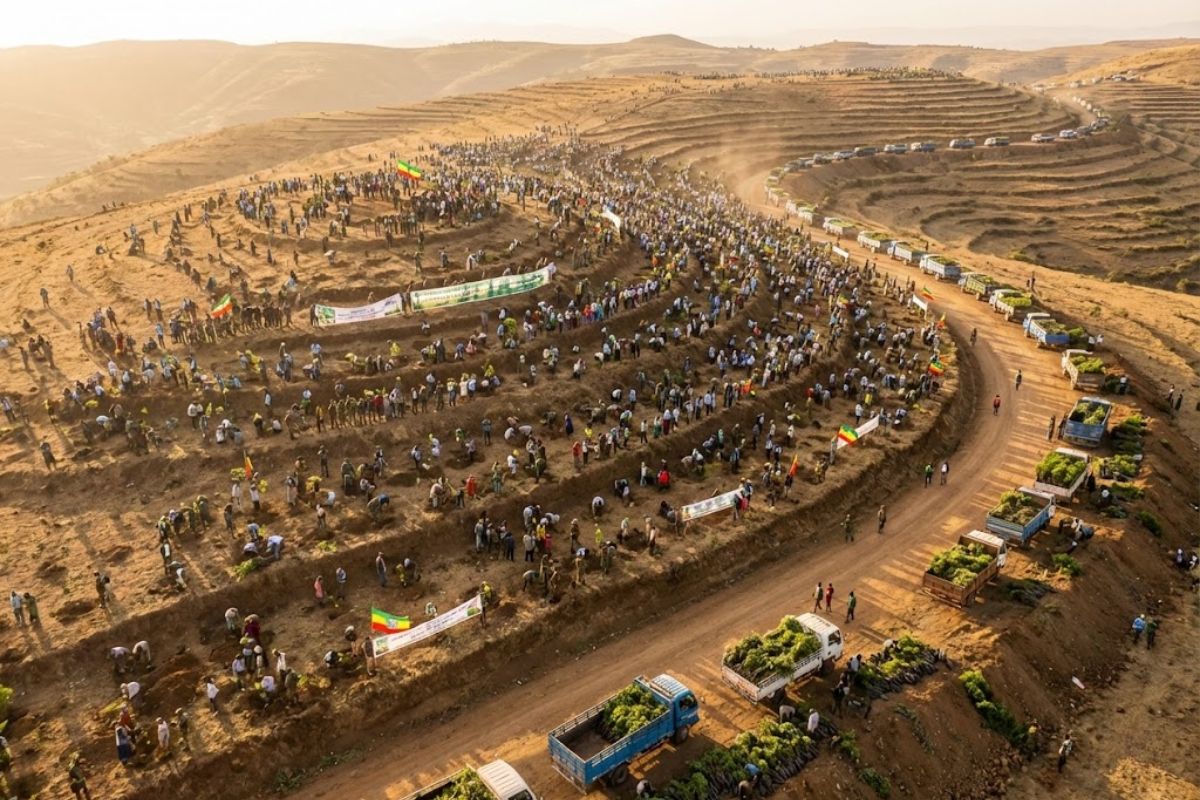


Across The Territory Of Ethiopia, Volunteers Joined The Green Legacy Program Launched By Abiy Ahmed And Planted More Than 350 Million Seedlings In 12 Hours, Surpassing The Goal Of 200 Million. The Government Claims To Have 2.6 Billion Already Planted And Aims For 4 Billion By October In The Rainy Season.
In Ethiopia, a national mobilization saw millions of people planting en masse and led the country to record more than 350 million trees in 12 hours. The action occurred throughout Ethiopian territory, with participation from volunteers, and was incorporated by the government as a practical response to environmental degradation and climate pressure.
The effort is part of the Green Legacy initiative, launched by Prime Minister Abiy Ahmed, with a declared goal of 4 billion trees by the end of the rainy season in October. The proposal aims to connect reforestation, soil protection, and economic resilience in a country where agriculture is a social base and climate instability weighs on daily life.
The Record In 12 Hours And The Goal Surpassed The Same Day

Ethiopia reported that it planted more than 350 million seedlings in 12 hours, surpassing the original goal of 200 million in one day.
-
A Brazilian street cleaner built a machine to recycle PET bottles in the hinterlands of Paraíba, transforming the trash he swept from the streets into threads, brooms, and equipment sold even outside Brazil, and began earning about R$ 7,500 per month with his own invention.

-
In a city where every piece of land is worth gold, he began buying plots in the 1960s and built a real estate empire with over a thousand properties.

-
An artist sank over 500 life-sized human statues at the bottom of the Caribbean Sea, and what seemed like macabre art turned into a living reef covered with corals that attracts divers from all over the world.

-
A fossil kept for years in a small museum in Montreal concealed 450-million-year-old soft tissue, a discovery that has only happened once before in history.


The government treated the milestone as something greater than a one-time performance, positioning the result as part of a continuous strategy, with nationwide mobilization campaigns.
The previous record cited is that of India in 2017, when volunteers planted 66 million trees in 12 hours.
By surpassing this number, Ethiopia reinforced the narrative that mass planting can be organized as a recurring public action, rather than as an isolated event.
Green Legacy, Abiy Ahmed And The Mathematics Of 4 Billion By October

The Green Legacy program was launched by Abiy Ahmed with a declared goal of 4 billion trees by the end of the rainy season in October.
The plan is presented as a collective challenge: 40 seedlings for every person in the country, with an explicit invitation for popular participation.
The Ethiopian Ministry of Agriculture stated that 2.6 billion new trees have already been planted, more than half of the announced goal.
Continuity depends on mobilization, seedling logistics, climatic window, and subsequent maintenance, because reforestation does not end with the act of planting.
Historical Deforestation And Declining Forest Cover

The campaign is described as an attempt to reverse decades of deforestation associated with a lack of regulation on logging, land clearing, and property rights.
The outcome pointed out is a sharp decline in forest cover in the country.
Data cited by research linked to forest restoration in East Africa indicates that, at the turn of the 20th century, forested areas accounted for almost a third of Ethiopian territory, while today this figure would be only 4%.
For Ethiopia, mass reforestation appears as a direct response to this loss.
Climate, Soil, And Agriculture Under Pressure In Rural Areas
The effects of climate change are described as particularly strong on Ethiopia’s agrarian population.
Excessive agriculture with few regulations is pointed out as a factor of land degradation and soil erosion, reducing productivity and increasing vulnerability.
At the same time, rising temperatures amplify the threat of extreme weather events, with explicit reference to droughts and floods.
In this context, reforestation ceases to be symbolic and becomes a tool for territorial survival, with expected impacts on soil stability, water, and microclimate.
Why Trees Are Counted In Carbon And Global Warming
An estimated cited indicates that 15 billion trees are cut down worldwide each year, increasing pressure on global warming.
Another cited piece of data indicates that deforestation accounts for more than 15% of greenhouse gas emissions.
The mechanism described is direct: the carbon removed from the atmosphere is stored in branches and trunks, and when trees are cut down and burned, the carbon returns to the air.
In this context, Ethiopia uses reforestation as a strategy for climate risk reduction and environmental recovery.
Mass Reforestation As A National Survival Strategy
Ethiopia treats the operation as a policy of scale, linking record, annual goal, and reconstruction of vegetation cover.
Mass planting, by mobilizing volunteers and the government, becomes an instrument to face historical desertification, respond to global warming, and recover degraded areas.
The final effect depends on what happens after the record: survival of the seedlings, maintenance, annual continuity, and the ability to transform numbers into mature forest.
Nevertheless, the mobilization already functions as a sign of national priority, with public goals and official counting of planted trees.
If Ethiopia managed to mobilize millions and plant 350 million trees in 12 hours, what would prevent other countries from doing something similar on a national scale?





História, para a história. Todos os países ao invés de politicagem, deveriam fazer isto.
Parabéns pra Etiópia que todos os países fossem isso teria u muito menos quente 🙏💓🌟🌟🌟🌟🌟💓🙏
Exemplo que todas as nações deveriam seguir, ao invés de só ficarem discutindo o que deve ser feito, e criando desavenças com outros países por causa de petróleo .
Isso. Se cada governante tomasse essa medida,logo,logo se resolveria o problema do desmatamento do mundo.
.