






 Portuguese
  Spanish


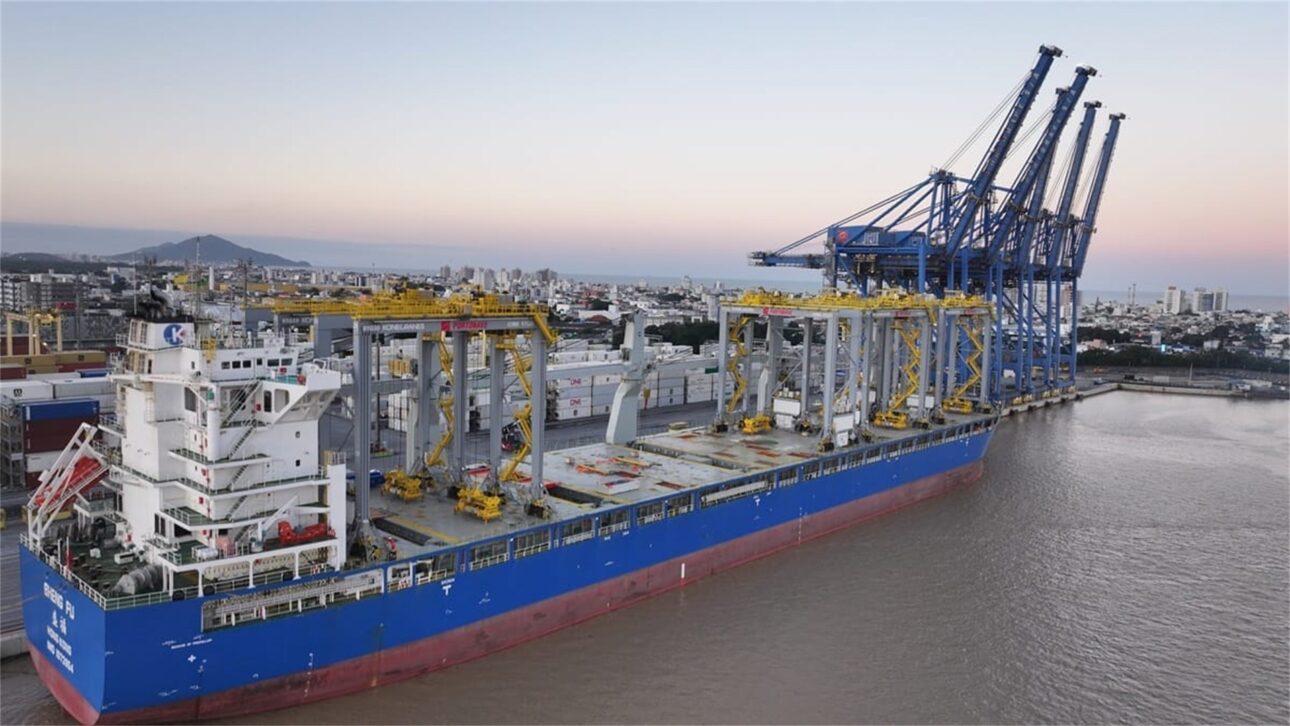
On July 7, 2026, the port of Navegantes, in Santa Catarina, received a significant boost: Portonave received the first 7 of 14 100% electric megacranes, each 28 meters tall and 156 tons, that traveled about 20 thousand kilometers from China as part of a R$ 210 million package to double container movement.
According to information published on the NSC Total portal, the first seven pieces of equipment arrived aboard a ship operated by Cosco, one of the largest container shipping companies in the world, after leaving the port of Dalian, in northern China, and crossing about 20 thousand kilometers of open sea to the Santa Catarina quay. The investment totals R$ 210.14 million and is part of a plan to increase the terminal’s capacity from 1.5 million to 2 million containers (TEUs) per year, practically doubling the volume of cargo passing through the port.
Each of these giants is 28 meters tall, equivalent to a building of about nine stories, and weighs 156 tons. They are e-RTG type machines, 100% electric rubber-tired gantry cranes used to move and stack containers in the yard, and arrived without burning a drop of diesel in the operation. The current batch brings seven of the 14 units ordered by Portonave, and the other half is expected to arrive in the following weeks, marking the largest reinforcement of yard machines in the recent history of the port of Navegantes.
A 20 thousand kilometer journey from China to Santa Catarina
The journey of the new cranes began far from the Santa Catarina coast. Manufactured in China, the equipment was loaded at the port of Dalian, in the north of the Asian country, aboard a ship operated by Cosco. From there, they embarked on a voyage of approximately 20 thousand kilometers across the oceans to reach the Portonave quay in Navegantes. It was a long-haul logistics operation to bring machines that alone weigh 156 tons each.
-
They exchanged the idea of a large house for a 35 m² warehouse, spent US$ 12,000 on the structure, and created a tiny house in Colorado with space to live and work.

-
A newly opened terminal in the middle of the Amazon has begun transporting soy and corn through Amapá, eyeing the queue of ships that is congesting the ports in the South.

-
Goodbye to old tiles: renovation technique without construction transforms bathrooms in a few hours, eliminates debris, and reduces costs with coverings using special paints, high-resistance adhesives, and modern finishes that completely renew the space.
-
Goodbye to the traditional clay brick: Indian startup transforms burnt straw into a carbon-negative brick that costs half, insulates better, and even removes CO2 from the air.


The first batch disembarked on Tuesday, July 7, 2026. In total, 14 units were ordered, and the initial half has already crossed half the world to reinforce the terminal. The other seven pieces of equipment are expected to arrive by the end of July, completing the largest reinforcement of yard machines in the recent history of the port.
Bringing seven structures of 28 meters in height at once is no trivial task. Each crane needs to be transported, unloaded, and assembled with millimetric precision at the Santa Catarina dock, a job that requires planning and specialized teams. The arrival of the giants by sea transformed the horizon of the Santa Catarina port and marked the beginning of a new phase for Portonave. Never before had the terminal received so many large machines at once, in a single logistical operation coming from the other side of the world.
Giants of 28 meters and 156 tons: the technical specifications of the new cranes
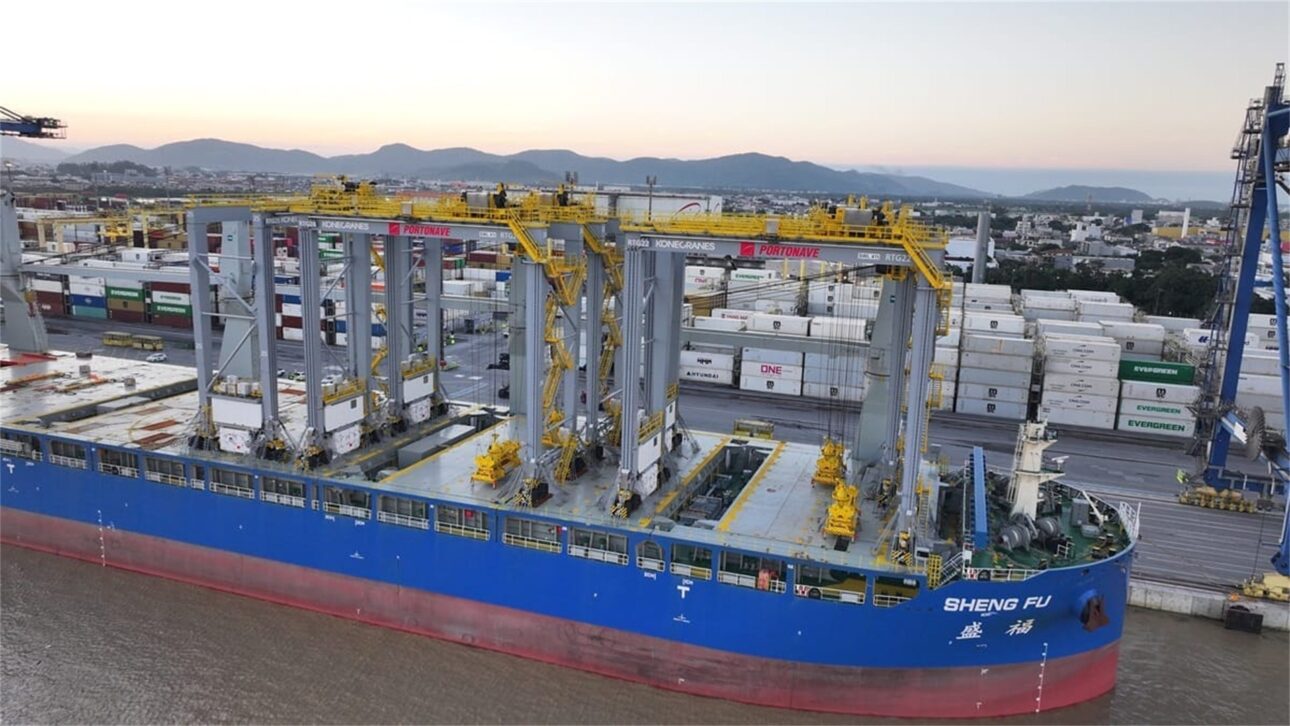
The new equipment is of the Rubber Tyred Gantry type, known by the acronym e-RTG, cranes on wheels used to move and stack containers in the terminal yard. The project is by the Finnish company Konecranes, a world reference in the sector, with manufacturing done in China. Each unit reaches 28 meters in height, equivalent to a building of about nine stories, and weighs 156 tons.
The work capacity is as impressive as the size. Each crane can lift loads of up to 41 tons and stack boxes up to seven levels, although the terminal adopts a limit of five levels for safety. With these giants, the yard gains agility to organize the growing mountain of cargo passing through the port of Navegantes.
Being machines on wheels, the e-RTGs have the mobility to move between the stacks of cargo, unlike fixed cranes on rails. This flexibility is crucial for a terminal that needs to rearrange thousands of boxes per day. The new electric cranes were chosen precisely for combining brute strength, precision, and energy efficiency in one piece of equipment.
Why the cranes are 100% electric
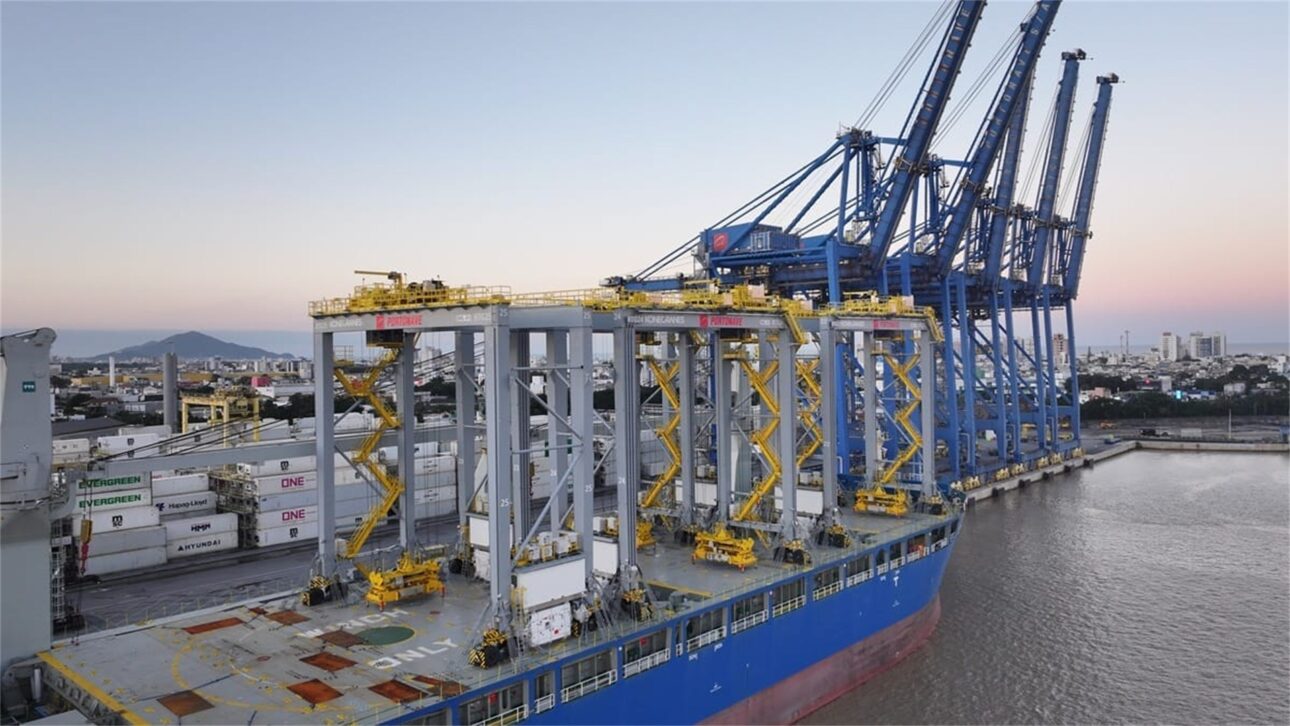
The biggest differentiator of the new machines is not just their size, but their energy source. The 14 units are 100% electric and completely dispense with combustion engines, which eliminates diesel burning in yard operations. For a port that moves cargo all day, switching from fossil fuel to electricity represents a large-scale environmental change.
The investment in electric equipment is part of a broader effort by the terminal to reduce its carbon footprint. Since 2016, the Navegantes terminal has achieved a 96.5% reduction in pollutant gas emissions, and the arrival of electric cranes is likely to further increase this number. Each crane that stops burning diesel helps clean the air around the port.
Besides the environmental gain, electric cranes tend to have quieter operation and different maintenance costs compared to combustion models. The choice of electric machines aligns the terminal with the global trend of port decarbonization, a movement gaining strength in cargo terminals worldwide. On the docks, sustainability has moved from promise to a lineup of equipment ready to operate.
Cutting-edge technology: sensors, anti-collision, and emergency braking
The new giants impress not only with their strength. Each piece of equipment is equipped with anti-collision sensors, which prevent collisions between machines and with cargo during operation. In a busy yard like this, such features reduce accident risks and protect both the goods and the operators.
The list of embedded technology is long. The cranes feature an electronic load sway control system, which stabilizes the suspended container and prevents dangerous oscillations. There is also emergency braking during lifting and automatic monitoring of container weight, ensuring that no load exceeds safe lifting limits.
All this equipment transforms electric cranes into intelligent machines, capable of operating with more precision and fewer human errors. For the terminal, investing in safety and automation also means investing in productivity, as fewer incidents mean fewer stoppages. The state-of-the-art equipment arrives to raise the technical standard of the port of Navegantes.
The goal to double container movement
The goal behind the R$ 210 million package is clear: to double the container handling at the terminal. Today, Portonave has the capacity to handle 1.5 million TEUs per year, the standard measure equivalent to a 20-foot container. With the new cranes and ongoing works, this figure is expected to jump to 2 million containers annually.
The capacity leap doesn’t rely solely on the cranes. The terminal’s quay is undergoing adaptation works that, once completed in the second half of 2026, will allow the docking of ships up to 400 meters long, the so-called giants of the seas. The larger the ship, the more boxes are unloaded at once, and more machines are needed to handle the flow.
This is where the 14 new electric cranes come in as a central piece. Without enough equipment in the yard, there’s no point in receiving huge ships full of cargo. The expansion of the crane fleet is what makes the promise of doubling the handling feasible and transforming the terminal into one of the most robust in the country.
What changes for the port of Navegantes and for foreign trade
Portonave is a private port located in Navegantes, on the coast of Santa Catarina, and is already a national leader in ship productivity. Since the beginning of operations, it has handled around 15 million TEUs, a number that helps to gauge the importance of the port for Santa Catarina’s and Brazil’s foreign trade.
The investments don’t stop at the cranes. Over the years, Portonave’s investments in quay modernization and new equipment exceed R$ 2 billion, of which R$ 210 million correspond to the first seven cranes of this batch. It’s a volume of resources that repositions the port on the logistics map of South America. Few Brazilian ports simultaneously gather this level of investment and such a new fleet of yard equipment.
For Santa Catarina’s economy, more cranes and more capacity mean more cargoes shipped, more ships serviced, and more leeway for exporters and importers. Each container that passes through the quay represents products arriving or leaving Brazil more quickly. By doubling the container handling, the terminal promises to shorten queues and speed up the state’s foreign trade.
Schedule: when the cranes start operating
The arrival of the giants is just the beginning of the story. After being unloaded, the equipment undergoes assembly, testing, and adjustments before becoming operational. According to the terminal’s schedule, the first batch of seven cranes is expected to start operating in August 2026, a few weeks after being unloaded in Navegantes.
The second batch, with the other seven cranes, is expected to arrive by the end of July and should begin operation in the first week of September. In a few months, therefore, the 14 new electric cranes will be in full activity in the port yard, moving containers side by side.
When the entire package is running, the Santa Catarina port will have made a technological and environmental leap all at once, with more powerful, cleaner, and smarter machines. In a world that increasingly depends on container transport, how many Brazilian ports will be able to keep up with the pace that Portonave has just set with its new electric cranes?


