Portuguese
  Spanish


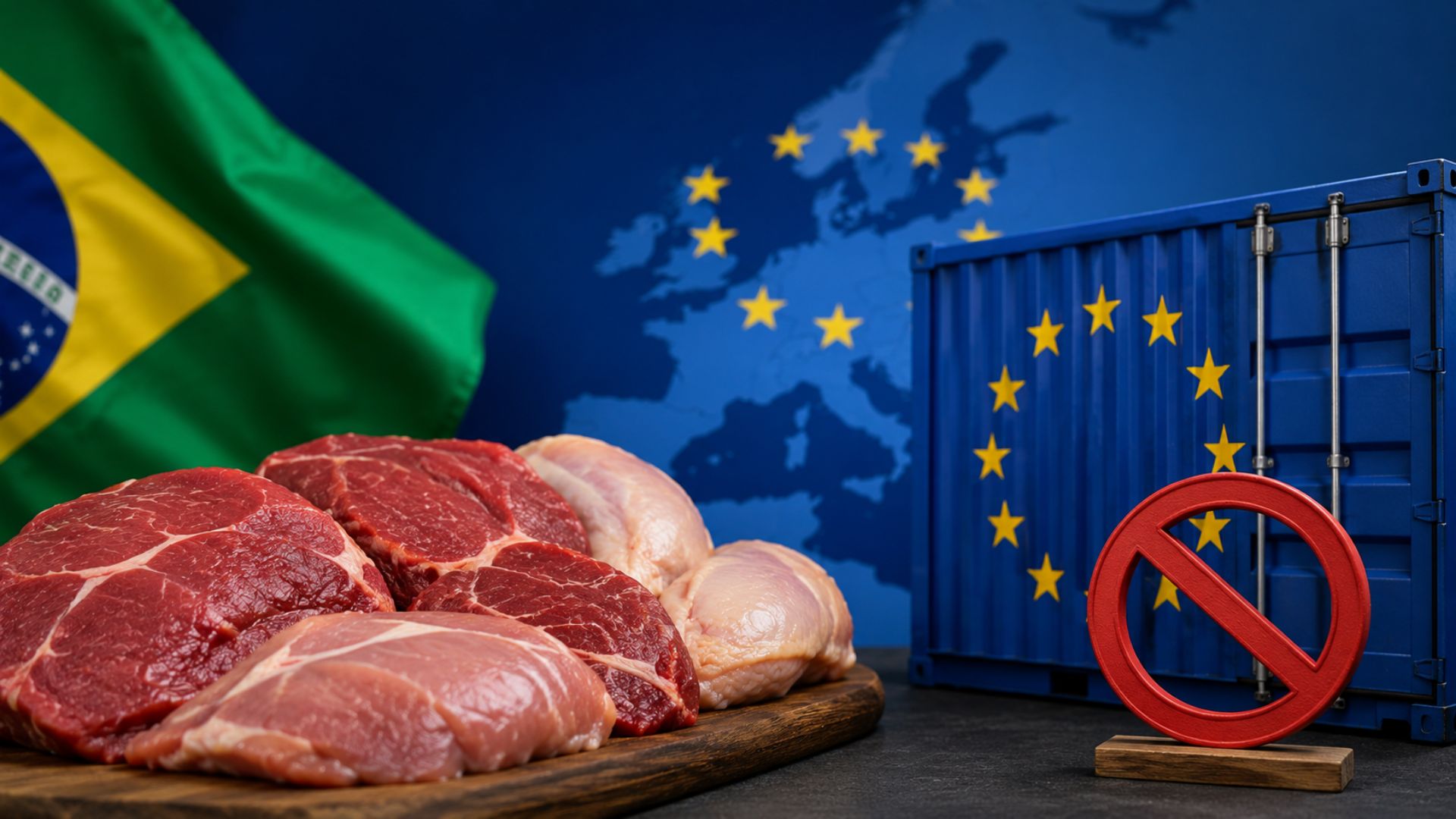

The European Union excluded Brazil from the list of countries authorized to export meat and other animal-origin products to the European bloc. According to information from the channel Band Journalism, the decision, announced this Tuesday (13), will take effect on September 3, 2026, and is directly linked to sanitary requirements regarding the control and prohibition of antibiotic use in Brazilian livestock, which the bloc considered insufficient.
The decision was made by the European Commission, the executive body of the European Union, which assessed that Brazil did not provide sufficient guarantees regarding the control of antimicrobial use in animal production. When the measure takes effect: on September 3, 2026, from which date Brazilian meat exports to the bloc will be blocked. How the exclusion was formalized: by removing Brazil from the list of countries authorized to export animal-origin products, affecting not only beef but also poultry, eggs, fish, and honey. Why now: the announcement comes during the provisional implementation of the trade agreement between Mercosur and the European Union, which took effect on May 1, creating a paradox between the negotiated trade opening and the imposed sanitary barrier.
The Brazilian government expressed surprise at the decision and stated that it will take all necessary measures to reverse the exclusion before it takes effect. Agribusiness entities, including the Brazilian Association of Animal Protein and the Brazilian Association of Meat Exporting Industries (Abiec), are working together with the Ministry of Agriculture to meet European requirements in time. Abiec highlighted that Brazil remains authorized to export beef to the European market until September, and the ban will only be enforced if the requirements are not met by the deadline.
What changes for Brazilian meat exports

The exclusion from the European list affects a wide range of animal-origin products. Besides beef, which is the main export item of the sector to Europe, the ban extends to poultry, eggs, fish, and honey, all subject to the same requirement of proving control over antibiotic use in the production chain. For Brazilian agribusiness, which relies on market diversification as a survival strategy, losing access to the European Union represents a significant blow in both volume and revenue.
-
India’s Sugar Export Cuts and Ethanol Shift Amid El Niño Threat Could Impact Global Prices and Stocks

-
Quarantine Pest Threatening Palm Trees Puts Brazilian Authorities on Alert, Prompts Monitoring at University of Taubaté and Potential Control Measures Across São Paulo
-
Global Alert: Report Finds 159 Pesticides in Coffee Beans Sold in Europe, Posing Serious Risks to Millions of Farm Workers
-
Low-Demand Brazilian Beef Offal Gains Popularity Abroad: Indonesia Purchases $19.5 Million, Boosting Revenue and Reducing Waste



The measure does not mean that Brazil’s meat exports stop immediately. The deadline until September 3 serves as a window for the Brazilian government and the private sector to present the technical guarantees required by the bloc. If Brazilian authorities can demonstrate that controls over antimicrobials meet European standards before the deadline, the exclusion can be reversed without any shipment being effectively blocked. The real risk is that the time may not be sufficient to adjust processes involving thousands of rural properties and dozens of slaughterhouses spread across the country.
Antibiotics in livestock: the center of the dispute
The European Union’s requirement is related to the use of antibiotics as growth promoters and as preventive treatment in production animals. The European bloc banned the use of antimicrobials for animal fattening in 2006 and since then requires exporting countries to demonstrate equivalent controls, arguing that the indiscriminate use of antibiotics in livestock contributes to bacterial resistance, a global public health problem recognized by the World Health Organization.
Brazil has regulations on the use of antibiotics in animal production, but the European Union considers that the inspection and monitoring mechanisms are insufficient. The issue is not just whether Brazilian legislation prohibits certain substances, but whether the surveillance system can ensure that the prohibition is effectively enforced in the hundreds of thousands of livestock properties in the country. It is in this gap between law and practice that the European decision is based, and it is in this area that the Brazilian government needs to act to reverse the exclusion.
The Mercosur and EU agreement: a timing paradox
The announcement of Brazil’s exclusion from the list of meat exporters comes at a politically delicate moment. The trade agreement between Mercosur and the European Union entered provisional implementation on May 1, 2026, after more than two decades of negotiation. The treaty precisely foresees the reduction of trade barriers between the two blocs, including preferential tariff quotas for Brazilian meats. Being excluded from the list of exporters in the same month the agreement begins to function creates a contradiction difficult to explain to producers and investors.
Other Mercosur countries, such as Argentina, Paraguay, and Uruguay, were also affected by the same requirement. The European measure is not exclusive against Brazil but affects the South American bloc as a whole, adding a multilateral dimension to the issue. For ongoing negotiations on the full implementation of the trade agreement, the sanitary barrier may become a point of friction that harms the broader relationship between the two blocs.
The reaction of the government and the private sector


In a joint statement, the Ministries of Agriculture, Development, and Industry stated that the government was caught by surprise by the European decision. The statement declares that Brazil will take all necessary measures to reverse the exclusion and that the priority is the recognition of Brazilian sanitary quality. The government also expressed concern about possible impacts on domestic consumer prices, should the volume of meat no longer exported to Europe need to be absorbed by the domestic market.
The Brazilian Association of Animal Protein stated that the country meets international standards for sanitary control and is willing to provide technical clarifications to European authorities. Abiec emphasized that Brazil remains authorized to export beef to the European Union until September and that the issue under discussion is specifically related to the monitoring of antimicrobial use. The public and private sectors are working together to implement improvements in the monitoring system before the deadline expires.
What is at stake for Brazilian agribusiness
The European Union is not the largest market for Brazilian meats in volume, a position held by China, but it is one of the most valuable in terms of price per ton. Beef exported to Europe reaches significantly higher prices than that destined for other markets, due to the quality, traceability, and specific cuts demanded by European consumers. Losing this market means not only reducing volume but giving up premium revenue that sustains the profitability of authorized slaughterhouses.
For rural producers, the exclusion could have chain effects that go beyond direct exports. If the volume that no longer goes to Europe is redirected to the domestic market or to lower-value destinations, the average price of meat tends to fall, putting pressure on profitability throughout the chain. The government recognized this possibility by mentioning concern about impacts on consumer prices, a sign that the scale of the potential impact is significant enough to enter the economic policy agenda.
September is the deadline, and the clock is already ticking
The European Union has given Brazil until September 3 to demonstrate that its controls on the use of antibiotics in livestock meet the standards required by the bloc. If the guarantees are presented in time, the exclusion can be reversed without an effective interruption of meat exports. If not, Brazil will lose access to one of the world’s most valuable markets for animal protein in the same year that the Mercosur-European Union trade agreement finally came into effect.
Do you think Brazil will be able to reverse the exclusion from the European list before September? Tell us in the comments what you think about the antibiotic control requirement, whether you believe Brazilian agribusiness meets international standards, and how you assess the timing of the European decision during the full implementation of the Mercosur-EU agreement. We want to hear your opinion.