





 Portuguese
  English
  Spanish
  3 min of reading
  0 comments


Understand The Dispute Between ExxonMobil And Chevron
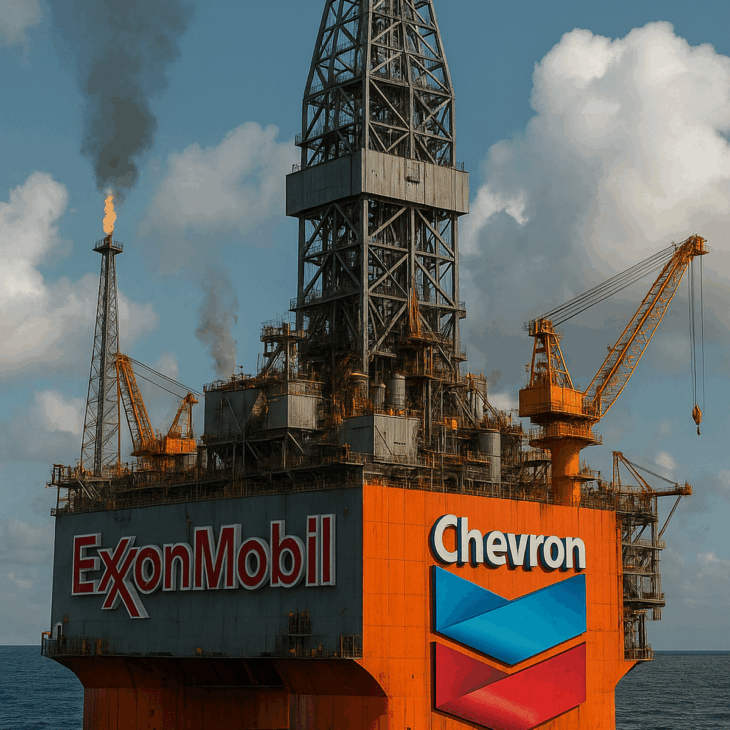
ExxonMobil and Chevron are engaged in a high-stakes legal dispute over 30% of the Stabroek oil field in Guyana. With estimated reserves of 11 billion barrels, the field represents a potential of US$1 trillion in revenues. The arbitration, initiated on May 26, 2025, in London, could redefine the future of oil exploration in the region.
Dispute Over Preferential Rights in The Stabroek Field
The controversy arose after Chevron announced, in September 2023, the acquisition of Hess Corporation for US$53 billion. Hess holds 30% of the Stabroek field, while ExxonMobil has 45% and the Chinese CNOOC holds 25%. ExxonMobil claims it has a right of first refusal to acquire Hess’s stake, according to prior agreements between the companies. CNOOC also asserts this right. Chevron argues that the right of first refusal does not apply to corporate acquisitions but only to direct asset sales. ExxonMobil contests this interpretation, bringing the dispute to arbitration at the International Chamber of Commerce. The outcome, expected in the third quarter of 2025, could influence future joint venture agreements in the sector.
Strategic Importance Of The Field
Since 2015, the Stabroek field has been one of the most significant discoveries in the oil industry. With production starting in 2019, over 500 million barrels have already been extracted as of November 2024. Production is expected to reach 1.3 million barrels per day by 2027. ExxonMobil, the leader of the consortium, considers the field essential for maintaining its market position. Chevron sees the acquisition of Hess as an opportunity to strengthen its reserves, which fell to 9.8 billion barrels in 2024, the lowest level in over a decade.
-
Oil surges again after attacks and standoff between the US and Iran increase global tension

-
HIDDEN TREASURE AT THE BOTTOM OF THE SEA? Oil discovery nearly 20,000 feet deep challenges engineering limits off the coast of Brazil
-
90 billion barrels of oil, 1.669 trillion cubic feet of natural gas, and 84% of probable reserves in offshore areas are under the Arctic, and the melting ice that opens maritime routes and exposes this energy treasure is turning the North Pole into a strategic dispute between the USA, Russia, China, and Canada for oil, gas, navigation, and military power.
-
IBS and CBS regulations change credit reimbursement and raise financial alert in the oil and gas industry





Impacts On Brazilian Oil Exploration
The dispute between the American giants is also reverberating in Brazil. The Brazilian Equatorial Margin, which extends from Amapá to Rio Grande do Norte, is considered one of the most promising frontiers for oil exploration. The success of Guyana in exploring Stabroek increases pressure on Ibama to grant exploration licenses in the Brazilian region. Petrobras has already expressed interest in exploring the Equatorial Margin, highlighting the economic and strategic potential of the area. The decision by Ibama will be crucial for the future of oil exploration in Brazil.
Perspectives On The Global Energy Sector
The arbitration between ExxonMobil and Chevron is closely watched by investors and analysts, as it could set precedents for joint venture agreements and preferential rights in the sector. Furthermore, the dispute highlights the growing importance of Guyana in the global energy landscape. Therefore, the resolution of the case will directly impact the expansion strategies of the companies involved. Additionally, it will decisively influence the dynamics of the international oil market. Meanwhile, Guyana continues to solidify its position as one of the leading emerging oil producers.




Be the first to react!