Portuguese
  Spanish


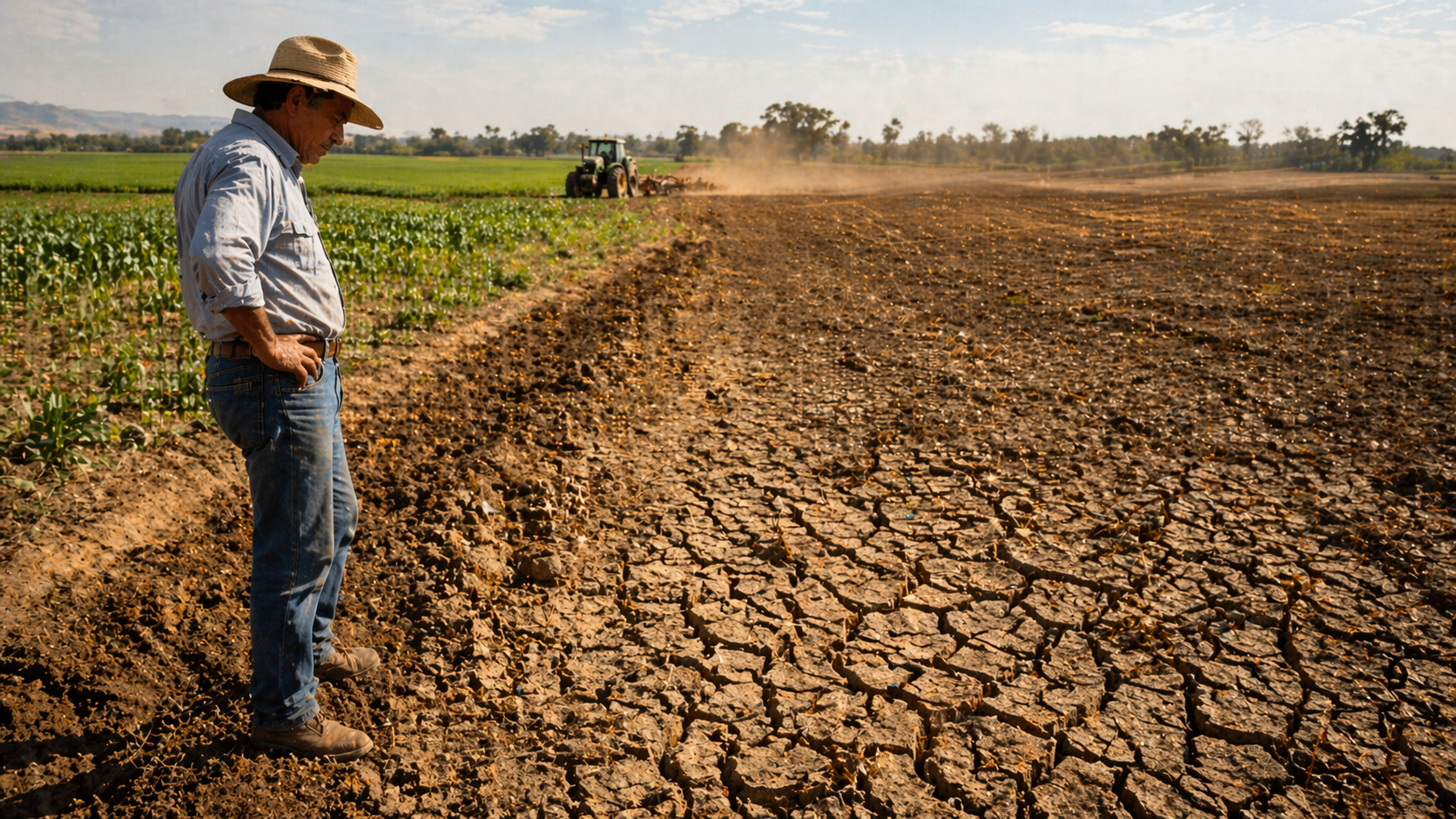

FAO warns that up to 75 billion tons of fertile soil may disappear and compromise food production worldwide.
In 2024, the Food and Agriculture Organization of the United Nations (FAO) raised an alert about a structural risk that is advancing on a global scale: soil degradation is eroding the physical foundation of the planet’s food production. In a publication dated July 1, 2024, the Global Soil Partnership, led by the FAO, stated that the world loses approximately 75 billion tons of soil from arable land each year, with an estimated loss of US$ 400 billion per year in lost agricultural production.
In a statement on December 9, 2024, the FAO itself reinforced that 95% of the food consumed by the global population directly depends on soil, which turns erosion, degradation, unsustainable land use, and loss of fertility into a systemic threat to global food security.
What is happening to the soil and why is it disappearing at an accelerated rate
Soil degradation is the result of a combination of natural factors and intensive human activities. Among the main processes involved are erosion, loss of organic matter, compaction, and salinization. These phenomena reduce the fertility and capacity of the soil to sustain agricultural crops.
-
Researchers Turn Discarded Mango Pits into Hydrogel That Absorbs 400% of Its Weight in Water, Offering Agricultural Solution for Droughts and Waste Reuse

-
Flower strips in Brazilian farms become pest control strategy, attracting predator insects and reducing the need for chemical pesticides.

-
Yara acquires Texas ammonia plant for $1.3 billion, boosting global fertilizer competition with 1.3 million tons annual capacity
-
At 35, Lawyer Leaves Corporate Career to Turn 1-Hectare Farm into Organic Supplier for Schools in Southern Brazil


Erosion is considered the main mechanism of loss, removing nutrient-rich surface layers through the action of water and wind. In poorly managed agricultural areas, this process can be significantly accelerated.


Additionally, practices such as deforestation, continuous monoculture, and improper land use contribute to degradation. The result is a progressive reduction in productive capacity, often without the loss being immediately perceived, as soil does not disappear all at once but deteriorates over time.
Soil formation is extremely slow and does not keep up with the speed of loss
One of the most critical points highlighted by the FAO is the difference between the speed of loss and the speed of soil formation.
While billions of tons are lost annually, the formation of just a few centimeters of soil can take hundreds to thousands of years.
This imbalance means that fertile soil is, in practice, a non-renewable resource on a human timescale. The current loss far exceeds the natural replenishment capacity, creating a continuous deficit that tends to accumulate over the decades.
Direct impacts on agricultural production and global food security
Soil degradation has direct effects on agricultural productivity. Degraded soils have a lower capacity to retain water, lower nutrient availability, and less support for plant growth.
This can result in decreased productivity, increased production costs, and greater vulnerability to climatic events, such as droughts and heavy rains.
Studies cited by the FAO indicate that soil erosion could reduce global agricultural production by up to 10% by 2050, if the current scenario continues. This impact is not uniform, being more intense in already vulnerable regions where agriculture heavily relies on natural conditions.

Cascade effect can impact food, prices, and economic stability
The reduction in agricultural productivity does not only affect the countryside. Lower production can lead to increased food prices, putting pressure on economies and affecting access to food, especially in developing countries.
Moreover, soil degradation can impact entire supply chains, from small producers to large international markets.
The effect can spread across different sectors, including:
- Food industry
- International trade
- Food security
- Social stability
This is an environmental problem with broad economic and social consequences.
Soil also plays an essential role in climate and the water cycle
In addition to supporting food production, soil plays fundamental roles in environmental balance. It acts as a carbon reservoir, helping to regulate the climate, and as a natural filter, contributing to water quality.
Healthy soils can store large amounts of carbon, reducing the concentration of greenhouse gases in the atmosphere.
When degraded, these soils can release carbon, contributing to global warming. Additionally, the capacity for water retention decreases, increasing the risk of floods and droughts.
Intensive agricultural regions are among the most vulnerable to degradation
Areas with intensive agriculture, especially those with continuous land use without conservation practices, are among the most affected. The combination of mechanization, use of chemical inputs, and removal of natural vegetation can accelerate degradation processes.
Tropical and subtropical regions are particularly vulnerable, due to the intensity of rainfall and the fragility of certain types of soil. However, the problem is not limited to these areas, being observed in different parts of the world.
Despite its importance, soil is rarely treated as critical infrastructure. Unlike roads, power plants, or electrical grids, soil is not visible as an economic asset, but it underpins the entire basis of food production.
This invisibility contributes to the lack of attention to the problem, even in the face of clear scientific evidence. The FAO emphasizes that soil degradation should be treated as a strategic issue, with implications for food security, climate, and the economy.
What is at stake with the ongoing loss of fertile soil on the planet
The loss of fertile soil represents not only an environmental challenge but a structural change in the planet’s productive capacity.
The continuation of this process could compromise food production, increase vulnerability to crises, and affect billions of people, directly or indirectly.
Moreover, soil degradation is linked to other global problems, such as climate change, loss of biodiversity, and water scarcity.
Have you ever imagined that the invisible base of the planet’s food may be disappearing without most noticing
The FAO’s warning reveals one of the most silent risks of the modern world.
While global debates focus on energy, technology, and climate, soil — the basis of practically all food production — continues to degrade at an accelerated pace.
The central question is not just how much soil has already been lost, but how much can still be preserved in light of current practices. The challenge involves understanding that global food security does not depend solely on technology or production, but on a natural resource that takes centuries to form and can disappear in just a few decades.
The question that remains is straightforward: to what extent is the world prepared to deal with the continuous loss of one of the most fundamental and least visible resources on the planet.