Portuguese
  Spanish


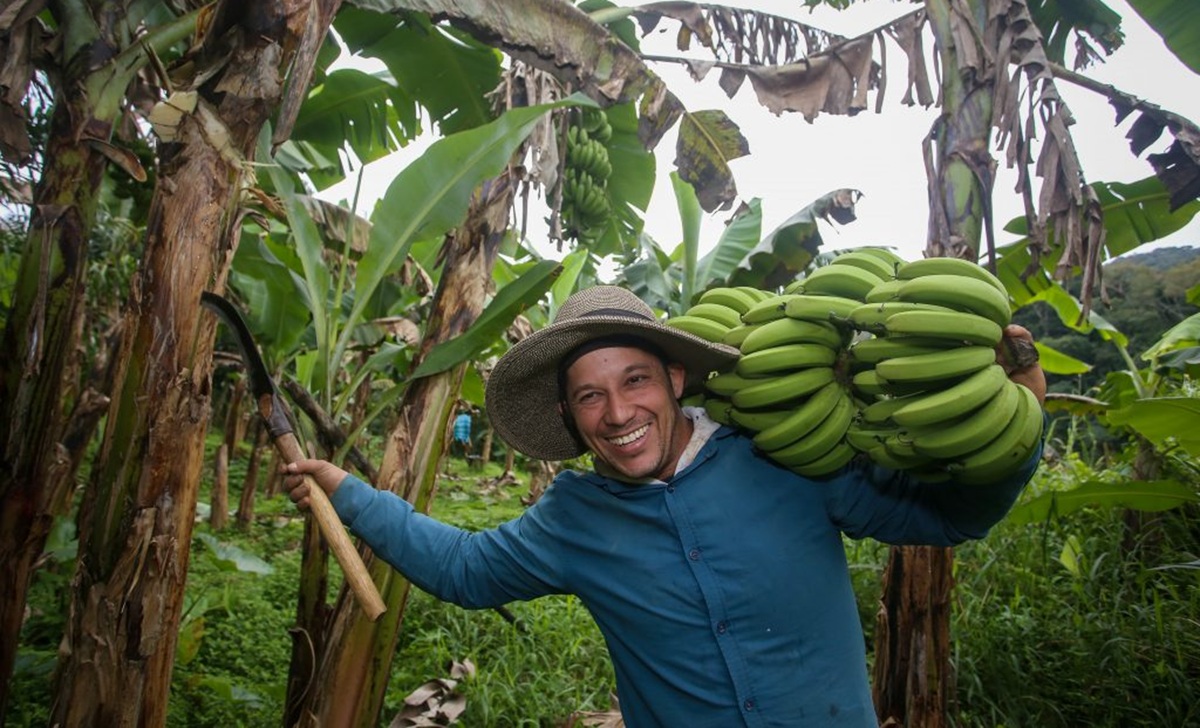

The recognition of the banana from the Vale do Ribeira as a Geographical Indication by the INPI protects the origin of the production of Cavendish and Prata, covers 13 municipalities in São Paulo, and reinforces the importance of the region, which concentrates 7.07% of the entire national area dedicated to banana cultivation
The banana from the Vale do Ribeira has obtained the Geographical Indication (GI) for the Cavendish and Prata varieties, a recognition issued by the National Institute of Industrial Property (INPI) that strengthens the productive sector and consolidates the region as one of the major hubs for the fruit in Brazil. With the registration, the name “Vale do Ribeira-SP” becomes protected and officially identifies the origin of the bananas produced in the designated area.
Issued by the INPI, the Geographical Indication recognizes products or services with a specific geographic origin that have qualities, tradition, or reputation linked to the place of production. In the state of São Paulo, this was the 14th GI obtained.
Banana from the Vale do Ribeira gains seal and origin protection
The recognition covers the Cavendish varieties, also known as Nanica, and Prata, creating a differential for regional production. The measure boosts the productive sector and opens new market opportunities for producers in the Vale do Ribeira.
-
Study of Brazil’s Tietê River Finds 25 Pesticides in Water, Including Cancer-Linked Substance Near Source

-
Young Entrepreneur Expands from 50 to 1,400 Chickens, Proving “Happy Hens” Can Be a Viable Business
-
Small Farm in Brazil’s Minas Gerais Produces 403 Liters of Milk Daily, Sets Benchmark for Rural Producers
-
Man Revives 1930s Abandoned Trout Farm, Learns from Scratch, and Earns $1.1 Million Annually Selling Fish to Michelin-Starred Restaurants



The initiative received support from the Secretariat of Agriculture and Supply, through the Directorate of Integral Technical Assistance (CATI). In São Paulo, it is the responsibility of the Secretariat to issue the Official Instrument of Geographical Area Delimitation, while the CATI receives, protocols, and forwards the documentation for analysis by a technical committee responsible for evaluating the request.
In the process of requesting the GI for bananas, the Regional CATI of Registro actively participated in institutional articulation. The regional office was present in strategic meetings with the Association of Banana Producers of the Vale do Ribeira (ABAVAR) and with partners such as IFSP and Sebrae.
Region strengthens banana production with institutional support
These meetings helped to technically define the territorial scope of the Geographical Indication and also contributed to the collective construction of the Technical Specifications Book. The document gathered production standards aligned with local reality, establishing the technical basis for the recognition.
Tais Canola, head of the Division of the Regional CATI of Registro, stated that the GI opens a new horizon for banana producers by protecting the origin of the Cavendish and Prata varieties and generating market opportunities that enhance work in the field. She also highlighted that the achievement serves as a tool for regional development, combats the devaluation of the product, and ensures a competitive differential that strengthens the sustainability of rural communities.
Augusto Aranha, president of ABAVAR, stated that the seal boosts agriculture in the region, especially family farming. For him, the achievement reaffirms the commitment of the Vale do Ribeira to modern agriculture, which respects the environment and strengthens those who live from rural production.
History of banana cultivation and area covered by the designation
Bananas are among the most consumed fruits in the world and are present throughout Brazil. In São Paulo, cultivation began on the coast and, starting in the 1930s, advanced to the Vale do Ribeira, where the more suitable soils and lower susceptibility to flooding favored the expansion of the activity.
In the geographical delimitation of the IG of the banana from Vale do Ribeira, 13 municipalities were included: Cajati, Cananéia, Eldorado, Iguape, Itariri, Iporanga, Jacupiranga, Juquiá, Miracatu, Pariquera-Açu, Pedro de Toledo, Registro, and Sete Barras. The definition of this territory was a central part of the recognition process.
The Geographical Indication reinforces the strength of Vale do Ribeira in the state and national production of bananas. Data from IBGE and the LUPA Project show that the region accounts for 7.07% of the entire national area dedicated to banana cultivation, consolidating the significance of the bananas produced in Vale do Ribeira in the Brazilian scenario.