






 Portuguese
  Spanish
  3 min of reading


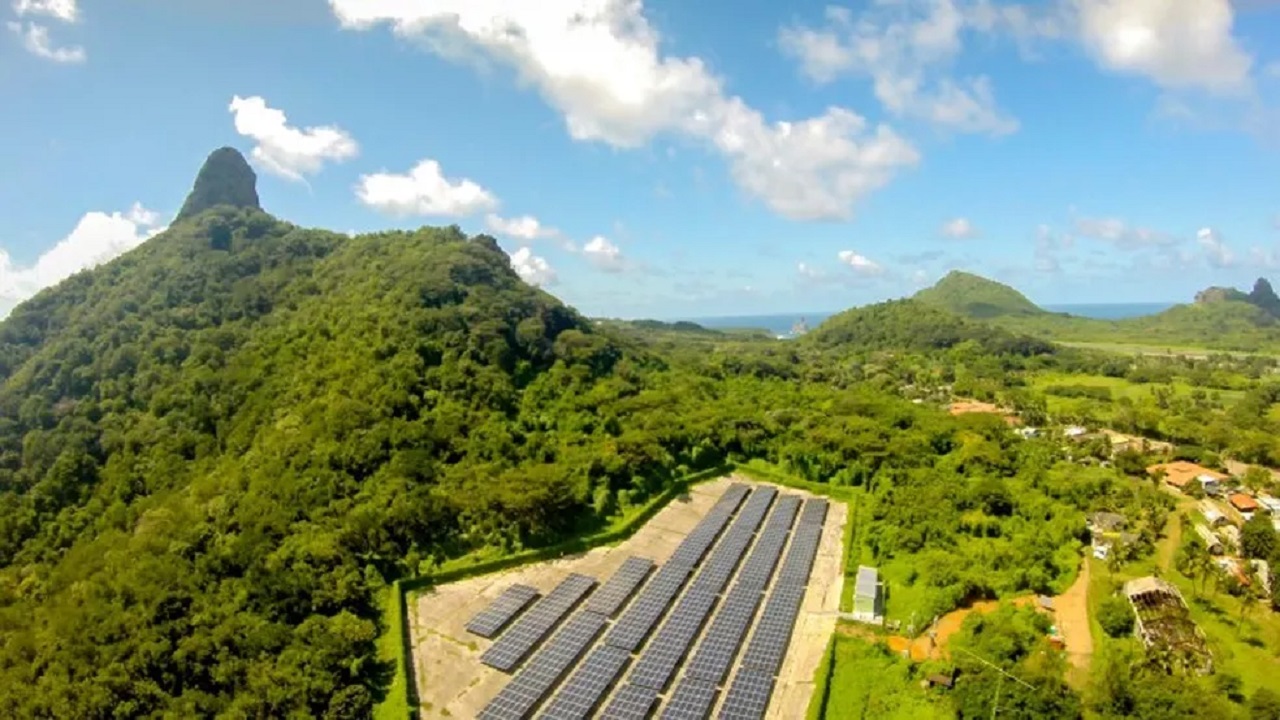
Fernando de Noronha Is Investing in a Solar Power Plant and an Energy Storage System Focused on Charging Stations for Electric Cars.
Fernando de Noronha, on the northeastern coast of Brazil, recognized by UNESCO as a Natural Heritage Site, is becoming a research center for electric cars. The first initiative in this sector came from the government of Pernambuco, the state where the archipelago is located, by developing the Zero Carbon Noronha Project back in 2013. Among other things, the goal is for conventional vehicles to no longer circulate on the island starting in 2030, with electric cars being charged by a solar power plant and energy storage system.
Electric Cars in Fernando de Noronha Were Charged with ‘Polluting Energy’
Only in 2019 did the first electric cars arrive, which, although they do not emit any type of pollutant, were charged with dirty energy produced by diesel generators, which have always been the energy suppliers of Fernando de Noronha.
However, now the initiative from the government of Pernambuco has gained new momentum with the development of a program that foresees, among other things, the installation of solar power plants and energy storage systems that will generate electricity for electric cars and the island’s population.
-
Chinese Giant Uses Metal Structures and Cranes to Deliver Over 700 Electric Cars to Brazil

-
Uber Faces Shareholder Scrutiny as Board Accused of Ignoring Safety, Compliance, and Harassment Warnings Amid Over 3,500 U.S. Lawsuits

-
Ferrari’s First Electric Car Divides Fans, Priced at $630,000, Amid Concerns Over Limited Editions; Brand Clarifies It’s Not Just for Future Perks
-
BYD Dolphin Mini: The Electric Car That Defies Depreciation, Losing Only 3.58% in a Year and Becoming the Best-Selling Retail Model Under $22,000


The plan includes two solar power plants of 100 kWp, with the first expected to be operational later this month in June.
According to the energy company of Pernambuco, Neoenergia, since the capacity of the new plant is about three times greater than the initial demand of the project, the surplus will be injected into the distribution network, which can be used by consumers for other activities.
Charging Stations Will Be Installed in Fernando de Noronha
Currently, there are about 70 electric cars operating in Fernando de Noronha, including 18 newcomers. To facilitate battery charging for the vehicles, the Green Trail project aims to install 12 charging stations on the main island, with 8 having a capacity of 22 kW and four with a capacity of 7.4 kW.
Two of them can receive unused energy from the vehicles to feed the grid. To allow the use of renewable energy even when there is insufficient solar generation, an energy storage system with a capacity of 100 kW/200 kWh will be installed.
Currently, two battery modules are in testing and should be operational later this year.
Several Companies Are Involved in the Urban Mobility Project
The Green Trail project brings together companies and entities such as Neoenergia, WEG, Renault, Iati, Incharge, eiOn, CPCD, and the Federal University of Pernambuco. Mobility has always been a somewhat challenging issue in Fernando de Noronha, considering that the archipelago is 545 km from the mainland and everything that arrives there must go by boat or plane. Its main island, with 17 km², has only one highway, BR-363, which is the shortest in the Northeast, with a length of 7.5 km.
On-site, there is only one fuel station, which does not sell ethanol, only gasoline and diesel, where a liter of gasoline costs R$ 9.79. There are approximately 1,000 vehicles including cars, motorcycles, and commercial vehicles in circulation, and the rule states that for a new car to enter Fernando de Noronha, an old one must exit. According to the Zero Carbon Noronha Project, starting in 2023, only electric cars will be allowed.
A large part of the vehicles are used for professional activities, district administration, tourism workers, and public companies. The population, about 3,000 people, gets around on foot, hitchhiking, or by bicycle.


Be the first to react!