Portuguese
  Spanish


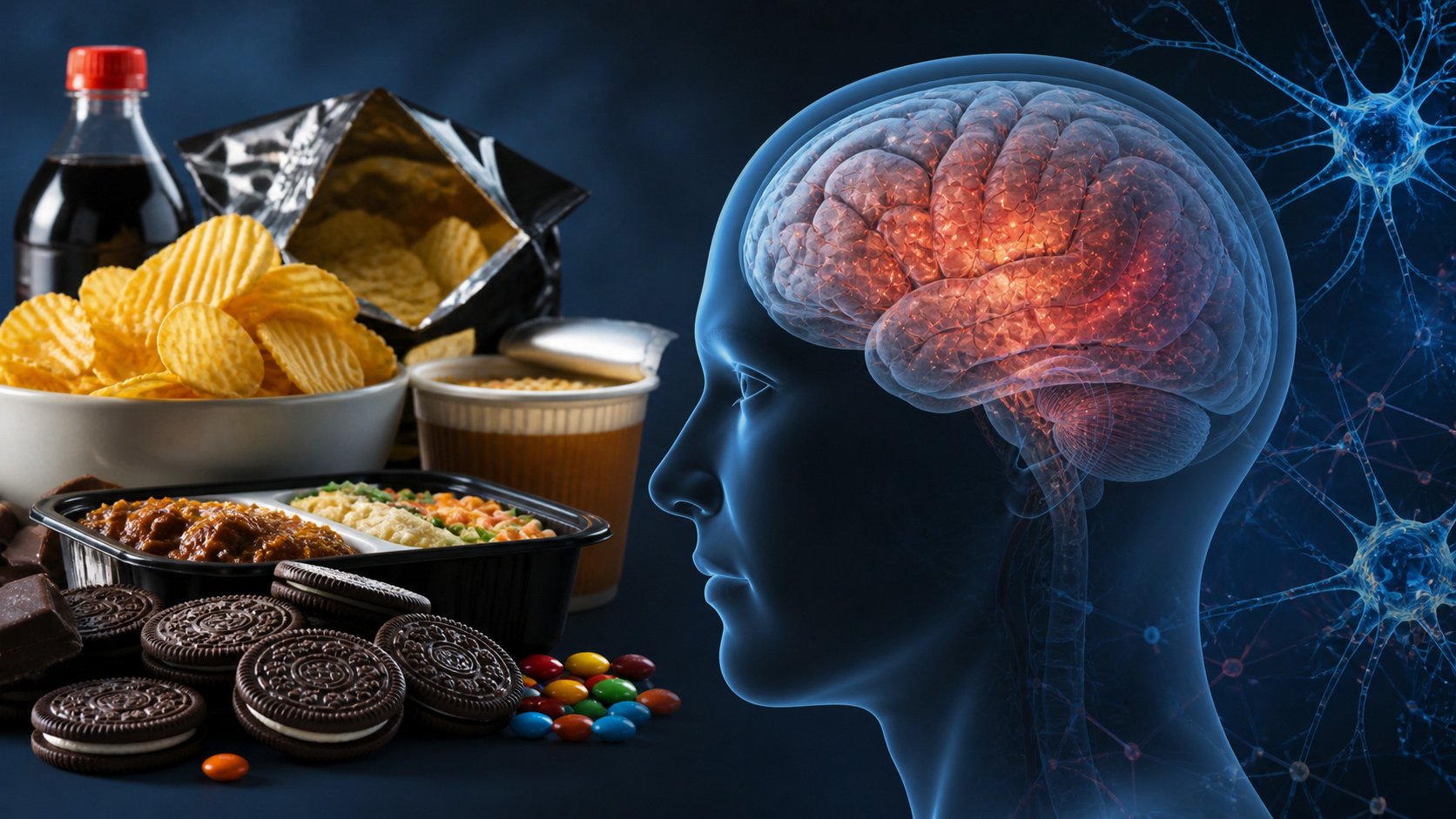


Brazilian study with over 10,000 adults links ultra-processed food consumption to up to 28% faster cognitive decline and raises memory alert.
In 2022, Brazilian researchers associated with the Longitudinal Study of Adult Health, ELSA-Brasil, placed common ultra-processed foods under a new scientific alert. Published online by JAMA Neurology on December 5, 2022, the study analyzed the relationship between the consumption of these products and cognitive performance over time, with a central finding: adults with a higher proportion of ultra-processed foods in their diet showed a 28% faster global cognitive decline compared to the group with lower consumption.
The research followed 10,775 Brazilian civil servants aged 35 to 74, recruited in six Brazilian cities, over a median of 8 years, evaluating memory, verbal fluency, executive function, and other cognitive indicators.
The result drew attention because it shifted the debate on ultra-processed foods, historically associated with obesity, metabolic syndrome, and cardiovascular risk, to an even more sensitive area: the possible impact of these foods on the brain, cognitive aging, and the ability to preserve mental functions throughout life.
-
AI Video Generator Automatically Creates Subtitles and Animated Captions

-
São Paulo Unveils Latin America’s Largest Underground Reservoir, Holding 900 Million Liters, in the Greater São Paulo Area

-
Chinese Teen Wins Gold in Germany for Invention Turning Air Moisture into Underground Irrigation in Drought-Stricken Areas

-
Desertification Threatens Brazil’s Caatinga: 85% of Semi-Arid Region Affected, 30 Million at Risk, and Efforts Underway to Restore 10 Million Hectares by 2045




Brazilian study with over 10,000 participants shows relationship between ultra-processed foods and accelerated cognitive decline
The analysis published in JAMA Neurology used data from ELSA-Brasil, one of the largest cohort studies in Latin America, initiated in 2008 to investigate chronic diseases in Brazilian adults. Participants had an average age of 51 at the start of follow-up, an important point, as the focus was not on the elderly, but on people in their productive years.
Researchers classified the foods consumed by participants based on the NOVA system, which categorizes foods according to their degree of processing. Products such as soft drinks, filled biscuits, instant noodles, processed meats, and ready meals were classified as ultra-processed.


Throughout the follow-up period, standardized cognitive tests were conducted to measure different brain functions. These tests assessed memory, verbal fluency, and reasoning ability, allowing for the observation of gradual changes over time.
The most relevant result was that individuals with higher consumption of ultra-processed foods, defined as more than 19.9% of daily calories coming from these products, showed a 28% faster global cognitive decline rate compared to those who consumed less than 9.8%.
Impact also appears in executive function, a critical area for decisions and reasoning
In addition to global memory, the study identified a significant effect on executive function, which involves skills such as planning, decision-making, impulse control, and problem-solving.
The data showed that the group with higher consumption of ultra-processed foods experienced a 25% faster decline in executive function, a result that increases concern, as this ability is directly linked to professional performance and autonomy throughout life.

This type of alteration does not necessarily mean immediate dementia, but indicates a process of cognitive wear that is more accelerated than expected for the age.
This point is central to the correct interpretation of the study: it is a statistical association over time, not direct proof of cause and effect, but the volume of data and prolonged follow-up reinforce the relevance of the finding.
What are ultra-processed foods and why are they different from common foods
Ultra-processed foods are not just industrialized, but undergo multiple processing steps and contain ingredients not used in home preparations, such as emulsifiers, colorants, flavorings, and stabilizers.
Among the most common examples are:
- filled cookies
- packaged snacks
- soft drinks and sweetened beverages
- instant noodles
- ready-to-eat frozen products
These foods are often formulated for high palatability, long shelf life, and convenience, but frequently feature high caloric density, low nutritional value, and the presence of chemical additives.
The hypothesis raised by researchers is that this set of characteristics can influence inflammatory processes, energy metabolism, and even the functioning of the nervous system.
Possible mechanisms linking ultra-processed foods to the brain are still under investigation
The ELSA-Brasil study did not directly investigate the biological mechanisms behind the observed association, but scientific literature already points to some hypotheses that help contextualize the results.
One of the main lines of investigation involves systemic inflammation. Diets rich in ultra-processed foods can increase inflammatory markers in the body, and chronic inflammation has been associated with cognitive decline and neurodegenerative diseases.
Another possible mechanism involves the gut microbiota. Frequent consumption of ultra-processed foods can alter the balance of intestinal bacteria, which, in turn, can affect the gut-brain axis, a communication system that influences cognitive and emotional functions.

There are also hypotheses related to metabolic impact, such as insulin resistance and vascular changes, which can affect cerebral blood flow.
It is important to note that these mechanisms are still being studied and have not been directly proven in this specific work, which requires caution in interpretation.
Results reinforce global trend of investigation into diet and brain health
The Brazilian study adds to a series of international research that has been analyzing the impact of diet on the brain. In recent years, the focus of scientific nutrition has shifted from looking only at body weight to also considering cognitive performance and neurological aging.
Studies in different countries have already pointed to associations between low-nutritional-quality diets and worse cognitive performance, but the differential of the Brazilian work lies in the robustness of the sample and longitudinal follow-up.
The use of data from over 10,000 participants over nearly a decade gives statistical weight to the result, even without establishing direct causality.
Furthermore, the fact that the study was conducted on a Brazilian population extends its relevance to the national context, where the consumption of ultra-processed foods has grown consistently in recent decades.
Growth in ultra-processed food consumption in Brazil coincides with public health concerns
Food survey data show that the participation of ultra-processed foods in the Brazilian diet has been increasing, especially in urban areas and among younger populations.
This growth is driven by factors such as convenience, relative cost, marketing, and lifestyle changes, including longer working hours and less time available for meal preparation.
The result is a gradual replacement of fresh or minimally processed foods with industrialized products. This scenario creates an environment where the study’s findings gain practical relevance, as it is not an isolated behavior but a broad dietary trend.
Study does not prove direct causation, but reinforces need for caution in interpretation
Despite the impact of the numbers, the study’s authors themselves emphasize that the results show association, not a definitive causal relationship.
This means that it is not possible to state that the consumption of ultra-processed foods, by itself, causes cognitive decline. Other factors, such as education level, income, lifestyle, and health conditions, can also influence the results.
The researchers used statistical adjustments to reduce these interferences, but acknowledge that additional studies are needed to confirm the mechanisms involved.
This methodological transparency is fundamental to avoid exaggerated interpretations or simplistic conclusions, keeping the debate within scientific rigor.