Portuguese
  Spanish


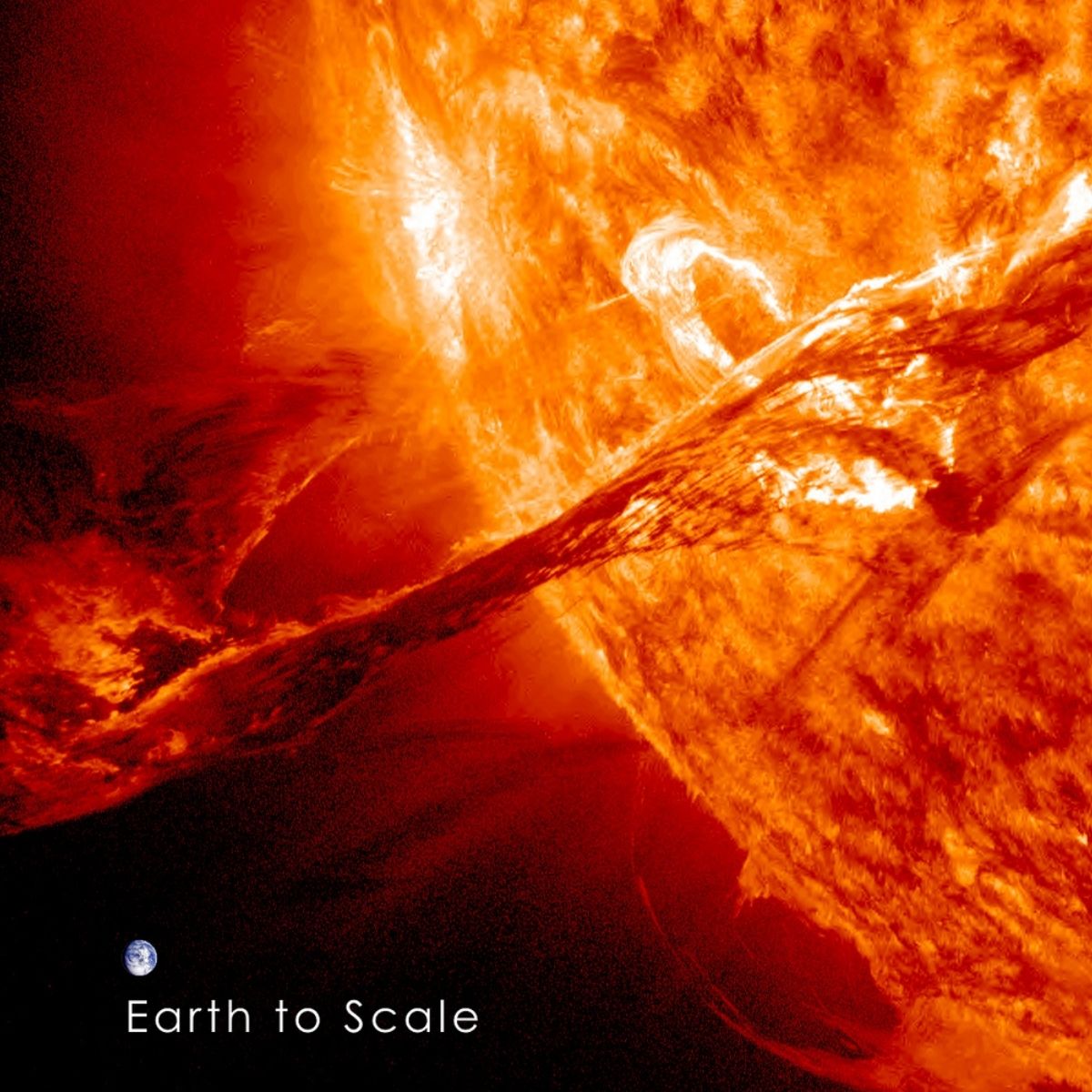

The 2012 solar storm, comparable to the 1859 Carrington Event, crossed Earth’s orbit at 3,000 km/s but the planet was a week behind, escaping an impact that would have caused US$ 600 billion to US$ 2.6 trillion in damages with blackouts, transformer burnouts, and satellite failures.
On July 23, 2012, one of the most violent coronal mass ejections ever recorded by science crossed Earth’s orbit at a speed exceeding 3,000 kilometers per second, four times the average speed of a common solar eruption. The solar storm, recorded by NASA’s STEREO-A satellite, was classified by scientists as comparable to or possibly superior to the legendary 1859 Carrington Event, the largest geomagnetic storm documented in modern history, but the planet had passed that exact point in its orbit a week earlier, narrowly escaping what would have been one of humanity’s greatest technological collapses. “If it had hit, we would still be picking up the pieces,” declared Daniel Baker, professor of atmospheric and space physics at the University of Colorado, in an official statement released by NASA in 2014 when publishing the full analysis of the event in the scientific journal Space Weather.
The episode only came to light in December 2013, when Baker and his team published the complete data that the STEREO-A satellite had collected after being directly hit by the solar storm. According to analyses, the coronal mass ejection generated a geomagnetic disturbance estimated between minus 600 and minus 1,182 nanoteslas on the Dst index (a measure of Earth’s magnetic field disturbance), an intensity that surpasses the storm that caused the 9-hour blackout in Quebec, Canada, in 1989 (minus 589 nT) and approaches estimates for the Carrington Event itself (minus 800 to minus 1,750 nT). To put it in perspective: if the 2012 solar storm had hit Earth with this intensity, according to a 2013 study by Lloyd’s of London and the American Geophysical Union, damages in the United States alone would have ranged between US$ 600 billion and US$ 2.6 trillion, with an estimated full recovery time of between 4 and 10 years.
What made the 2012 solar storm so powerful

The exceptional speed of the July 2012 solar storm was not the result of a single eruption, but a combination of factors that amplified the event. According to a study by Janet Luhmann and Ying D. Liu published in Nature Communications in 2014, the coronal mass ejection on July 23 was actually composed of two CMEs separated by an interval of only 10 to 15 minutes, and four days earlier a third eruption had “cleared the way” in interplanetary space, removing residual solar plasma that normally slows down subsequent ejections. The combination of the double eruption and the clear corridor left by the previous storm allowed the CME to accelerate to 3,000 km/s, a speed that reduced the travel time between the Sun and Earth’s orbit to about 20 hours and 47 minutes, when the normal would be 2 to 3 days.
-
She spent 73 years breathing inside an iron lung, survived the aftereffects of polio, and became the last woman in the United States dependent on the equipment before dying at 78 years old.

-
Brazilian students created a $1 filter using pine bark, cotton, and 3D-printed parts to clean cassava wastewater, reduce the toxicity of a hazardous waste, and transform contaminated water into biofertilizer.

-
Astronaut from Artemis II steps down after mission to the Moon and decision surprises after a record of 406,771 km, a historic 10-day journey, and an unprecedented achievement for Canada.

-
A fossil kept for years in a small museum in Montreal concealed 450-million-year-old soft tissue, a discovery that has only happened once before in history.


The solar region that produced the storm, cataloged as AR 11520, was positioned such that the ejection pointed directly to the point in orbit where Earth had been a week earlier. If the planet had been seven days ahead in its orbital path, the solar storm would have hit Earth’s magnetosphere with enough force to induce surface electrical currents capable of burning out high-voltage transformers in power grids worldwide, damaging or rendering unusable telecommunications and GPS satellites, and paralyzing electronic systems that operate critical energy, water, transportation, and financial infrastructure. The STEREO-A satellite, which was positioned at that point in orbit, was directly hit and survived because it was designed to withstand extreme space conditions, but it transmitted data that allowed scientists to reconstruct what would have happened to Earth.
What happened in 1859 and why the 2012 solar storm would be worse

The Carrington Event of 1859 is the reference scientists use to gauge the risk of extreme solar storms. On September 1, 1859, English amateur astronomer Richard Carrington observed a solar flare with the naked eye through his telescope, and hours later, auroras were seen at latitudes as low as Cuba and Hawaii while telegraph systems worldwide failed: operators received electric shocks, lines caught fire, and in some cases, equipment continued transmitting without batteries, powered by the current the solar storm induced in the wires. The event occurred in an era when the planet’s only electrical infrastructure consisted of telegraph lines, yet the impact was global and well-documented.
The difference between 1859 and 2012 is the degree of technological dependence that civilization developed in the 153 years separating the two events. Professor Daniel Baker described the potential impact of a Carrington-class event on the modern world as capable of “returning modern civilization to the 18th century,” a reference to the pre-electric era before the Industrial Revolution, because the simultaneous burning of high-voltage transformers in multiple countries would leave entire regions without power for months or years while parts that take 1 to 2 years to manufacture were replaced. Without electricity, there is no water pumping, food refrigeration, hospital operation, telecommunications, rail transport, banking, or internet access, a cascade of consequences that would make the 2012 solar storm incomparably more destructive than that of 1859 despite being physically similar.
What is the probability of a solar storm of this magnitude hitting Earth?
The frequency with which extreme solar storms occur is a subject of study that produces numbers that alarm scientists. Physicist Pete Riley, from Predictive Science Inc., published in February 2014 in the journal Space Weather a calculation estimating a 12% probability of a Carrington-class event hitting Earth in the following decade, between 2014 and 2024, a window that has already closed without the event occurring. “Initially I was surprised by the high probability, but the statistics seem correct. It’s a thought-provoking number,” Riley stated in a NASA release, and updated models in subsequent years suggest similar probabilities for each ten-year window, meaning the question is not if a Carrington-class solar storm will hit Earth, but when.
The Sun entered a solar maximum phase in 2025, a period of increased activity within the approximately 11-year cycle that governs solar flares. The solar maximum means more sunspots, more flares, and more coronal mass ejections directed into space, and although most of these eruptions are low intensity and pose no risk to Earth, the probability of an extreme solar storm is statistically higher during this phase of the cycle than during the solar minimum. The combination of an active solar maximum and technological infrastructure increasingly dependent on satellites and interconnected electrical grids makes 2025 and 2026 a period when space weather monitoring by agencies like NASA, NOAA, and ESA is particularly critical.
Why the 2012 solar storm matters for the energy and oil sector
The impact of an extreme solar storm on the energy sector is not speculation: it is a documented risk with real precedent. On March 13, 1989, a geomagnetic storm much smaller than that of 2012 caused a 9-hour blackout in the province of Quebec, Canada, affecting 6 million people and burning high-voltage transformers, a practical demonstration that solar storms can bring down entire power grids in a matter of minutes. The 1989 storm measured less than 589 nT on the Dst index, while the 2012 storm would have generated between less than 600 and less than 1,182 nT, meaning an intensity ranging from comparable to twice as great as the event that blacked out Quebec.
For the oil and gas sector, the risk is specific and documented. SCADA systems that operate oil and gas pipelines and refineries depend on electronics sensitive to the electromagnetic induction a solar storm produces, offshore operations depend on GPS for dynamic platform positioning, and natural gas distribution in large networks depends on electric pumps that would stop without power, a set of vulnerabilities that makes space weather a national energy security issue in countries like the United States, United Kingdom, and Canada, which already include solar storms in their contingency plans. Brazil, although less vulnerable than high-latitude countries (because the geomagnetic effect is more intense near the poles), operates interconnected electrical and oil systems that are not immune to a Carrington-magnitude event, a reality that ONS (National Electric System Operator) monitors as part of the sector’s risk management.
And you, did you know that Earth escaped by one week a solar storm that could have brought down technological civilization? Do you think we are prepared for the next one? Leave your opinion in the comments.