






 Portuguese
  Spanish


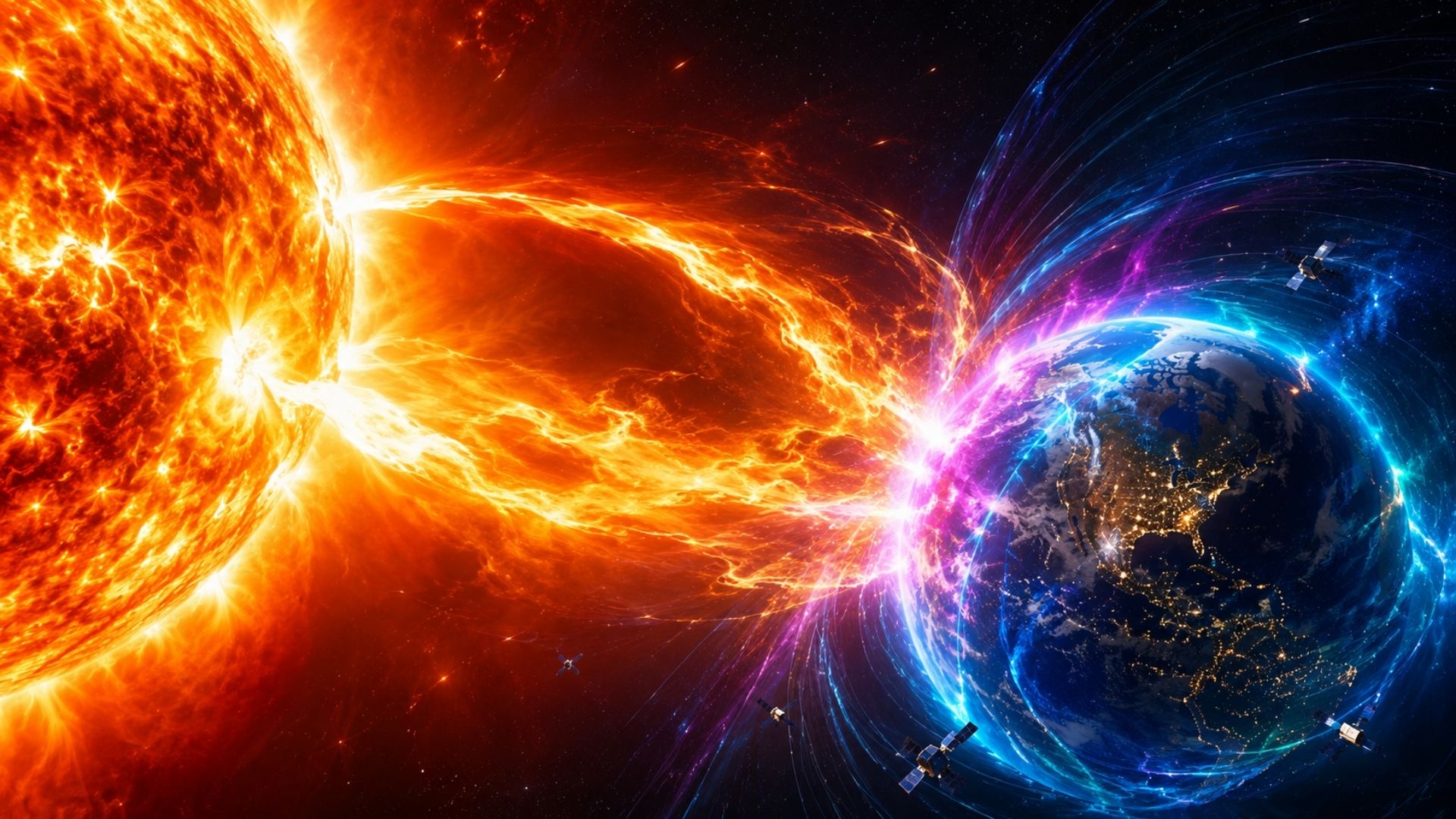

Scientists propose that an S-type solar flare represents a leap above the X-class on the Sun, with the potential to push Earth into extreme space weather episodes.
Scientists published this proposal in the Journal of Geophysical Research: Space Physics while attempting to answer a question that has challenged solar physics for years: when the Sun might again produce an eruption truly outside the usual scale. The study states that these S-type super-eruptions would not be mere theoretical hypotheses, but events already recorded in the recent past and concentrated in windows of higher probability during the current Solar Cycle 25.
According to the Olhar Digital portal, the detail that changes the weight of the story is that the S category is not yet part of the standard operational classification used by NASA and NOAA, which ranges from A to X, but is born precisely to try to describe explosions above what the letter X can intuitively communicate. Instead of suggesting an imminent apocalypse, the study points to temporal windows of higher risk, including an interval spanning 2025.7 to 2026.6 and another between 2027.2 and 2027.9.
The strongest detail lies in the sample size and the leap to a new class of eruption

The work starts from a hard-to-ignore basis. According to the authors, the analysis gathered 95,627 solar eruptions with data on year, month, day, latitude, and class in X-rays, including 37 S-type events reported between 1978 and 2025. The scale of this survey is what gives strength to the attempt to transform a rare behavior of the Sun into something statistically treatable.
-
Are Cleaning Staff in Large Buildings Becoming Obsolete? Autonomous Robots Now Clean Airports, Hospitals, and Shopping Centers for Hours, as Companies Invest in Automating Repetitive Tasks

-
Xiaomi Launches Compact Photo Printer with Bluetooth, Extra Black Ink, and Augmented Reality Photo Printing
-
Teen Invents AI-Powered Traffic Light to Assist Elderly Pedestrians by Extending Crossing Time

-
NASA Plans Telescope That Can Be Repaired by Robots 1.5 Million Kilometers from Earth


This proposal gains even more impact when compared to the traditional system. NASA explains that solar flares are classified as A, B, C, M, and X, with a 10-fold increase in energy for each letter. The X-class is already the most intense but has no upper limit, and the largest event ever measured was recorded in 2003 as X28, after sensors became saturated. It is precisely in this territory above X10 that the authors want to fit the new S designation.
The curious twist is that the most extreme explosion may have already appeared without the label scientists now want to create
The study doesn’t just say that super-eruptions can happen. It argues that they have already happened and that a clearer way to address them was lacking. By compiling literature and historical records, the authors categorize 37 events as S-class, which moves these explosions from the realm of speculation into the realm of scientific reclassification.
This reinterpretation aligns with recent observations. In May 2024, ESA reported that the Solar Orbiter saw an estimated X12 flare on the far side of the Sun, then the strongest of the current cycle and one of the ten most intense since 1996. The study also mentions two eruptions above X10 detected on the far side in May 2024. In other words, the Sun has already given concrete signs that it can still produce events above the proposed threshold for the new category.
The broader context shows that the risk is not on Earth’s surface, but in the potential scale of technological damage
NASA describes solar flares as intense bursts of radiation on the Sun. The energy reaches Earth in about eight minutes, and although the atmosphere and magnetic field protect us on the ground, strong eruptions can disrupt radio communications, affect satellites, and harm spacecraft. Energetic particles and coronal mass ejections associated with these events can also degrade circuits, damage solar panels, and increase risks for astronauts.
This is where the S-type hypothesis gains real dimension. The study talks about super-eruptions with the potential to produce extreme space weather conditions, and ESA has already shown how a powerful flare in 2024 increased memory errors in missions like Mars Express and BepiColombo. In other words, the issue is not imagining fire falling on cities, but understanding how far an eruption far above the X-class can stress systems that rely on satellites, communication, and electrical infrastructure.
Why this could change how scientists try to predict the Sun
The study focuses less on pinpointing the exact minute of an eruption and more on identifying temporal windows and heliographic ranges where the risk increases. The authors say they have found two recurring patterns, one of about 1.7 years and another of approximately 7 years, linked to interactions of magneto-Rossby waves with solar magnetic dynamics. The proposal is to use these patterns to build medium-term probabilistic forecasts.
If this holds up, the change is significant. Today, operational forecasting usually focuses on the visible activity of sunspots and short-term probabilities for C, M, and X flares. A model that highlights longer windows for super-eruptions would give space agencies and infrastructure operators a different type of preparation, closer to strategic planning than to a simple last-minute alert. This is an inference supported by the method described by the authors and the limitations of current monitoring.
What still needs to be confirmed before treating category S as a new official standard
There’s a crucial point here: class S is a scientific proposal, not an official category already adopted by monitoring agencies. NASA and NOAA continue to use the traditional scale culminating in X, and the study itself seeks to offer a new framework for events above X10. This means the idea can gain academic and practical influence without necessarily becoming an operational standard immediately.
The predictive performance of this model also needs to be tested over time. The authors identify 2025.7–2026.6 and 2027.2–2027.9 as main windows of high probability in Cycle 25, but the real strength of the proposal will depend on how the Sun behaves in the coming years. It is precisely this confrontation between prediction and observation that will decide whether we are facing a new key to understanding space weather or just a bold hypothesis about our star’s most violent events.
In the end, what is most impressive is not just the idea of a solar explosion above class X. It’s the fact that scientists now see enough patterns in almost half a century of data to say that these super-eruptions can be treated as a category of their own, with preferential windows and real technological risks. If they are right, Earth may not be awaiting an impossible event, but something rare, extreme, and already inscribed in the Sun’s repertoire.


