






 Portuguese
  Spanish


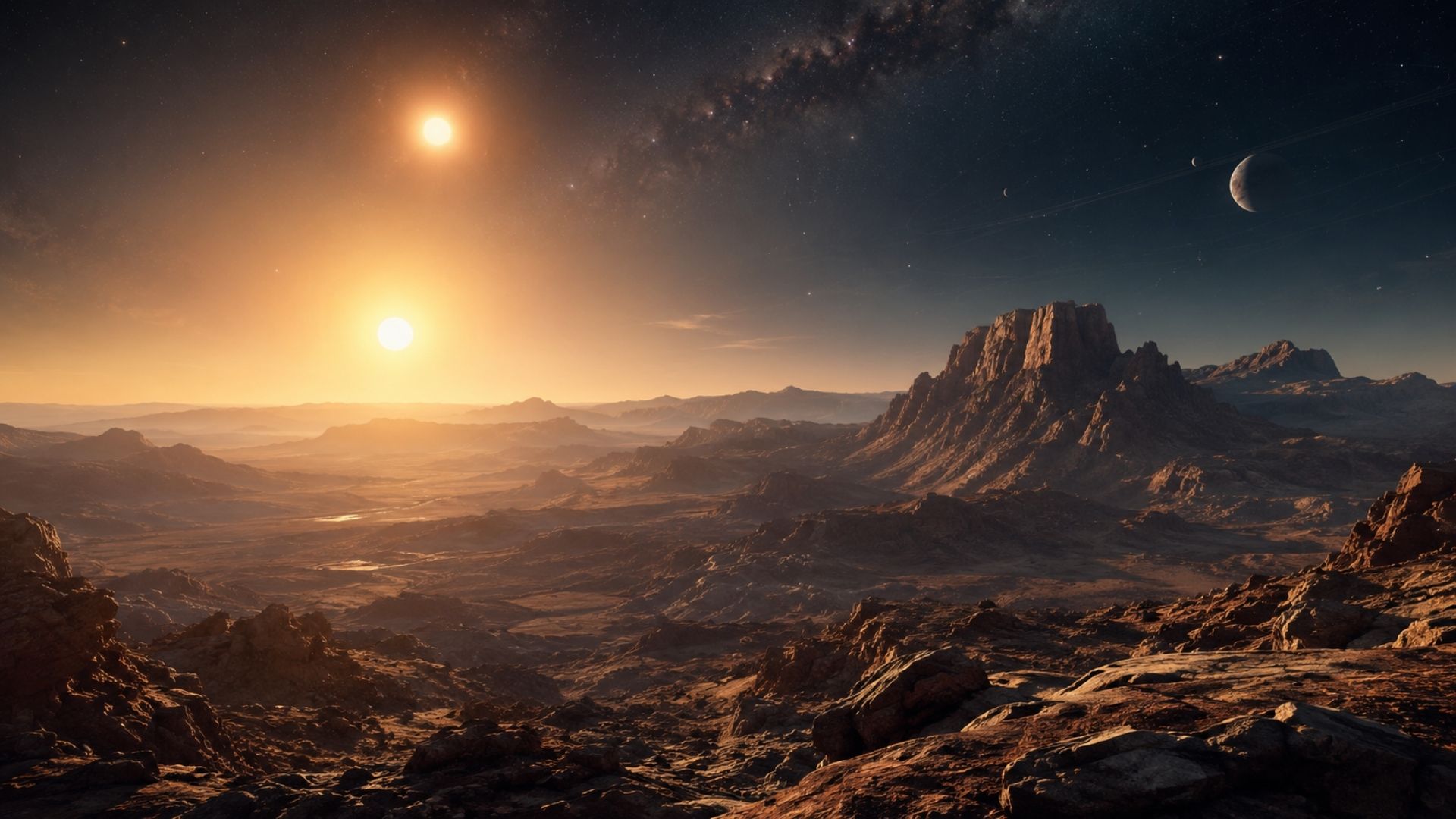

Circumbinary planets, those that orbit two stars and resemble worlds with two suns like Tatooine, have moved from rarity to the center of astronomy after a study identified 27 new candidates and reignited the search for previously invisible exoplanets.
Planets with two suns have definitively entered astronomy’s radar with the publication of a study by the University of New South Wales, Australia, which reported 27 possible circumbinary worlds detected from a sample of 1,590 eclipsing binary systems observed by NASA’s TESS satellite. The work was published in the Monthly Notices of the Royal Astronomical Society and draws attention because it uses a different route than the most common one to find exoplanets.
According to the portal Olhar Digital, what makes this discovery something greater than just another list of candidates is the scale of the gap it exposes. If 27 possible planets with two suns emerge from a single scan, it suggests that astronomy may have spent years looking only at the easiest part of the landscape, while an entire population of Tatooine-style worlds remained hidden out of reach of traditional methods.
The strongest detail lies in the leap that almost doubles the known universe of worlds with two suns

Until now, astronomers knew of only about 18 circumbinary planets, a tiny number compared to the more than 6,000 exoplanets already cataloged in single-star systems. The new research does not confirm 27 worlds at once, but adds 27 solid candidates, enough to deeply shift the perception of how rare these systems truly are.
-
Are Cleaning Staff in Large Buildings Becoming Obsolete? Autonomous Robots Now Clean Airports, Hospitals, and Shopping Centers for Hours, as Companies Invest in Automating Repetitive Tasks

-
Xiaomi Launches Compact Photo Printer with Bluetooth, Extra Black Ink, and Augmented Reality Photo Printing
-
Teen Invents AI-Powered Traffic Light to Assist Elderly Pedestrians by Extending Crossing Time

-
NASA Plans Telescope That Can Be Repaired by Robots 1.5 Million Kilometers from Earth



The impact is even greater because the candidates appear scattered across distances ranging from about 650 to 18,000 light-years from Earth. Some have a mass comparable to Neptune’s, while others can reach something like ten times Jupiter’s mass, revealing a diversity that reinforces the idea that planets with two suns may not be isolated eccentricities, but an entire family of worlds still undercounted.
The curious twist is that these planets emerged not by transit, but by a ‘mismatch’ between stars

Most exoplanets are discovered by the transit method, when the planet passes in front of its star and causes a drop in brightness. The problem is that this requires a very specific alignment with Earth’s line of sight. If the orbit is too inclined or if the geometry doesn’t cooperate, the planet simply disappears to this method.
The Australian team used another clue: apsidal precession. In simple terms, they monitored subtle changes in the timing of eclipses between two stars orbiting each other. When this ‘calendar’ doesn’t perfectly match and cannot be explained solely by relativistic effects, tides, or stellar rotation, suspicion arises of a third body messing with the system. This third body could be precisely one of the planets that were invisible to more common methods.
The broader context shows that astronomy may have underestimated a huge part of the cosmos
The study analyzed 1,590 eclipsing binary systems from the Gaia DR3 catalog and found 36 cases with precession signals that require an additional gravitational perturber. Of these, 27 are compatible with the hypothesis of circumbinary planets, while 6 seem to indicate companions with higher minimum mass. This doesn’t solve everything, but it opens a powerful window to see what was outside the field of view of traditional methods.
This possibility gains weight because more than half of the stars in the Universe exist in binary or multiple systems. In other words, if the search for exoplanets focused for a long time on the easiest systems to detect, it is plausible that many planets orbiting two stars have remained hidden not because they don’t exist, but because the dominant technique was not designed to find them.
Why this could change how astronomy searches for habitable and strange worlds
The discovery doesn’t just serve to increase the count. It changes the mental map of planetary search. If circumbinary worlds are more common than they seemed, astronomy gains a much broader field to study planetary formation, orbital stability, and even the possibility of extreme environments in systems that challenge the classic image of a single sun.
There is also a powerful cultural and scientific consequence. For decades, Tatooine seemed more fiction than observable reality. Now, these 27 candidates reinforce that cinema may have anticipated a type of cosmic scenario less rare than previously supposed. What once seemed an exception may end up revealing an entire category of planets that astronomy has only just begun to unravel.
What still needs to be confirmed before turning candidates into official new worlds
The authors themselves make it clear that these 27 objects are not yet confirmed. The observed dynamic signal could be produced by lower-mass bodies in closer orbits or by more massive companions in wider orbits. To separate one hypothesis from the other, additional observations will be necessary, especially radial velocities and spectral analyses.
That’s precisely where the story gets more interesting. Even without final confirmation, the new technique has already played a decisive role: showing that the sky may be hiding many more planets with two suns than astronomy has been able to prove until now. If the next steps confirm a significant portion of these candidates, the search for exoplanets could enter a completely new phase, less limited by perfect alignment and much more open to the real diversity of stellar systems.
In the end, the big news isn’t just the number 27. It’s the feeling that a single scan was enough to reveal the outline of something much larger. Circumbinary planets have ceased to seem like an exotic collection of exceptions and have begun to suggest a hidden population, scattered throughout the Universe, waiting for methods capable of seeing them. If this is confirmed, Tatooine may cease to be a pop metaphor and become just the most famous face of an entire family of worlds that has always been there, just out of focus.


