





 Portuguese
  English
  Spanish
  5 min of reading
  0 comments


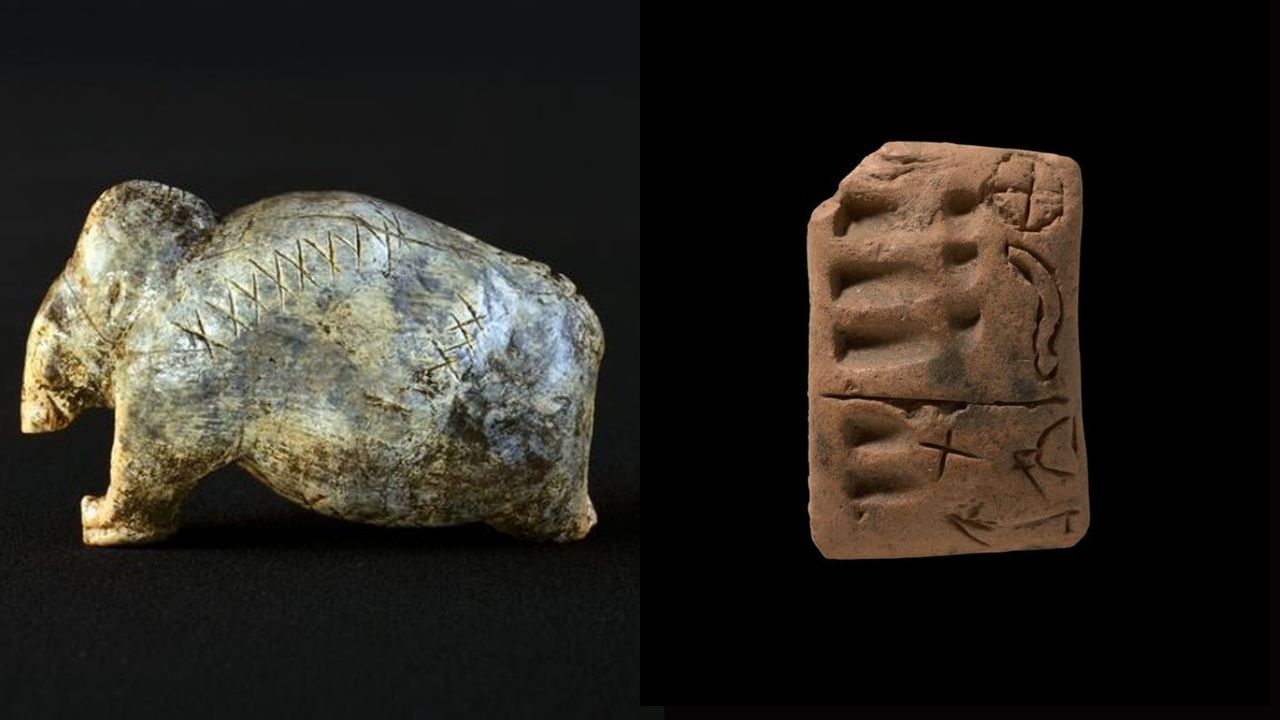
Artifacts from 40 thousand years ago with structured signs may represent a precursor to writing and change the origin of human communication.
In 2026, a study published in the Proceedings of the National Academy of Sciences and reported by Reuters brought new evidence on one of the most complex topics in archaeology: the origin of symbolic systems that preceded writing. By analyzing more than 200 artifacts dating from about 43,000 to 34,000 years ago, found at four archaeological sites in southwestern Germany, researchers identified recurring sequences of geometric marks that may represent a conventional system of signs, possibly a remote precursor of structured graphic communication.
The objects include bones, ivory, horns, and other worked materials, with notches organized in lines, dots, crosses, and repetitive sequences. What caught the scientists’ attention was not only the presence of these signs but the way they appear selectively and consistently across different pieces, suggesting intent, pattern, and cultural transmission over generations, rather than mere random decoration.
The discovery does not support that these human groups had mastered writing in the modern sense, but reinforces that the ability to organize symbols with informational function may have emerged tens of thousands of years earlier than traditionally thought. In a note about the work, Saarland University states that these sequences exhibit a level of complexity and informational density comparable to that of early proto-cuneiform, although still without proven links to spoken language.
-
About 150 workers are driving, one by one, 4,585 BYD electric cars off a 220-meter ship at the Port of Itajaí. The 48-hour mega-operation is the largest shipment from the Chinese automaker in Santa Catarina this year.

-
Samara left the city, built a small power plant on her property, and now lives surrounded by waterfalls, her own energy, sustainable recycling, and preserved nature in the Serra da Mantiqueira.
-
The end of Japan? Population is disappearing, country loses more than 3 million inhabitants in just five years and birth rate falls for the tenth consecutive year, raising alarm about demographic collapse and lack of workers.
-
China surprises the world by inaugurating a new era: the country will create a “digital ID” for 28,000 humanoid robots from 100 manufacturers, while machines capable of cooking, doing laundry, and caring for the elderly begin free domestic testing in 2027.


Repetitive patterns indicate symbolic organization and not simple decoration
One of the main arguments of the study lies in the regularity of the markings found on the artifacts. Unlike random scribbles or decoration, the signs exhibit characteristics that point to systematic use.
The researchers observed that:
- The markings follow consistent alignments
- There is repetition of specific shapes across different objects
- The symbols appear in organized sequences
- There is balanced distribution of the signs on the surface
This set of evidence suggests that the objects were not marked casually. On the contrary, they indicate a clear intention to record or represent something.

This type of organization is one of the fundamental elements for any symbolic system that could evolve into writing.
Artifacts were produced by modern humans during expansion through Europe
The analyzed objects are attributed to populations of Homo sapiens that inhabited Europe during the Upper Paleolithic, a period marked by the expansion of modern humans across the continent.
This historical moment is already known for significant advances, such as:
- Production of rock art
- Ivory sculptures
- Development of more sophisticated tools
- Increased social complexity
The presence of more elaborate symbolic systems reinforces the idea that these populations possessed advanced cognitive abilities, including abstraction and structured communication.
Comparison with protowriting suggests initial level of information coding
To assess the significance of the markings, researchers compared the patterns found with known systems of protowriting — early forms of symbolic recording that precede formal writing.
Although the artifacts do not show direct correspondence with alphabets or complete systems, the density and organization of the signs show similarities with early stages of information coding.
This means that the objects may have been used to:
- Record quantities
- Mark events
- Indicate belonging
- Convey basic information
This type of use would represent an intermediate step between simple symbolism and fully developed writing systems.
Discovery challenges traditional chronology of the origin of writing
To this day, the oldest records of recognized writing date back to about 5,000 years, associated with civilizations in Mesopotamia.
The new evidence, however, suggests that the cognitive basis for writing may have emerged much earlier, even in pre-agricultural societies.

This does not mean that formal writing existed 40 thousand years ago, but that the fundamental elements — such as symbolic organization and intent to record — were already present. This shift in perspective significantly expands the time required for the complete development of writing.
Use of modern technology was essential to identify hidden patterns
The identification of these patterns was only possible thanks to the use of advanced analysis techniques, including digital imaging and statistical methods.
These tools allowed differentiation between:
- Natural wear marks
- Intentional notches made by humans
- Repetitive patterns not visible to the naked eye
Moreover, comparative analysis between different objects helped confirm that the patterns were not isolated, but part of a recurring behavior.
Symbolic communication may have been more common than thought
The discovery raises the possibility that structured symbolic systems were more common among prehistoric populations than previously imagined.
If confirmed, this would indicate that the ability to represent information abstractly did not emerge abruptly, but evolved gradually over thousands of years.
This process may have occurred in different regions and times, with multiple attempts at symbolic organization before the consolidation of writing.
Artifacts reinforce cognitive complexity of prehistoric humans
The analyzed objects contribute to a broader revision of the view on prehistoric societies. Far from being simple, these groups demonstrate capabilities such as:
- Abstract thinking
- Planning
- Structured communication
- Creation of symbolic systems
These characteristics indicate a level of cognitive sophistication comparable to that of modern humans.
Possible precursor to writing expands debate on origin of language
Although oral language and writing are distinct systems, both depend on the ability to assign meaning to symbols. The presence of organized patterns in such ancient artifacts suggests that the foundations of symbolic communication may have developed in parallel with spoken language.
This opens new possibilities for understanding how humans began to transform experiences into shareable information.
One of the main challenges in interpreting these artifacts is distinguishing between decorative art and functional symbolic systems.
The same characteristics that define an artistic pattern may also indicate a communication system. This overlap makes analysis complex and requires multiple approaches to avoid hasty conclusions.
Do these signs represent the beginning of writing or just an intermediate stage in the evolution of human communication?
The discovery raises a central question for archaeologists and linguists: do these markings represent a true precursor to writing or are they just an intermediate stage in the development of symbolic communication?
The answer still depends on new evidence and analyses, but the fact is that these objects are already redefining the way we understand the emergence of writing and the very human capacity to transform symbols into information.








-

-

-

4 people reacted to this.