






 Portuguese
  Spanish
  3 min of reading
  0 comments


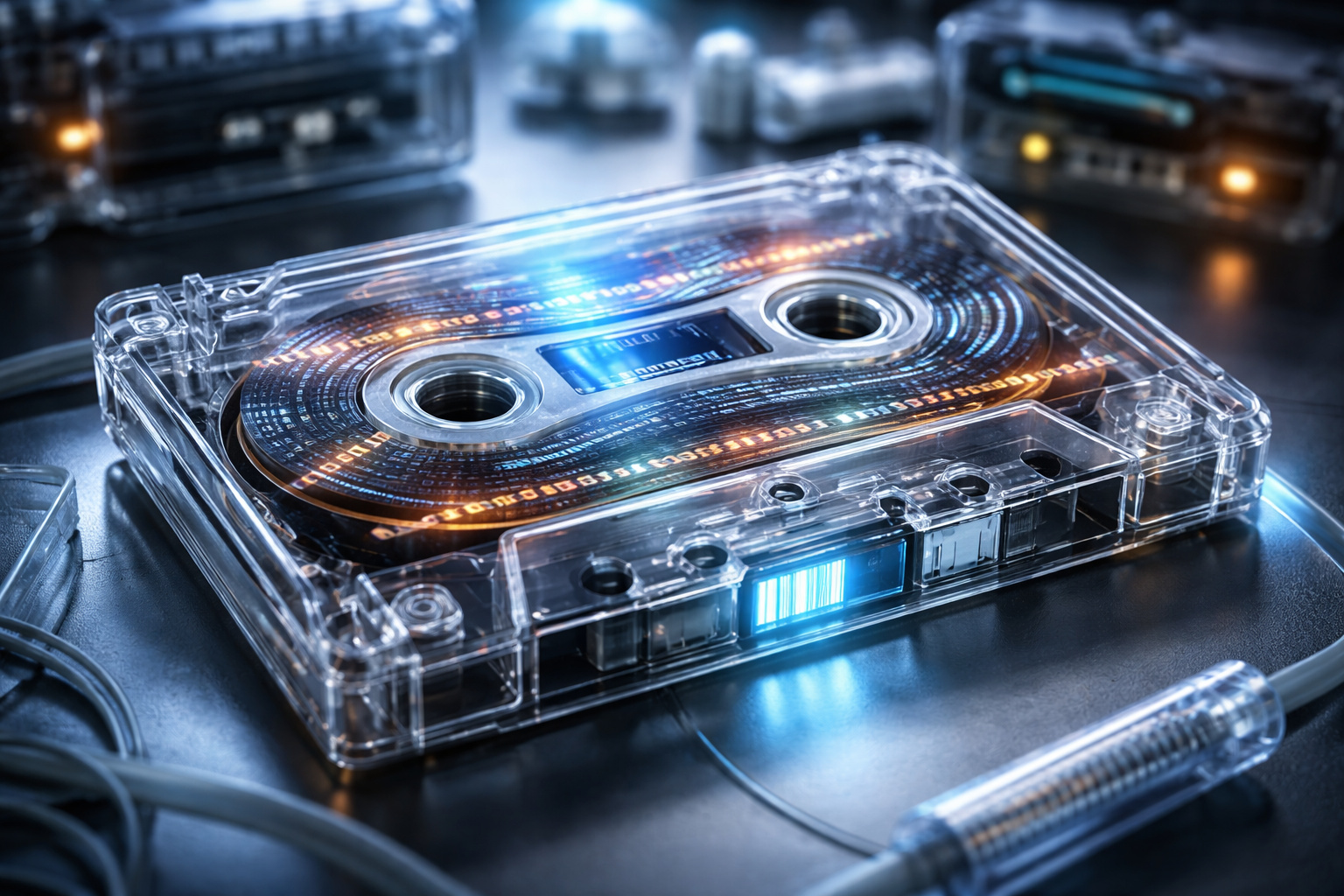
New Format Published in 2025 in Science Advances Presents Automated Solution for Cold Data Storage Based on Synthetic DNA
A significant technological innovation was presented in September 2025, attracting attention in the DNA data storage sector.
Researchers from the South China University of Science and Technology published a study in the journal Science Advances proposing the adaptation of DNA to a scalable physical format inspired by the traditional cassette tape.
The technology, explored since 2012, converts digital files into the chemical bases A, C, G, and T.
These synthetic sequences are then preserved as stable molecules, capable of storing information for long periods.
While previous models used tubes, plates, or encapsulated powder, these formats only worked in the lab.
Additionally, they required multiple individual containers, occupied relevant physical space, and complicated automation and precise addressing.
-
After building a 5-acre lake on his farm, the owner reveals plans for a new artificial lake with a flowing river, waterfalls, islands, and even an indoor version with a retractable roof to control light, temperature, and transform the rural landscape.

-
A giant is disappearing from the map: the Dead Sea, between Israel, Jordan, and the West Bank, loses 1.2 meters per year, has already shrunk by one-third in 50 years, and is 427 meters below sea level.

-
Ghost town of 4,000 residents, abandoned after the collapse of an iron mine, now becomes a drone training field for police, rescue, and emergency teams.
-
Colorectal cancer advances worldwide, but most cases can be prevented.





Physical Reconfiguration Transforms DNA into Scalable Media
The proposal presented in 2025 reorganizes this structural limitation.
Instead of isolated containers, DNA is fixed onto a membrane made of nylon and polyester, chemically treated to function as a mechanical support.
Just as cassette tapes used in the 1980s and 1990s had fixed tracks, the new model features over 500,000 physically accessible data partitions.
Thus, a high-speed barcode reader identifies the exact location of each file in fractions of a second.
Furthermore, a compact drive was developed, approximately the size of a shoebox.
This device performs searching, reading, and writing automatically, without human intervention.
Information Density Redefines Physical Limits
The advancement is directly linked to the density of genetic material.
It is estimated that one gram of DNA can store up to 455 exabytes of data.
This volume corresponds to nearly all the monthly traffic of the global internet.
Additionally, the media’s potential durability can reach thousands of years.
During the writing process, small droplets of synthetic DNA are deposited in the tape’s partitions.
This method, termed Deposit-Many-Recover-Many, allows for erasing and re-recording information in the same physical location.
To prevent degradation, researchers applied a crystalline layer composed of metal-organic structures called ZIFs.
This protection acts as a barrier against moisture and heat, preserving molecular integrity.
Strategic Applications and Operational Limits
Initially, the most immediate application involves cold data, such as historical records, scientific files, and long-term backups.
In this scenario, the priority is durability and low energy consumption, even with slower access.
The DNA tape requires no continuous energy and complex refrigeration systems.
Therefore, it can contribute to more sustainable big data centers.
However, performance is still inferior to that of conventional hard drives, SSDs, or magnetic tapes.
In tests described in the September 2025 study, copying a file of several hundred kilobytes took dozens of minutes.
According to the article published in Science Advances, DNA reading has become relatively accessible.
However, the chemical synthesis of sequences remains slow and costly, making immediate commercial use unfeasible.
Conceptual Transition in Digital Storage
Still, the adaptation of the cassette tape represents a conceptual reorganization of digital storage. Instead of relying solely on electricity and silicon, the system utilizes the very chemistry of life.
Therefore, with future advancements in DNA synthesis and reading, digital storage may migrate to a molecular base. Thus, digital files could remain preserved in the same structure that has supported genetic information for billions of years.
Do you think DNA will consolidate itself as a viable solution for long-term digital storage?


Be the first to react!