Portuguese
  Spanish


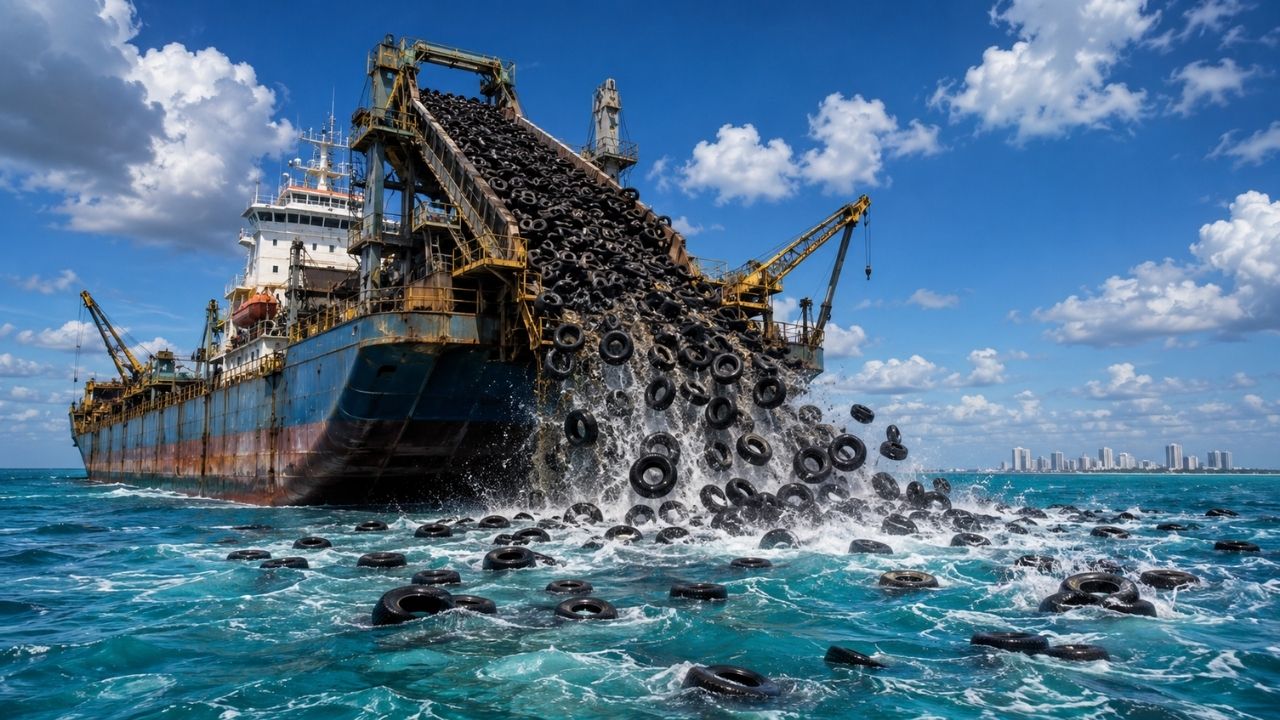


Project that took tires to the ocean near Fort Lauderdale promised to solve disposal and form an artificial reef, but the rubber came loose, hit corals, and became an expensive cleanup. Decades later, teams are still removing material from the seabed, while environmental recovery remains uncertain in Florida after hurricanes and prolonged abandonment.
The tires in the ocean were launched near Fort Lauderdale, Florida, in 1974, as part of a project that promised to transform rubber waste into an artificial reef. The idea involved about 2 million tires dumped on the seabed, according to the source, as an attempt to create shelter for fish.
In a video released by the Simple Discovery channel on June 17, 2026, the plan, supported by public and private actors of the time, took place near the Osborne Reef, just over 1.5 km from the coast and about 20 meters deep. Decades later, what began as an environmental solution came to be treated as a disaster after hurricanes spread tires and damaged natural corals.
A celebrated solution became a problem on the seabed
In the 1970s, tire disposal was seen as a growing challenge. The increase in vehicle fleets generated enormous volumes of used rubber, while recycling capacity was still limited to absorb the entire mountain of waste.
-
Indian Inventor, 58, Develops Steering Wheel-Free Agricultural Machine Operated by Levers, Offering Cost-Effective Alternative to Expensive Tractors

-
Brazilian Senate Approves Bill to Automate Child Support Payments Directly from Debtors’ Accounts
-
Brazilian Student in the U.S. Helps Provide Clean Water to 50 Families in São Paulo Slum, Launches Year-Long Volunteer Project with National Expansion Plans
-
Daughter of Farmers from Brazil Uses Social Media to Highlight Rural Life and Promote Agriculture


It was in this context that the proposal to throw tires into the ocean to create an artificial reef emerged. The promise seemed simple: remove tires from the path, sink them into the sea, and transform waste into a habitat for marine life. In practice, the environment showed that the equation was much more complex.
Fort Lauderdale received an operation with a spectacle atmosphere
The campaign took place in June 1974, with more than 100 private boats gathered off the coast of Fort Lauderdale, according to the transcript. The project even had the participation of the USS Trasher ship, giving the action a grand and almost ceremonial appearance.
The tires were grouped into bundles, secured with nylon ropes and steel clamps, and sent to the seabed. In a few days, millions of units formed a huge mass of submerged rubber, covering an estimated area of 150,000 square meters.
The idea depended on a condition that never materialized
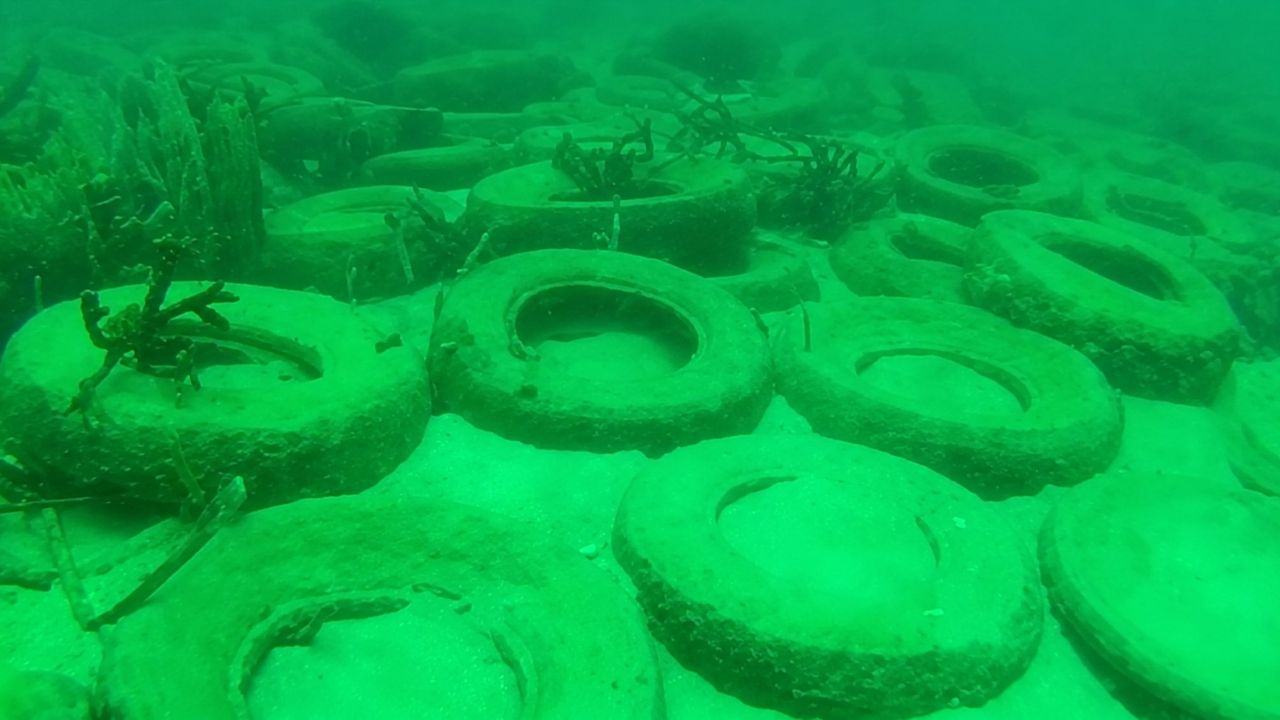
For an artificial reef to work, the structure needs to remain stable for many years. Heavy, immobile, and porous materials can offer attachment points for marine organisms, as long as they are in a suitable environment.
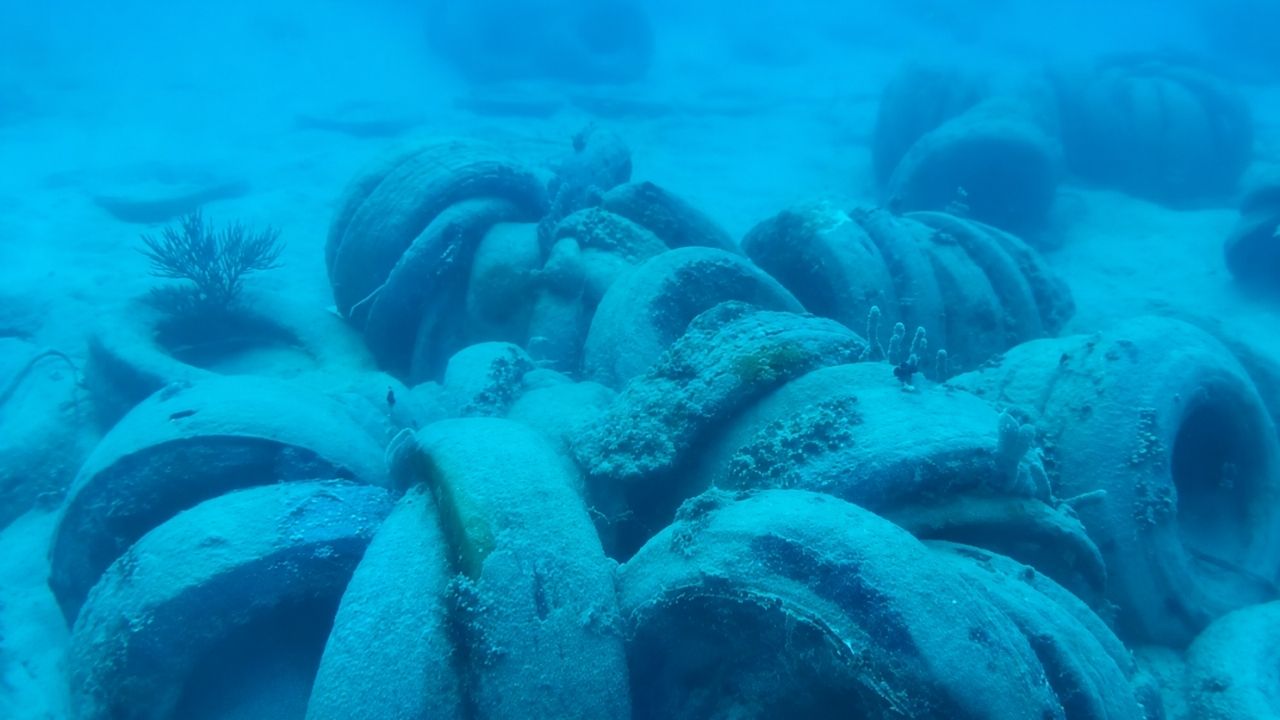
The problem is that tires do not behave this way. They are light, rounded, hollow, and can roll with currents and storms. The smooth surface of the rubber also made it difficult for marine life to attach, contrary to the expectation that the tires would quickly become a base for corals and fish.
Hurricanes turned the bundles into a mobile threat
Over time, the nylon ropes and steel clamps began to fail in the salty environment. When the bundles came loose, the tires in the ocean ceased to be a fixed structure and started moving across the seabed.
The location in a hurricane-affected zone worsened the problem. With each storm, part of the rubber was pushed, dragged, or scattered, hitting natural corals and marine life areas. What was supposed to serve as shelter became an agent of destruction.
Corals were broken and recovery became more difficult
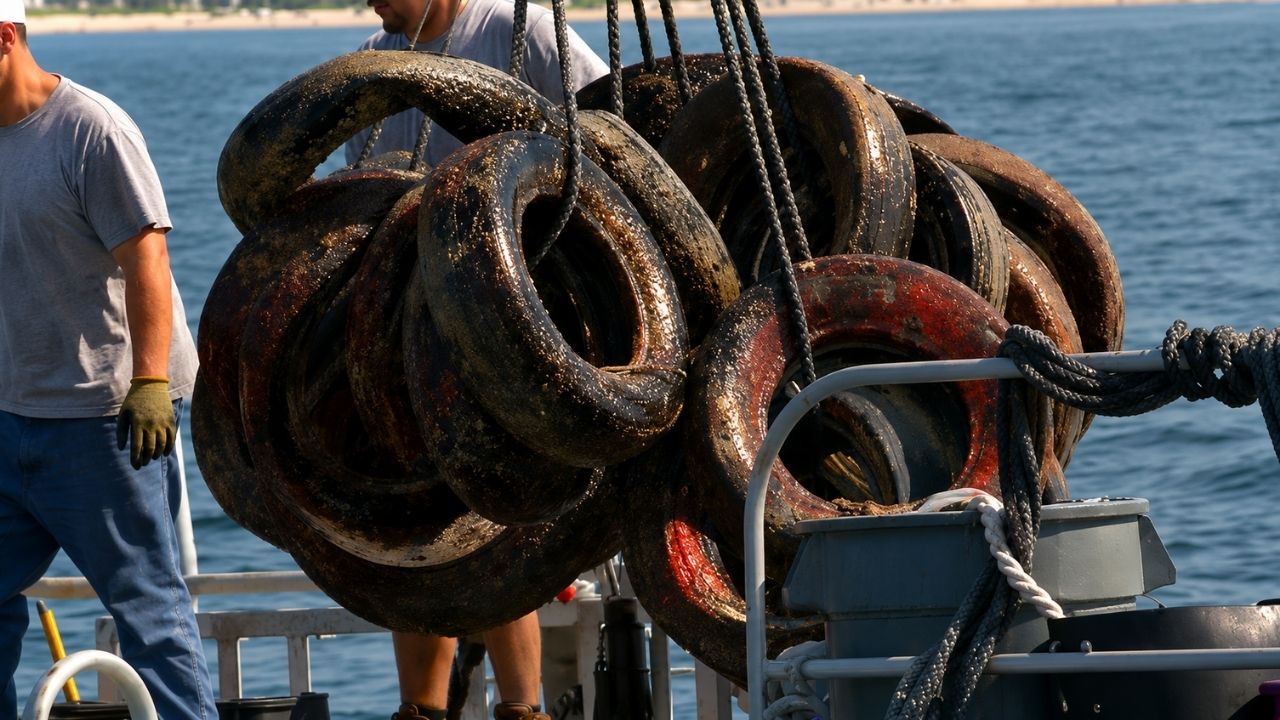
According to the source, surveys conducted in the 2000s indicated severe damage to the surroundings of the Osborne Reef. The movement of the tires had broken corals, suffocated young formations, and hindered natural regeneration in nearby areas.
The impact also affected the perception of artificial reefs made with improvised materials. The tragedy showed that sinking objects in the sea does not automatically create an ecosystem. Corals depend on chemical, physical, and biological conditions that cannot be replaced merely by the volume of material.
Cleanup began decades later and became an expensive operation
The removal of the tires in the ocean began to gain momentum when environmental warnings became harder to ignore. In 2001, researcher Robin Sherman from Nova Southeastern University returned to the area with initial funding from NOAA to test the removal of the debris.
The result showed the extent of the problem. Even after weeks of diving, the team managed to remove only a small part of the material. Each tire removed required diving, transportation, team, equipment, and proper disposal, making the cleanup slow and expensive.
Military, divers, and companies joined the removal
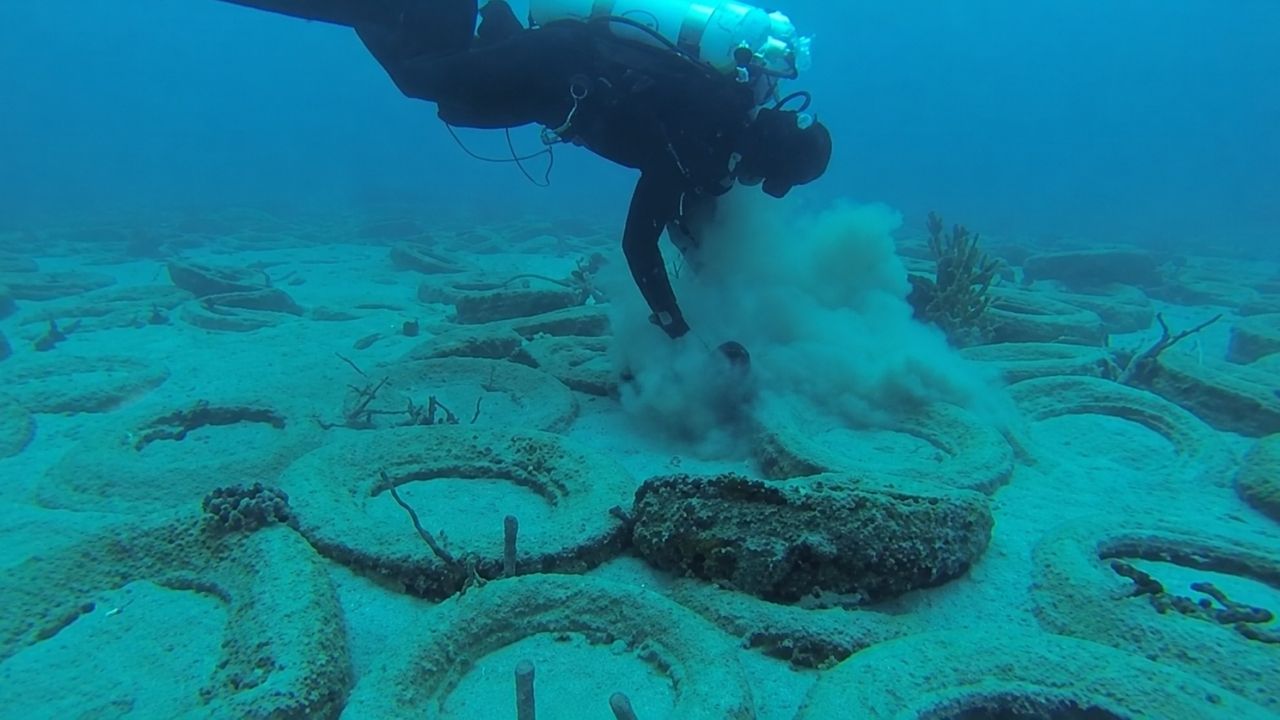
In 2007, the situation led to the involvement of U.S. military divers. The removal of the tires also became a training exercise, with teams facing currents, underwater risks, and scattered beams.
Later, the operation continued with private organizations and environmental groups. According to the transcript, even after years of work, hundreds of thousands of tires could still remain at the bottom of the ocean in 2024. The correction of the error became longer and more expensive than the original project itself.
Responsibility became a difficult dispute to resolve
Another critical point was the difficulty of identifying those responsible. The project involved local government, companies, military, and environmental organizations, which fragmented the decision-making chain and complicated any attempt at legal accountability.
With so many parties involved, the question of who should pay or be held accountable for the damage had no simple solution. The case of the tires in the ocean became an example of how poorly monitored environmental projects can leave decades of damage without a clear responsible party.
New reef tries to correct the scar left in the sea


Florida has started to invest in a new phase, called Osborne 2.0 at the source. Unlike the original project, the new proposal avoids tires and makeshift materials, using more suitable structures such as cellular concrete, limestone, and bioneutral modules.
Even so, the timelines themselves indicate caution. Marine recovery can take decades and there is no guarantee that the ecosystem will return to its previous state. After half a century of error, the repair attempt still depends on time, monitoring, and nature’s response.
An ecological promise that turned into a global warning
The story of the tires in the ocean near Fort Lauderdale shows how an apparently creative solution can turn into disaster when it ignores the real dynamics of the sea. The project promised to solve waste and create life, but ended up spreading rubber, damaging corals, and requiring a cleanup that spans decades.
The case raises an uncomfortable question: when engineering tries to correct nature without understanding its limits, can the risk of worsening the problem be greater than the promised benefit? Do you think artificial reefs should still be built or does this example show that the ocean cannot be treated as a laboratory? Share your opinion.